


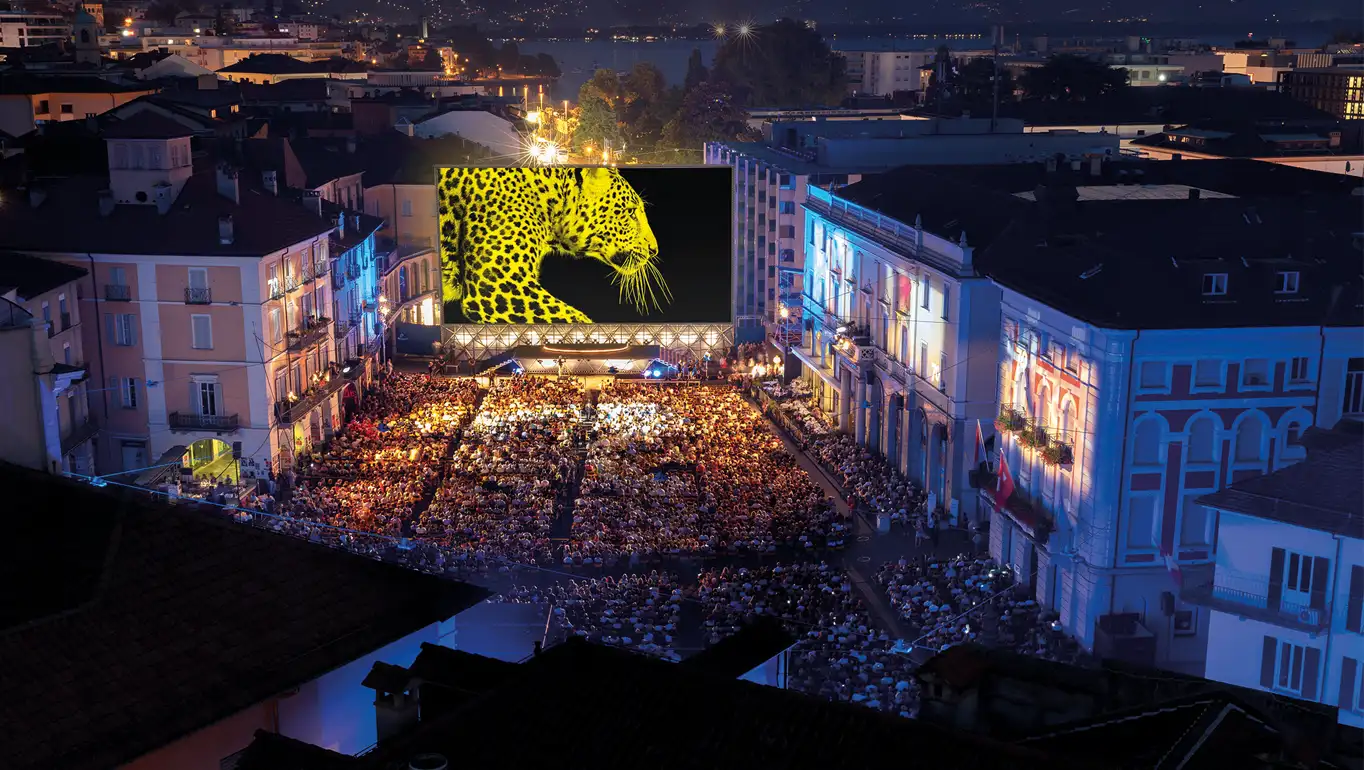
In August each year, thousands of people gather in Locarno’s Piazza Grande to watch films under the open sky, surrounded by the facades and arcades of the city’s old town. The setting is local, rooted in Italian-speaking Ticino and its strong community ties to this event, yet the artistic program and the audience are highly international. For eleven nights, the square is transformed into a shared space where stories and ideas from around the world are projected, experienced collectively, and then discussed and debated afterward.
Today, debates in public policy increasingly recognize that culture is not a luxury to be added once other priorities are funded, but a form of essential infrastructure that supports democratic societies. Cinema has the capacity to drive change in ways that purely economic measures cannot. Economists increasingly argue that arts and culture do not simply contribute to GDP; these sectors help shape the direction of economic and social development by influencing how communities imagine their shared future, how they define and confirm their values, and how political action can be mobilized in response to a changing global order.
Seen in this way, the Locarno Film Festival functions as an ecosystem rather than a single event: a place where diverse publics encounter different perspectives, where empathy develops through repeated exposure to a range of stories, and where key issues, from climate justice and gender equality to digital rights, emerge through cinema and discussion. The Piazza Grande becomes, during those days in August, a public arena in which thousands of people respond directly to what they see, laughing, listening, sometimes disagreeing, but always engaging with social questions through a shared experience.
From its beginnings in 1946, the Locarno Film Festival built a reputation for its strong defense of artistic freedom, placing discovery and the support of new cinematic voices at its core. In its early years, the Festival, sometimes controversially, welcomed filmmakers working under censorship in the Eastern Bloc. Those values remain central today. In 2025, Iranian filmmaker Mohammad Rasoulof received the inaugural Locarno City of Peace Award during the Festival’s Diplomacy Day. The prize, created to honor cultural figures who advance peace, diplomacy, and dialogue on the centenary of the Locarno Treaties, highlighted how the Festival’s artistic mission is closely linked to a broader civic role.
Beyond the screen, the Festival hosts Diplomacy Day, an initiative that makes the connection between culture and politics a clear part of its mandate. Diplomacy Day brings together more than 200 delegates from business, politics, science, and culture for dialogue within one of the world’s major film events. In 2025, the day included appearances by David Lammy, then British Foreign Secretary, Ignazio Cassis, Vice-President of the Swiss Federal Council, as well as Carlos Álvarez Pereira, Secretary General of the Club of Rome, and Pierre Krähenbühl, Director-General of the International Committee of the Red Cross.
In 2026, the program will focus on the theme “Reimagining Global Cooperation,” developed in collaboration with the Club Diplomatique de Genève, the Wyss Academy for Nature, and Foundation Botnar, bringing together diplomats, policymakers, representatives of international organizations, technology leaders, foundations, and filmmakers. The topic reflects current political changes, including declining trust in global partnerships, increasing fragmentation, the urgency of the climate crisis, and the growing risks linked to artificial intelligence across diplomatic, political, and cultural contexts. Building on the Festival’s curatorial work, Diplomacy Day will open with discussions and interactive sessions, followed by a keynote that connects these ideas to cinema’s role in supporting cooperation. The day will conclude with networking and an open-air screening in the Piazza Grande.
As discussions on the future of multilateralism continue in Geneva and New York, the example of Locarno raises a simple question: what might change if, alongside negotiations in conference rooms, more consistent investment were made in cultural spaces, whether physical or symbolic, where the perspective of art can inform and deepen policymaking?
This article was written in collaboration with the Diplomatic Club of Geneva