


Jorge Luis Borges lived a long life. He sits in front of a large stone wall, alone, resting his hands on his cane. The statues around him appear imposing and distant. The square is quiet in the afternoon. He turns his head slightly to the right. Above him, four stone figures look straight ahead. They do not acknowledge one another. They are unresponsive, and Borges, now elderly, has been blind for many years. His vision failed, but his memory did not. In his mind, the image of Jean Calvin and the Reformers remains clear.
A tribute to his life’s work beckons this month as we reflect on the legacy he left behind.
Jorge Luis Borges first arrived in Geneva in April 1914 at the age of 15. His family settled in an apartment on Rue de Malagnou, where they lived until 1918.
He studied at Collège Calvin, where he learned French, Latin, and German. In Geneva, he formed friendships that lasted throughout his life and discovered literature as a shared activity, a way to connect with others.
During his teenage years, he was deeply interested in theology, which he later described as a form of fantasy literature. On July 7, 1917, at the inauguration of the International Monument to the Reformation, he saw the statues of Calvin, Farel, Beza, and Knox. That image stayed with him for the rest of his life and reappeared nearly seventy years later in his memories.
Between these two moments, his early years in Geneva and his later recollection of them, Borges created the body of work that made him one of the most important writers in world literature. His writing is filled with libraries, tigers, labyrinths, knives, mirrors, books, and swords. It often revisits the same themes in different forms and invites multiple interpretations, shaped by each reader’s perspective.
His work is usually divided into three periods. The first, from 1920 to 1935, is often called his criollista period.
During this time, he experimented with literary modernism and tried to develop a poetic voice connected to Argentina. The second period, from 1935 to 1955, is considered his mature phase. It includes his best known short stories and essays, many of which explore philosophical and metaphysical ideas. The final period, from 1955 to 1986, came as his blindness worsened. In this stage, his writing became more conversational and reflective, focusing less on intellectual systems and more on personal thought.
Borges did not write novels or plays. He preferred short stories, although he also wrote essays and poetry. The boundaries between these forms in his work are often unclear. His stories can be read like essays, his essays often contain poetic elements, and his poetry sometimes tells a narrative. He also wrote tango lyrics and film scripts, though these are less well known.
His writing is varied and often fragmented. With a few early exceptions, he rarely produced single, unified books. Most of his volumes are collections of texts that were originally published in newspapers and magazines. Reading Borges can produce different responses, including aesthetic appreciation, interest in language, and intellectual curiosity. Over time, however, many readers are drawn to the personal quality of his work and the sense of intimacy it conveys.
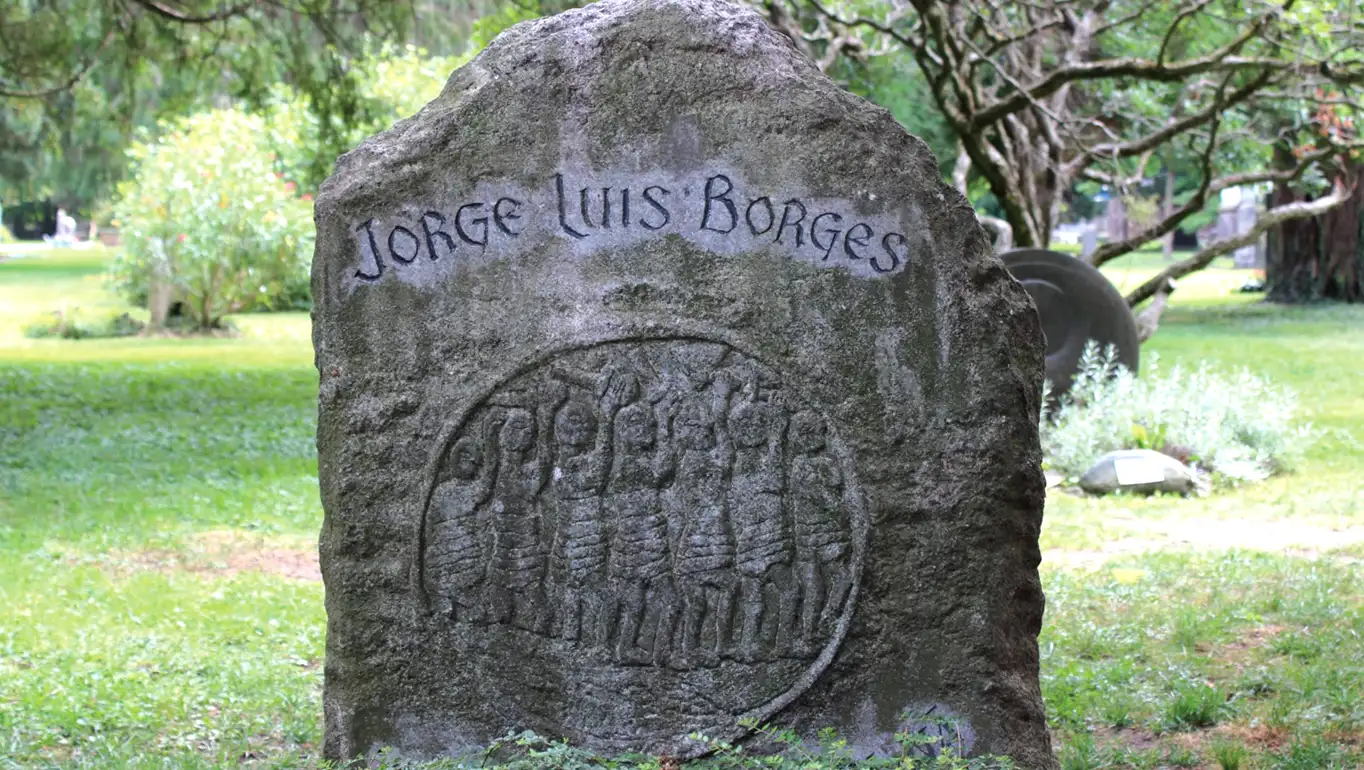
A stone in Plainpalais
Facing the wall, the man sits and thinks, more with certainty than nostalgia:
“I know I will always return to Geneva, even after my death.”
NUMEROUS TRIBUTES
On Sunday, June 14 at 4 p.m., at the Cimetière des Rois in Plainpalais, Geneva, the Swiss association Los conjurados (losconjurados.ch) will invite the public to visit Borges’s grave. Poems will be read in Spanish and French. Visitors will be able to leave messages in a dedicated box, and 40 yellow roses will be placed there, one for each year since his death. Writers, diplomats, academics, and cultural figures are expected to attend. Alberto Manguel, former director of the National Library of Argentina, has confirmed his participation. This event is part of a series organized by Los conjurados this year.
On May 7 at 6 p.m., the Bibliothèque de Genève in Parc des Bastions will host Spanish philosopher Fernando Savater, who will speak about key metaphysical themes in Borges’s work.
On June 2, 13, and 14, the Maison Rousseau et Littérature in Geneva’s Old Town will host talks with Argentine writers on different aspects of his work.
On November 28, theCité Bleue theater in Champel will hold a day of roundtable discussions, music, and film focused on Borges’s life and writing.