


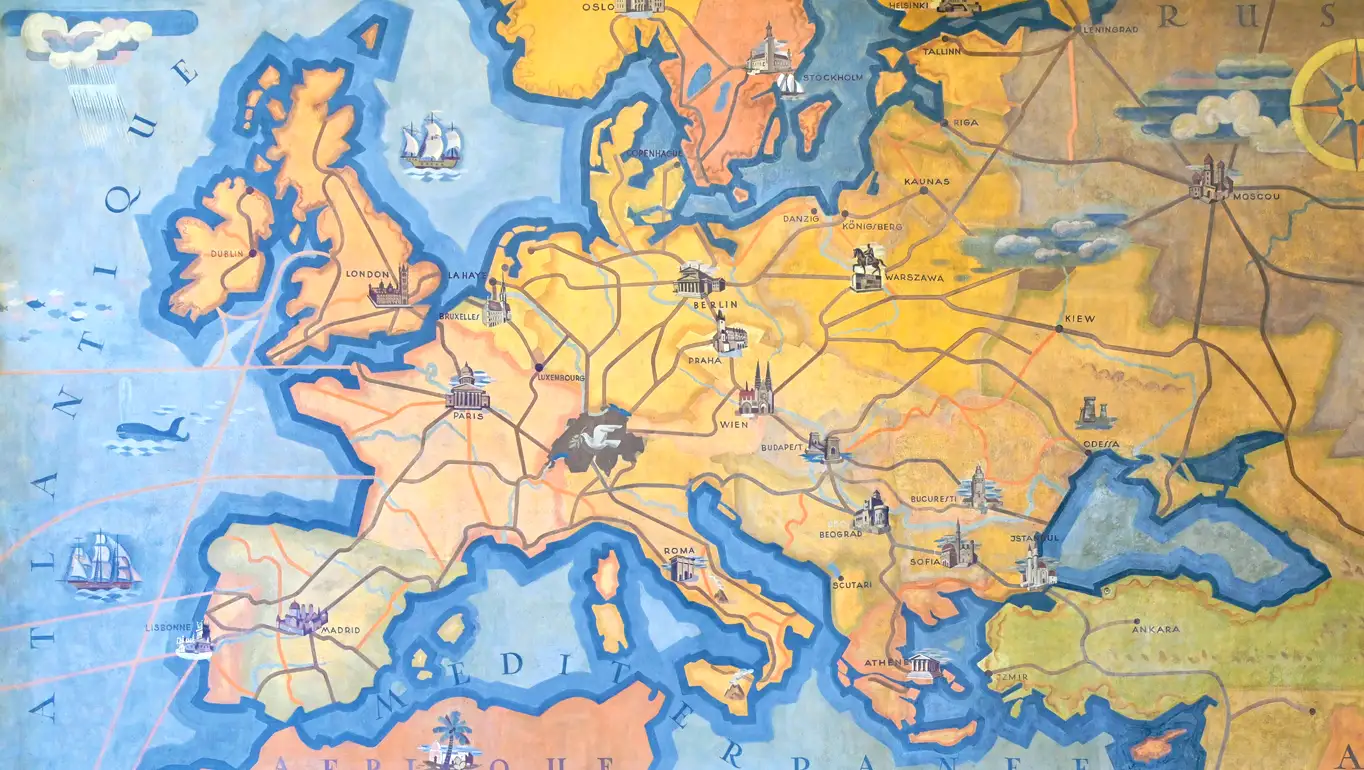
Since its recognition as a neutral country at the Congress of Vienna in 1815, the Confederation has been required to prevent any use of its territory for military purposes. This armed neutrality also entailed a duty of equal treatment towards belligerents.
But, after the breakout of World War II, from 1942 onwards, Switzerland found itself completely encircled by the Axis powers. To maintain supplies, stabilize its currency, and preserve employment, it conceded notable economic advantages to the Third Reich. Nevertheless, Switzerland held a course favorable to the Allies, as revealed by its role in the secret struggle against the Axis forces. Various intelligence services and resistance movements operating from Switzerland played a major role in the clandestine war that contributed to the Allied victory of 1945.
In the eye of the storm, Switzerland played the discreet part of a transit hub for Allied services, with the active support of its own intelligence structures. The Allies promptly grasped the strategic value of its central position in Europe.
The Confederation became an observation post as all actors in the conflict converged there. Quite rapidly, it hosted intelligence officers and clandestine networks linked to resistance movements. Switzerland was in reality not that neutral.
“And now, go and set Europe ablaze!” This was Churchill’s order to the agents of the Special Operations Executive (SOE), which he created on July 22, 1940. The British aimed to boost subversive warfare in occupied Europe, behind enemy lines. Originating from Section D (for Destruction) of the Secret Intelligence Service (MI-6), the SOE was an “action service” tasked with supporting resistance movements. Its agents, operating in civilian clothing, were infiltrated into occupied zones to carry out sabotage, organize parachute drops, and align resistance activities with Allied strategic objectives.
For the SOE, Switzerland became a strategic hub: from February 1941, an agent was stationed at the British Legation in Bern, equipped with a radio transmitter. The Confederation served as a rear base for British actions in France and Italy. During the war, numerous clandestine transmissions to European resistance groups passed through Bern, which played a key role in coordinating operations and Allied escape networks, some of which transited through Switzerland.
Meanwhile, on June 13, 1942, faced with the disaster of the Pearl Harbor attack and various shortcomings in the coordination of his services, President Roosevelt founded the Office of Strategic Services (OSS), tasked with centralizing intelligence activities and conducting clandestine operations abroad. A forerunner of the CIA, the OSS became a cornerstone of a shadow war waged in Europe. From the moment they entered the conflict, the United States perceived Switzerland as a particularly strategic observation post in Europe. Therefore, the OSS branch for continental Europe was set up in Bern.
Allen Dulles, a former diplomat and influential attorney, managed to enter Switzerland on 8 November, 1942, just before Geneva’s border with France was closed. His mission was to create and lead the OSS branch in Switzerland. Dulles’ apartment at 23 Herrengasse in Bern served as the agency’s unofficial headquarters, from where clandestine operations in Europe were directed. Dulles operated under the alias “Mr Burns” and officially held a position at the American Legation.
Thanks to the support of Swiss intelligence services, already in contact with Allied counterparts, and due to significant financial means, Dulles quickly established useful contacts with resistance members and various agents. OSS Bern thus became a major hub for intelligence in Europe.
In the meantime, a Soviet espionage network had been established in French-speaking Switzerland: the “Red Three,” led by Sandor Rado, a Hungarian operating under cover in Geneva. Agents were recruited in the Lake Geneva region who transmitted information to Moscow via shortwave transmitters.
From 1941 to 1943, this network communicated highly sensitive data on Wehrmacht movements, obtained by Rudolf Roessler, a German émigré in Lucerne, who was himself informed by a high-level source in Berlin. The intelligence passed through three clandestine transmitters, two in Geneva and one in Lausanne. It provided the Soviet General Staff with significant strategic advantages, notably during the Battle of Stalingrad, a decisive turning point in the war. Transmissions ceased in autumn 1943, when the Federal Police dismantled the network and arrested most of the operators.
The exhibition “Top Secret, Espionage and Resistance in Switzerland and Europe 1939-45” at Morges Castle (14 November 2025 – 20 December 2026) will showcase the strategic importance of Switzerland during WW2 whether through intelligence operations in favor of the Allies or as a rear base for the resistance. It will also seek to complete the narrative on how Switzerland experienced the Second World War. Finally, it will pay tribute to the women and men who risked their own lives to save others. English and German translations and guided tours will be available.