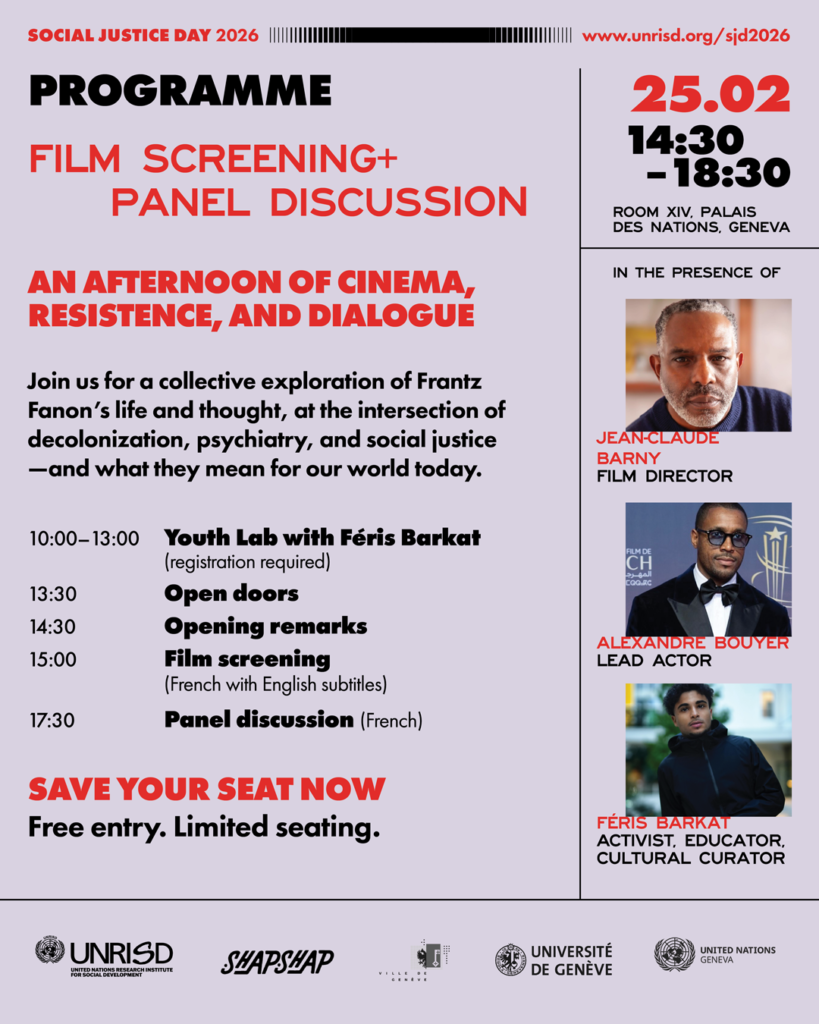
On 25 February 2026, the United Nations Research Institute for Social Development (UNRISD) and local NGO SHAP SHAP will transform the historic Palais des Nations into a space of cinema, reflection and intergenerational dialogue to mark the World Day of Social Justice 2026.
Under the theme “Exploring FANON: Decolonization, Mind, and Social Justice”, the event brings together cinema and youth voices to revisit the enduring legacy of Frantz Fanon — psychiatrist, revolutionary thinker and author of The Wretched of the Earth — whose analysis of colonialism and systemic oppression continues to resonate in today’s fractured world.
Hosted in Salle XIV, including an exclusive screening in the newly renovated UN Cinema, the afternoon programme will explore how Fanon’s ideas on liberation, dignity and psychological emancipation can inform contemporary struggles against inequality.
From film to forum
The centrepiece of the event is a screening of the 2025 feature film Fanon, directed by Jean-Claude Barny and starring Alexandre Bouyer in the title role.
Set during Fanon’s tenure as chief medical officer at Blida-Joinville Psychiatric Hospital in Algeria, the film traces his confrontation with the psychological violence of colonialism and his eventual commitment to the Algerian liberation struggle. It portrays not only a political awakening, but also a deeply human story of courage, moral conviction and sacrifice.
Following the screening, Barny and Bouyer will join activist and educator Féris Barkat for a panel discussion that will examine the contemporary relevance of Fanon’s thought — from systemic racism and structural inequality to youth mobilization and climate justice — and explore how cultural expression can serve as a tool for political imagination and social transformation.
Youth at the centre
Earlier in the day, a Youth Lab facilitated by Féris Barkat will convene 20–30 young people aged 16 to 25 — with a deliberate focus on those whose voices are too rarely heard in institutional spaces. Too often, “youth representation” reflects a narrow and already empowered segment of young people. This Lab seeks to do things differently.
The initiative aims to create a space for those at the forefront of social, economic and environmental struggles — young people who may not usually have access to formal platforms to speak, share and be genuinely listened to.
Designed as a participatory workshop, the Lab will invite participants to articulate their lived realities, identify priority concerns and co-develop practical responses. It is conceived as a legitimate space for dialogue — one where they feel heard.
Insights from the workshop will feed into the afternoon dialogue, ensuring that the event is not only about revisiting Fanon’s legacy, but also about amplifying contemporary youth perspectives on justice.
The initiative reflects UNRISD’s broader commitment to connecting research with lived experience and marginalized voices. Since 1963, the Institute has examined the political and social dimensions of development — including inequality, redistribution and power relations — areas that remain central to global debates on sustainable and inclusive societies.
Bridging local and global Geneva
The event is co-organized with SHAP SHAP, founded in 2015 in Geneva to combat global inequalities and racial and gender discrimination through cultural action and co-creation with artists and youth collectives from Geneva and the Global South.
In collaboration with the City of Geneva, the University of Geneva SDG Solution Space, and the United Nations Office at Geneva, this edition builds on past partnerships that have bridged local and international Geneva — including the first Antigel Festival held in the iconic Human Rights Room at the Palais des Nations in 2024, as well as other cultural initiatives at the Palais that bring together art, research, and activism.
By situating Fanon’s work at the intersection of psychiatry, decolonization and social justice, the 2026 observance invites participants to consider not only structural inequalities, but also their psychological dimensions — how systems of domination shape identity, belonging and agency.
As Fanon famously wrote, “Each generation must, out of relative obscurity, discover its mission, fulfill it, or betray it.” In 2026, that call resonates strongly with a generation confronting widening inequalities, climate disruption and renewed debates over historical injustice.
Through cinema and dialogue, this year UNRISD’s Social Justice Day aims to help that generation discover — and shape — its mission.
Event details
Date: 25 February 2026
Time: 14:30–18:30 (Youth Lab 10:00–13:00, registration required)
Location: Salle XIV, Palais des Nations, Geneva
Registration is required to access the Palais des Nations. Participants must complete the online registration process and obtain a digital UN grounds pass in advance.
http://www.unrisd.org/sjd2026