


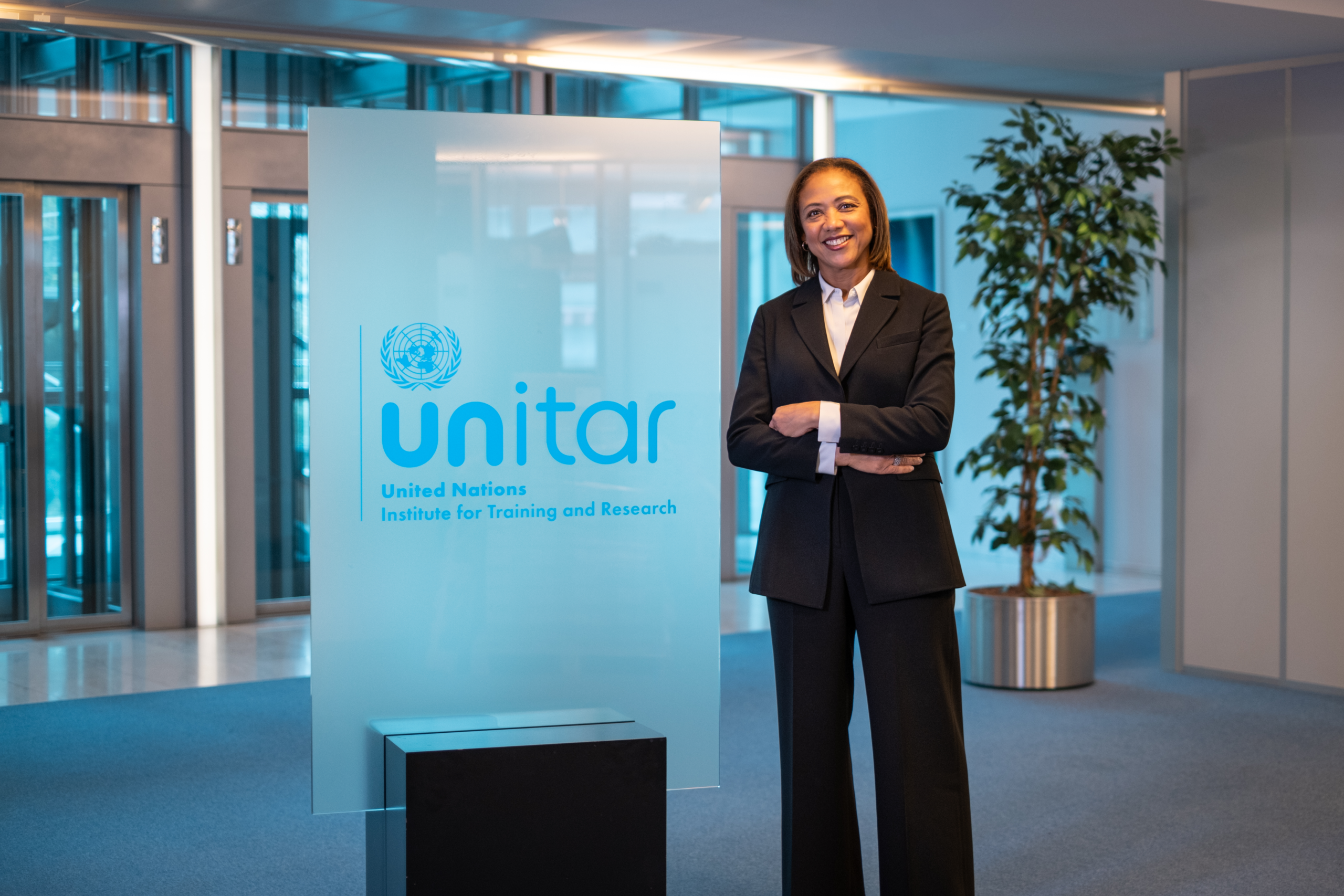
At the helm of UNITAR, Michelle Gyles-McDonnough draws on decades of international cooperation to shape its future. In conversation with Catherine Fiankan-Bokonga, she discusses UNITAR’s transformation, its merger with UNSSC, UNOSAT and the skills needed for a changing world.
As the first woman and the first Caribbean to lead UNITAR, what does this milestone mean to you?
I am very proud and delighted to lead this organization and to be its first Caribbean woman Executive Director. I believe that women leaders carry a particular responsibility to ensure that our leadership brings greater balance to our work, the services we provide and the experiences of our staff. Women’s leadership must be reflected throughout the organization, and achieving gender parity has enriched leadership across UNITAR.
Your appointment sends a powerful message to young girls. What would you like to tell them?
My message is that anything is possible with determination and hard work. I come from a country (Jamaica) that believes that nothing is impossible. Role models are important. It is good to be able to see, touch, and feel what is possible.
You initially chose to pursue a career in law. What inspired that decision?
I became a trade lawyer because I wanted to work on policies, norms, and rules that would allow small countries to participate fairly in the global economy. That is often difficult because there is formal power and informal power, and one has to find ways to work within both. But the rules of the game determine whether we are able to succeed.
How do you draw on your experience in international cooperation to strengthen UNITAR’s training and capacity-building work and promote the sharing of good practices?
International cooperation has been important throughout both my life and my career. I have worked as a Resident Coordinator and supported Resident Coordinators in the field, as well as in the Executive Office of UNDP, the Executive Office of the Secretary-General and the secretariat general of the Organization of American States. In each of these roles, I sought to influence the systems, structures and rules that shape people’s everyday lives. The last eight years involved hard work to transform the UN system so that it could perform better and be ready for the future. The 17 Sustainable Development Goals (SDGs) show that capacities, knowledge and expertise, strong institutions, finance, technology and cooperation are key constraints to further progress. As Executive Director, I now have an opportunity to see whether we can build capability and capacity at scale, better and differently, so that countries can “cook their own soup.”
How do you plan to further develop and strengthen UNITAR, which you have described as a “gem”?
For me, polishing that “gem” means being bolder and going beyond individual training.
UNITAR is highly appreciated for the skills it imparts, the training it provides, and the courses and degrees with which it works with other institutions. However, we need to balance individual training with institutional capability. UNITAR should use its flexibility and agility to address specific skills gaps, while also helping the rest of the UN system scale good solutions identified in the field and ensure that those solutions take root in countries.
As part of UNITAR, how does UNOSAT contribute to the organization’s work?
UNOSAT is a key part of UNITAR. It provides analytical services, including satellite-imagery and geospatial analysis, while also building countries’ capacity to use these tools.
Until now, this capability has primarily supported peace and humanitarian operations. However, the same analysis is needed for sustainable water and forest management, poverty and inequality. UNOSAT is therefore an important asset that must be used across the breadth of the 2030 Agenda. Support for the humanitarian and peace pillars will remain strong, while UNOSAT’s capabilities are increasingly being deployed in areas such as food security, in partnership with FAO, and sustainable urban planning, through its partnership with UN-Habitat, signed last January.
The UN General Assembly approved, on 3 September, the merger of UNITAR and the UN System Staff College (UNSSC) and the establishment of a new institution, the United Nations Institute for Capability and Learning Innovation (UNICLI). What is your comment on this decision?
This is an important moment for both institutions, but also for the United Nations as a whole. The decision forms part of the broader UN80 Initiative, which is fundamentally about making the UN better able to deliver, by aligning mandates, structures, resources, and capabilities around results.
The rationale is straightforward. Member States and the United Nations are facing increasingly complex and interconnected challenges, from conflict and humanitarian crises to climate change, technological disruption, and slow progress on the Sustainable Development Goals. Responding effectively requires people and institutions to continuously develop new skills, adapt, and turn knowledge into action.
How will the respective expertise of the two entities be brought together?
UNICLI will bring together the complementary strengths of UNITAR and UNSSC. UNITAR’s leadership in capacity development for Member States, public institutions, diplomats and development practitioners will be combined with UNSSC’s expertise in learning, leadership and organizational transformation. The aim is not simply to bring two organizations together. It is to create a more coherent and accessible platform for learning and capability development, giving Member States, UN entities and partners clearer entry points to expertise and support.
UNICLI will be formally established on 1 January 2027. What will happen between now and then?
This will be a phased transition. Until the end of 2026, UNITAR and UNSSC will continue to operate as separate entities, and our programs, services, partnerships, and existing commitments will continue. UNICLI will be formally established on 1 January 2027, with the integration of structures, systems and capabilities continuing throughout 2027. Our priority throughout this process is continuity, for Member States, UN personnel, our learners, our donors and partners.