


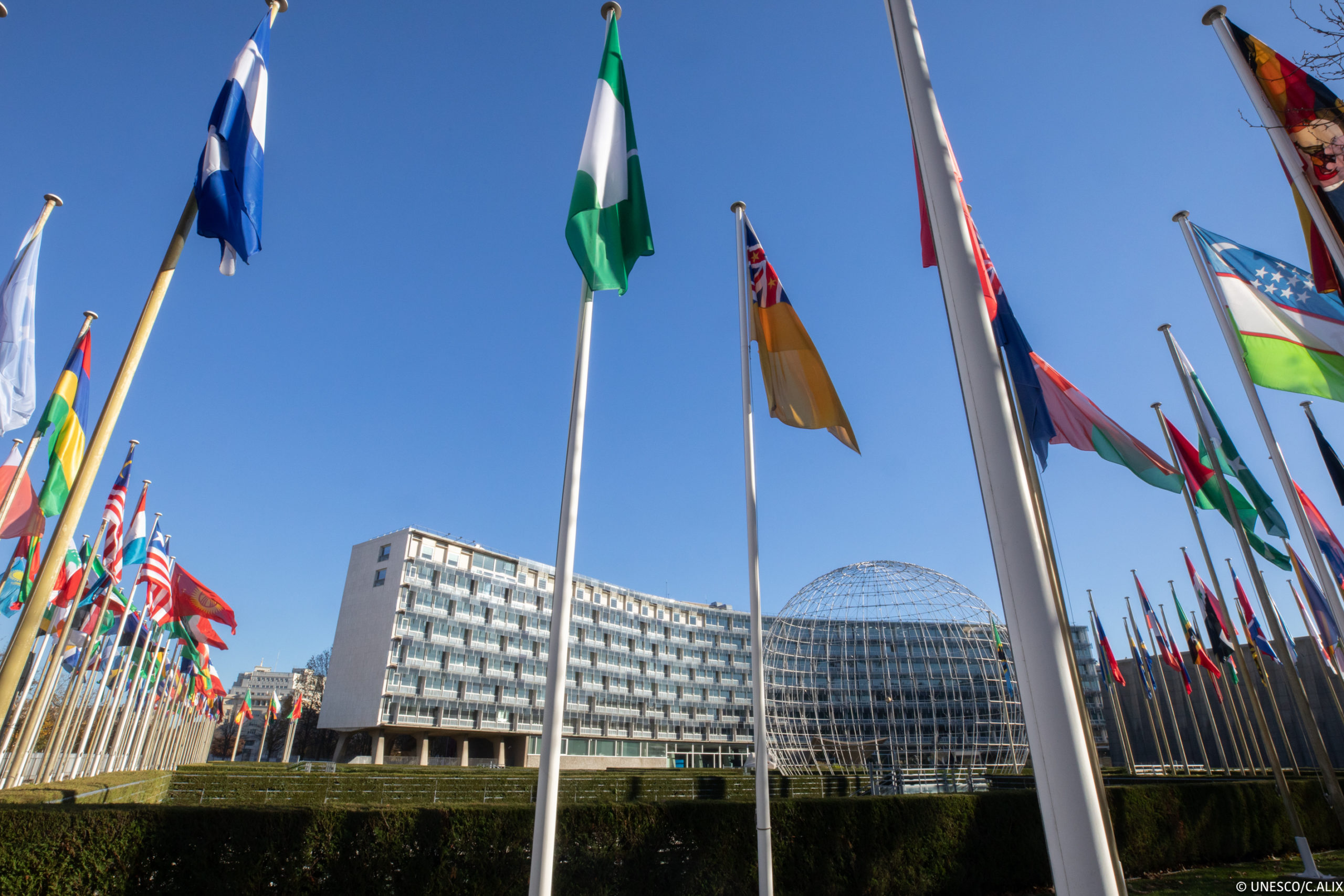
UNESCO recently held its 43rd General Conference in Samarkand, Uzbekistan, 80 years after the organization’s creation. Over two weeks, its 194 Member States adopted the world’s first Recommendation on the Ethics of Neurotechnology and welcomed a new leadership team under Director-General Khaled El Enany.
Yet alongside these advances, they also confronted the stark realities shaping today’s world: technological disruption, climate change, ongoing conflicts, and widening fractures in the multilateral system. In these uncertain times, it is worth looking back at why the United Nations’ ‘laboratory of ideas’ was founded, and why its mission remains more vital than ever.
Choosing to live together
As fractures deepen across the globe, the question of how societies understand one another has returned to the center of international politics. UNESCO was founded in the wake of two World Wars, after the world learned, at unbearable cost, what happens when ignorance and dehumanization harden into ideology.
Wars do not begin with the first gunshot; they begin when dialogue breaks down and shared values erode. Rebuilding after conflict therefore requires more than repairing infrastructure. It demands restoring trust and renewing the conditions for mutual understanding.
This conviction guided the Conference of the Allied Ministers of Education (CAME), which began meeting in 1942. Even as the Second World War raged, its members began imagining a permanent international organization dedicated to building something the British Prime Minister Clement Attlee called ‘that common understanding which is the best guarantee of peace.’
How was this understanding to be built? Through the ‘universal languages’ of education, science and culture. These languages, members believed, allowed the peoples of the world to communicate across borders and barriers. And, as Attlee underlined, ‘the better they understand each other, the more they will realize how much they have in common (…), the less prone they will be to take up arms against each other.’
Building on CAME’s proposals, delegates of 44 countries and eight observer intergovernmental bodies met in London in November 1945 for the Conference for the Establishment of the United Nations Educational, Scientific and Cultural Organization. When the Constitution of UNESCO was adopted, its opening lines read: ‘since wars begin in the minds of men, it is in the minds of men that the defences of peace must be constructed.’
From ideals to action
In the decades that followed, UNESCO worked to turn this founding vision into concrete progress, starting with the publication of The Book of Needs in 1947. Taking stock of the critical situation facing educational, cultural and scientific institutions in post-war countries, this text became a basis for allocating reconstruction funds.
One of the most urgent needs concerned the vast numbers of people who lacked what Director-General Julian Huxley called ‘the most elementary means of participating in the life of the modern world’, the ability to read and write. UNESCO responded with major literacy campaigns in the 1950s, notably in Italy and the Republic of Korea, placing education at the center of recovery.
This commitment to expanding access to education endured. The 1990 World Conference on Education for All established a global framework for universal primary education, contributing to major gains in access worldwide.
When the COVID-19 pandemic disrupted learning for 1.6 billion students in 2020, UNESCO again acted as a global convener, launching the Global Education Coalition to prevent temporary school closures from causing lasting inequalities.
UNESCO was also active in the science field, focusing first on rebuilding cooperation between scientists. In 1954, UNESCO played a key role in the creation of CERN, the European Organization for Nuclear Research, which became the world’s largest particle physics laboratory and later discovered the Higgs boson in 2012. UNESCO also supported the SESAME synchrotron in Jordan, which has brought together researchers from across the Middle East since 2018.
At the same time, UNESCO insisted that scientific progress must respect human dignity and human rights. The 1997 Universal Declaration on the Human Genome and Human Rights established ethical guardrails for advances in genetic medicine. This work continues today through its Recommendations on the Ethics of Artificial Intelligence (2021) and Neurotechnology (2025).
In the cultural sphere, UNESCO showed that cultural solidarity could transcend political divides. One example would be in 1960, with the International Campaign to save the Nubian monuments from flooding caused by the Aswan High Dam. The unprecedented global effort to relocate sites such as Abu Simbel helped shape the principle, later enshrined in the 1972 World Heritage Convention, that certain cultural and natural treasures of ‘outstanding universal value’ belonged to all humanity. Today, the Convention is one of the world’s most widely ratified treaties.
UNESCO later extended this vision through the 2003 Convention for the Safeguarding of the Intangible Cultural Heritage, recognizing that cultural heritage also included living traditions passed down through generations. In 2018, North and South Korea jointly inscribed ssirum/ssireum wrestling on the Representative List of the Intangible Cultural Heritage of Humanity, illustrating how culture can create spaces for dialogue, even where political fractures persist.
Underpinning all these achievements was an unwavering commitment to communication, ‘the channels through which may flow from nation to nation the streams of knowledge and thought, of truth and beauty,’ to quote Ellen Wilkinson, former United Kingdom Minister of Education. UNESCO placed special emphasis on instruments of mass communication, including the press, radio and cinema. This enduring commitment later found expression in the 1991 Windhoek Declaration, which affirmed press freedom as a cornerstone of democracy.
More effective multilateralism
Today, UNESCO continues to support cooperation in education, science, culture and information, cultivating the intellectual and moral solidarity on which lasting peace depends.
However, like other institutions in the United Nations and the wider multilateral system, it is facing challenges, including eroding trust and growing financial uncertainty.
And yet the multilateral system has never been more necessary, or more relevant. The threats the world now faces, climate disruption, technological upheaval, disinformation and conflict, do not stop at national borders. They demand responses that no country can deliver alone.
Multilateral institutions have a unique strength: they can achieve results that lie beyond the reach of individual nations, and they can sustain action over decades, across regions, and through political cycles. Situations like those confronting the world today are precisely why this system was created.
To stay relevant in a changing world, the United Nations must continue to demonstrate its value in concrete and visible ways. UNESCO has responded by renewing its focus on people, recognizing that trust in multilateralism is built not through mandates alone, but through sustained impact on the ground. As the new Director-General, Khaled El-Enany, puts it, everyone must see UNESCO as ‘the voice that carries their concerns, their pride, and also their hope.’
Through this renewed focus, UNESCO aims to show that even in fractured times, humanity can still choose cooperation over isolation, knowledge over ignorance, and understanding over fear.