


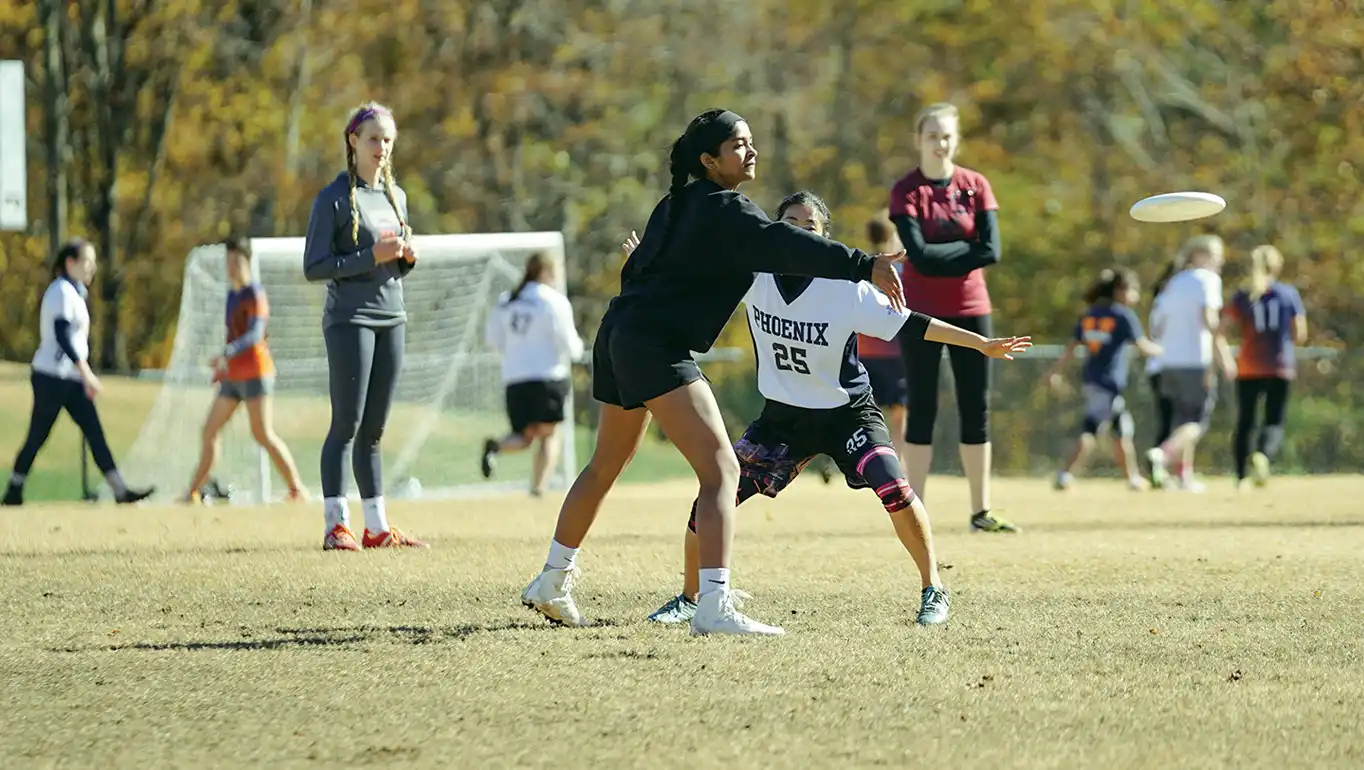
Ultimate is a sport without referees. Under a code called “Spirit of the Game,” players call their own fouls, resolve disputes mid-play and prioritize fair play over winning at any cost. It is, whatever else it is, an unusually trusting way to spend a Saturday afternoon.
The governing rules put it plainly: the game “relies upon a spirit of sportsmanship that places the responsibility for fair play on the player.”
It assumes no one will intentionally break a rule, and asks anyone managing a dispute to be fair, honest and courteous to their opponent. Sure, some elite tournaments now use neutral “observers” as a last resort when players can’t agree, but this is the exception. On an ordinary field, the players sort it out themselves.
From pie tin to world championship
The disc itself predates the sport by at least three decades. Yale students in the 1930s started tossing empty tins from the Frisbie Pie Company of Bridgeport, Connecticut, and by 1955 the toy designer Walter Morrison had developed a plastic version he called the Pluto Platter. Wham-O bought the rights in January 1957 and renamed it frisbee, after the name college students were already using.
The game began in 1967-68 at Columbia High School in Maplewood, New Jersey, where student Joel Silver introduced it to the student council. The first recorded match, in 1968, saw the council play the staff of the school newspaper. Buzzy Hellring and Jon Hines helped Silver formalize the rules in 1970, and the sport spread quickly through American universities. Rutgers vs. Princeton was the first intercollegiate game in 1972, then the disc, through national federations, landed in Sweden (1974), Japan (1975), Australia (1976) and Belgium and Austria (1977).
The World Flying Disc Federation (WFDF), the sport’s international governing body, was founded in 1984 and now counts 126 national federations among its members. The International Olympic Committee recognized the WFDF in 2015, and ultimate was under consideration for the Los Angeles 2028 Games before being dropped from the shortlist in 2022. This is a sport still waiting for its Olympic moment, despite the first World Championships being held in 1983, in Gothenburg, Sweden.
And yes, the sport’s own name is a small act of deference to a trademark: the term frisbee belongs to Wham-O, so what’s actually played is instead officially called “ultimate,” frisbee or not.
How the game actually works
A full game is played seven-a-side on a rectangular field about 100 meters long and 37 meters wide, with an 18-meter end zone at each end, a familiar setup for anyone who ran around a rugby or American football field. A team scores by catching the disc, while it is in the air, inside the end zone it is attacking.
The rules cap a side at seven on the field and set five as the minimum, so there’s room for a casual pickup game with whatever numbers turn up.
As with basketball, there is no running with the disc. If you catch the disc, you plant your foot and can pivot, as in netball, and you throw within ten seconds, counted aloud by the nearest defender. Let the count reach ten before releasing and you lose possession. It also changes if you drop it, or on an interception or the disc going out of bounds, which, with no contact allowed, makes the game considerably gentler on the body than it might appear.
The disc is standardized too: competition play uses a 175-gram model, adopted as the sport’s standard in the 1980s and written into the rules in 1991, so a disc bought for a casual throw in the park is built to the same spec as one used at a world championship. And actually throwing the disc? Most players start with the backhand and forehand, or “flick” – one off the hip, the other snapped off two fingers and the thumb – and can spend years refining these basics. More advanced players may add a hammer, thrown upside-down over a defender’s reach.
An easy sport to fall into
None of this requires a club, a court booking or specialist kit. You have a disc, a reasonably flat stretch of grass and enough people for two small teams? Great, you’re playing ultimate.
Mixed play is also somewhat more evolved than other sports: each team fields seven players with at least three of each gender on the field at once, so this isn’t a separate category bolted onto the men’s game, it is the original format itself, from casual pickup groups up through the World Ultimate Championships.
Ultimate is also forgiving on the body: there’s no body-checking and little of the contact risk that comes with most team sports, which keeps it open to a wider range of ages and fitness levels. No club membership on the scale of a golf course, no court booking, no season ticket. Just a disc, a stretch of grass and a willingness to referee your own game.
Get started
This is a cheap sport to take up. One disc between a few people is enough to learn the basic throws, and a full pickup game needs only two sets of markers for end zones and around ten to fourteen players split evenly. Most cities with a large international population already have some kind of ultimate scene, from club-level teams down to informal weekend pickup groups, but none of that is a prerequisite.
And heading into winter doesn’t mean waiting until spring. Indoor ultimate is its own format: five players a side, played on a basketball court with end zones just two to three meters deep, the walls doubling as boundaries. The stall count drops to seven seconds, points restart without a pause, and substitutions run on the fly, hockey-style. It’s how clubs keep a season going through the colder months.
MORE INFO:
If you’re in or around Geneva, check out the Wizards or Swiss Ultimate (both in French/German) on their websites here: wizards.ch ultimate.ch