


When a disaster strikes, the first questions are often: how severe, who is affected and where is help available? The answers depend on data. But increasingly, they also depend on trust – a component around data that’s less visible, and, increasingly, more fragile.
The World Disasters Report 2026, recently published by the International Federation of Red Cross and Red Crescent Societies (IFRC), is dedicated entirely to the recent explosion in misinformation in the humanitarian space. It argues that harmful information is no longer just a communications problem. It is a humanitarian risk, one that erodes trust and blocks life-saving operations.
An example: in 2018 in the Democratic Republic of Congo (DRC), Red Cross volunteers were working on slowing the spread of Ebola when rumors began, blaming the volunteers for bringing the virus into communities. This misinformation fuelled mistrust, leading at times to violence against Red Cross teams, particularly those conducting safe and dignified burials.
Or take the case of Canada in 2024, when wildfires devastated the small mountain town of Jasper, Alberta. The Canadian Red Cross responded immediately, providing shelter, financial assistance and a range of personal support services to evacuees. During the response, however, a coordinated disinformation campaign emerged, falsely claiming that the Canadian Red Cross was absent locally and that funds would not benefit the community.
When communities believe rumors more than the people trying to help them, neither the best medicine nor the best support services can do their job.
So it’s vital to push back.
In the DRC, the DRC Red Cross placed community engagement at the centre of its strategy. Volunteers went door to door sharing information on how to prevent, detect and respond to Ebola, hosted radio talk shows, organized mobile cinemas and conducted outreach to vulnerable groups. This approach had a measurable impact: community resistance and aversion to burials dropped drastically from 79% in the first two months of the operation to just 8% in September 2019.
In Alberta, the Canadian Red Cross challenged and corrected the disinformation in real time, highlighting its successful emergency relief operation and the impact on the community. Results from pulse surveys showed increased levels of trust in the Red Cross throughout the area.
Pushing back, therefore, takes time and uses resources. The World Disasters Report argues that reliable information – and the establishment of trust – has become a basic humanitarian need. Alongside food, water, shelter and healthcare, people in crisis must trust those guiding life-changing decisions, or vaccines may be rejected and evacuation warnings ignored.
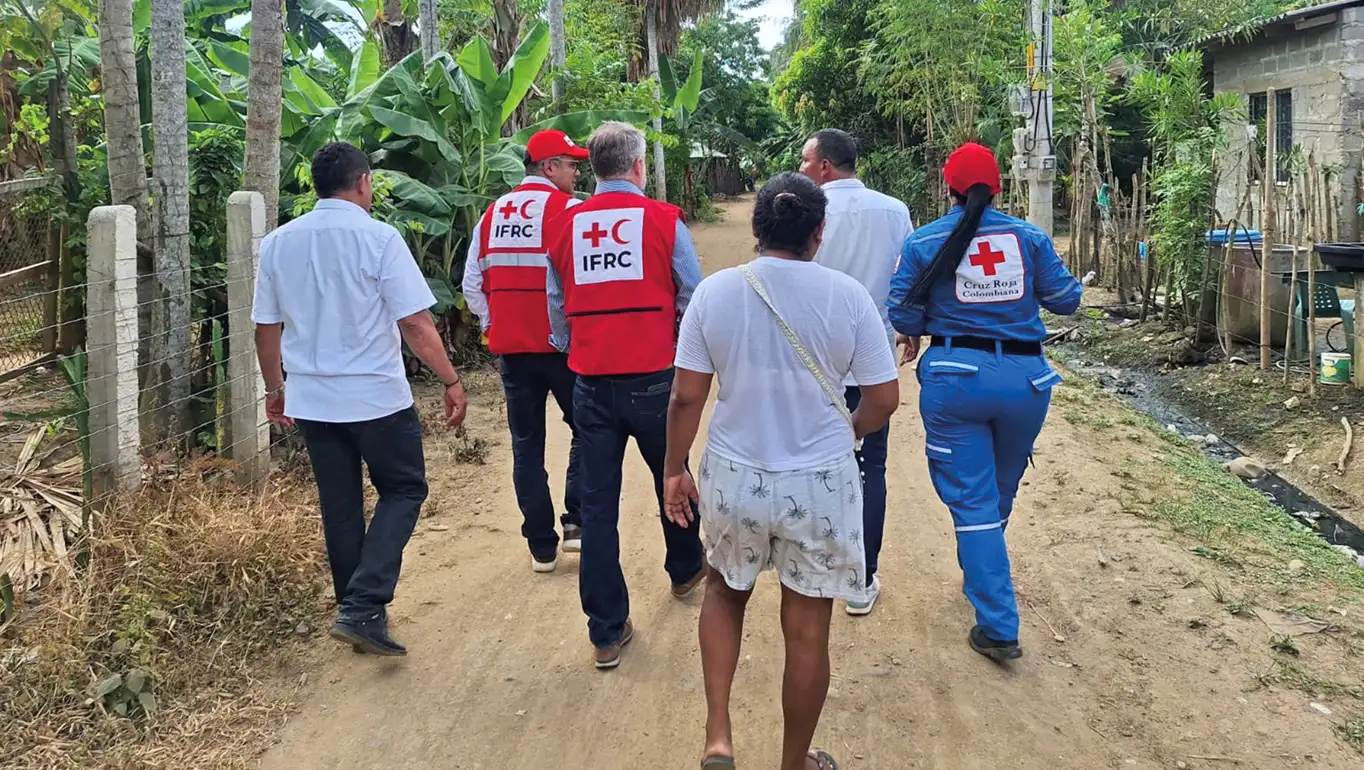
Today, we cannot assume trust as a given. It must be built in a reinforcing loop: from belief, to proof, to consistency. It must be earned repeatedly and through transparency. Local Red Cross and Red Crescent staff and volunteers are well-placed to achieve this. Their proximity and credibility can be a huge asset.
But of course, trust is no longer relevant only in physical communities. It appears in digital spaces – group chats, social media networks and online forums where narratives spread rapidly and shape public perception. False claims, rumors and manipulated narratives can travel faster than accurate assessments, shaping attitudes against those willing to help.
For humanitarian organizations like the IFRC, this nuance changes the meaning behind “local.” Showing up physically is simply no longer enough if the real conversation is happening online.
Instead, being present in communities now also means being present in the information spaces where people form opinions and, subsequently, make decisions.
The World Disasters Report argues that harmful information must be treated as an operational risk – something anticipated and managed just like logistics, security or access constraints.
It also calls for a broader shift: recognizing that information itself is a form of aid.
Providing communities with trusted, actionable information can be as life-saving as medicine or food. That means investing far more in community engagement. Nowadays, we too often think artificial intelligence has all the answers. In fact, stronger “humanitarian intelligence” – understanding how information moves and where trust is built or broken – is more important than ever.
But ultimately, addressing harmful information cannot fall to humanitarian organizations alone. Other international organizations, governments, technology companies, media and communities all play a role in shaping the information environments in which crises unfold.
Confronting this challenge requires stronger cooperation across sectors – from improving early warning and verification systems to investing in community engagement and ensuring trusted information reaches those who need it most. At a time when humanitarian needs are rising, protecting the integrity of information is essential to protecting lives.