


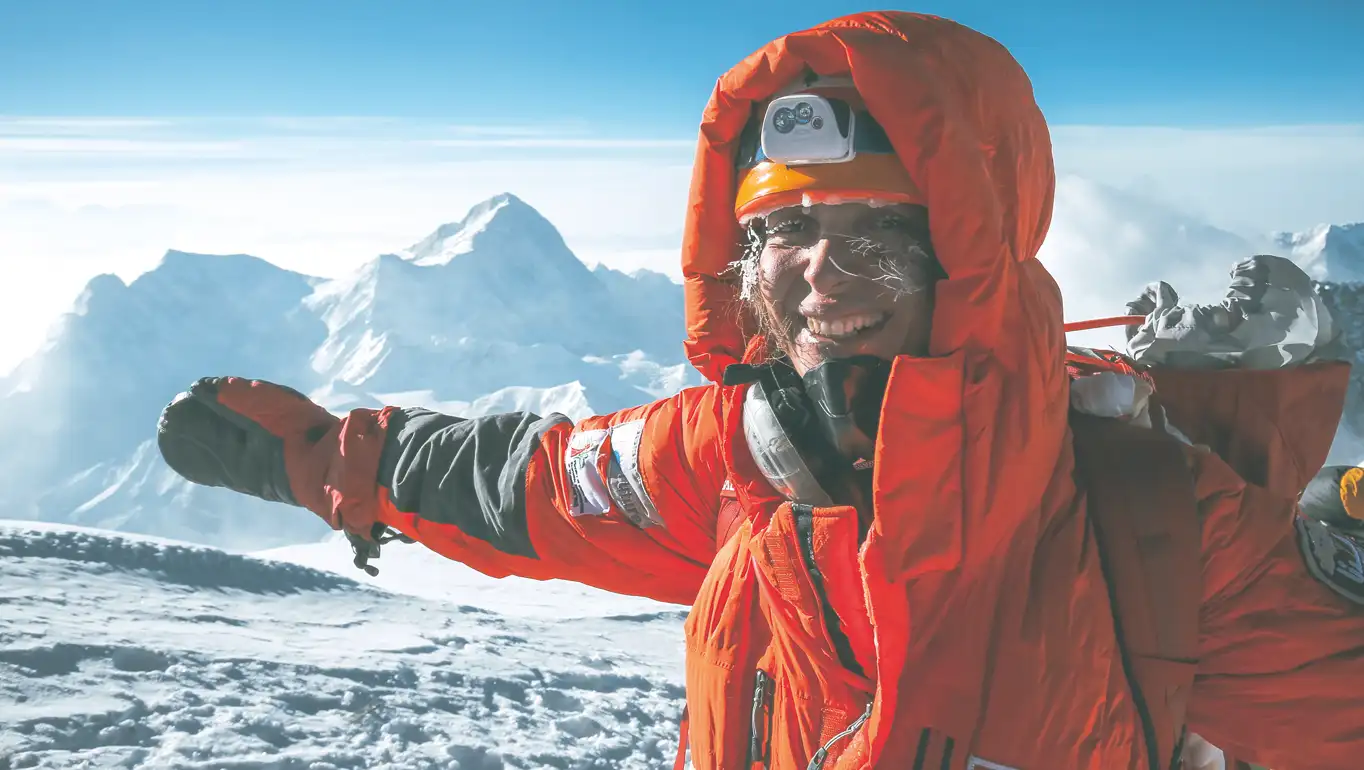
Joyce Azzam is a Lebanese mountaineer, conservation architect, and motivational speaker best known for becoming the first Lebanese woman to complete the Seven Summits Challenge. This includes climbing the highest peak on each continent, including Mount Everest. Not just admirable for her record-breaking achievements, she shares how she has become an advocate for women’s empowerment, environmental preservation, and mental resilience.
1. International Mountain Day is a reminder of the vital role mountains play in our environment and culture. As someone who has stood on the world’s highest peaks, what message do you hope to share about the importance of protecting mountain ecosystems and the communities that depend on them?
Mountains are more than landscapes; they are living ecosystems that provide water, food, and energy to nearly half of humanity. They are also cultural treasures and homes to resilient communities who often live in fragile conditions.
After 56 days on Everest, while descending from the high camps to Base Camp, I saw something I will never forget: an empty bottle of Sprite dancing in the melting water of the Khumbu Icefall. Just two nights earlier, I had slept on top of a pile of trash in the “Death Zone.” To witness plastic waste in such a sacred and remote place broke my heart and it forced me to recognize that climbers like me are also part of the problem.
That moment changed me. Together with Lakhphuti Sherpa, a local woman who shared the same passion and purpose, we co-founded Everest Voices. I even carried this message to UNEP headquarters, meeting with officials to push for global awareness. Then the pandemic hit and slowed our momentum, but the mission remains urgent.
As a PhD holder in Management of Landscape and Environment, I know that the solution cannot be just “cleaning the bottles.” Many clean-up campaigns have been done, but the root causes remain. What is needed are comprehensive management plans for mountain regions worldwide, plans that tackle waste, tourism, climate change, and livelihoods together. These must be developed alongside the communities who live in and depend on the mountains, empowering them as the true custodians of these fragile ecosystems. Only by combining science, policy, and community voices can we safeguard mountains for future generations.
For me, mountains are not only where I test my limits; they are where I found joy, strength, and peace. They are our mentors, and we must protect them.
2. Mountaineering often means confronting both physical danger and mental isolation. What’s the hardest challenge you’ve ever faced on an expedition, and how did you overcome it?
The hardest challenge was climbing Mount Everest. After nearly two months on the mountain, the final push to the summit meant entering the “Death Zone,” where oxygen is scarce, the body begins to shut down, and every step feels impossible.
At around 8,000 meters, I was already exhausted, moving slowly through the bitter cold. Just before reaching the Balcony, at about 8,400 meters, I looked down at my oxygen bottle and saw that the barometer was pointing to zero. This is when I looked at KB Sherpa, my experienced climbing partner who was supporting me through the climb. I asked him to change the bottle, but he pointed toward the Balcony, as we were still on a steep slope before reaching it. It is very dangerous to stop on the side of the safety rope to change an oxygen bottle, so he pointed to the balcony as a safer option for both of us. I could see the faint lights of climbers ahead who were resting there, but even if it was only about fifty meters away, moving that distance without oxygen at this altitude is deadly.
I kept climbing, one step at a time. My hands went completely numb, and as I reached the Balcony, I fell on the icy ground and lost consciousness. Everything went dark, but I remember hearing beautiful chanting around me and a familiar voice saying, “Breathe, you know how to breathe.” It was John’s voice—my ice-bath instructor back in Beirut, who had trained me twice a week to withstand freezing water by learning how to exhale slowly and convince my brain to stay calm when my body wanted to panic.
That breathing technique saved my life. As I sat unconscious on the Balcony, my body was shutting down from the lack of oxygen, but those long, controlled exhales helped me release the carbon dioxide that could have poisoned my body. While I was fighting to stay alive, KB Sherpa was setting up a fresh oxygen bottle. When he finally placed the mask on my face and opened the flow, I began to wake up. Slowly, breath after breath, I came back.
From there, I continued the climb and reached the summit. That moment taught me that survival in the mountains is not about being fearless. It is about managing fear, trusting your training, and knowing how to calm your mind when everything else is shutting down. It is also about teamwork, leadership, and trust. I owe surviving that moment to KB Sherpa, to the team of Madison Mountaineering, and to their leader guide, whose decisions and experience kept us all safe.
But to be honest, the hardest challenge in my journey was not only while climbing the mountain. It was before and after, when I faced a different kind of isolation. Because of my gender, I was attacked for following what many called a “nonsense dream.” I was told to focus on my academic career and get married, because I was getting older and might not be able to have a baby. Some even said I was taking sponsorship opportunities away from men who “deserved it more.”
Those words hurt deeply, but they also shaped me. I learned that isolation is not only physical; it can also be social and emotional. And just like on the mountain, I overcame it by staying true to my purpose, believing in my dream, and taking one step at a time, even when it felt like I was climbing alone.
3. As the first Lebanese woman to complete the Seven Summits and founder of mountaineering academy MounTurtle, what is your advice for future mountaineers?
My advice to future mountaineers is simple: respect the mountain, prepare for it, and let it teach you who you are. Climbing is not just a physical challenge; it is a journey of mindset, patience, and humility. The mountain rewards those who train well, listen deeply, and understand that every step, even the slow ones, matters.
I often tell young climbers about my first expedition to Aconcagua in 2012. It was my first attempt to climb one of the Seven Summits, and I did not reach the top. Yet it remains the most valuable expedition of my life. That climb taught me the importance of preparation and respect for nature, for the team, and for my own limits. It also taught me something even more powerful: that on a mountain there is no man or woman, there is only the mountaineer.
As mountaineers, we must invest in our preparation and training to be ready for what the mountain demands. A woman, as I have proven through my journey, has just as much courage, strength, and will as any man. We simply need to prepare on all levels, physically, mentally, and emotionally, and the climb itself becomes the greatest reward.
After eighteen years of climbing, I realized that the real summit is sharing what you have learned. That is why I founded MounTurtle Mountaineering Academy to help others prepare for their own mountains, physically and mentally, and to find joy and confidence through movement.
Today, as a UN Women Goodwill Ambassador, I say to every girl and woman who is aiming to climb her own mountain, whether it is a summit, a dream, or a challenge in life, that you already carry the strength within you. You just need to take the first step. The climb will reveal your power.