


Chances are, you know Switzerland for its chocolate, its precision-made watches, or its financial and international hubs. Maybe you have even visited before and gazed at a mountain peak or strolled along a glassy alpine lake. Prepare to be amazed by a lesser-known side to its sights and culture.
It all started with a signpost
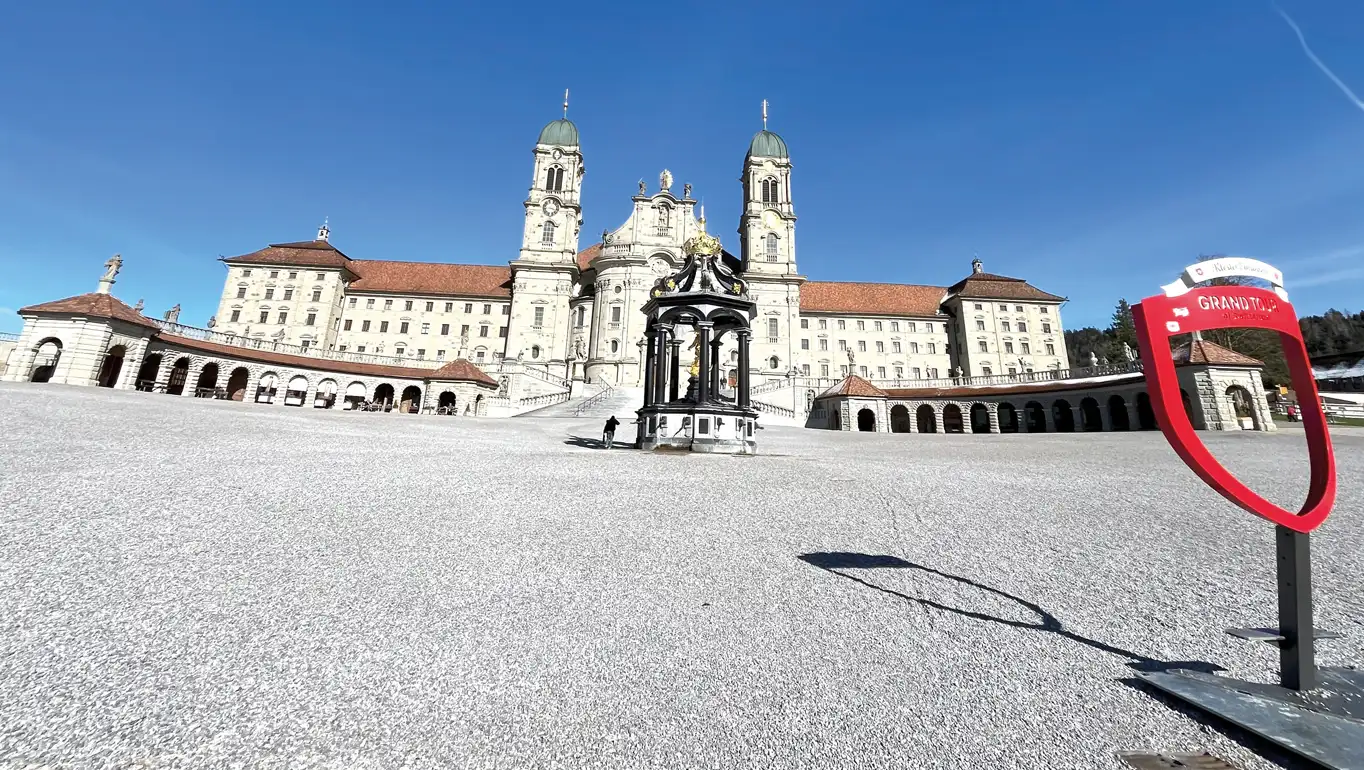
During a creative break in early 2024, I stumbled on a flashy red Grand Tour signpost in Interlaken, framing the Jungfrau massif. Though I’d passed a couple before without much notice, this time curiosity made me pause. That’s how I learned they’re official photo spots, each part of a circuit of remarkable sites across Switzerland, with a companion app that uses augmented reality to turn the journey into a treasure hunt of virtual tokens.
From a fleeting thought to a grand adventure
Looking for a meaningful way to keep myself engaged while gearing up for my next role, I decided to give it a try – not by car or motorcycle as designed, but instead with public transportation and a good pair of sturdy shoes.
The very next day, I tested the idea with a nearby photo spot in Fribourg. After taking every available train and bus to get as close as possible, then conquering a steep climb on foot, I finally had proof it could be done. That’s when the plan was born to complete the full journey in the most eco-friendly way possible.
So over the following months, I set out on day trips and longer excursions that gradually added up to an odyssey carrying me over alpine passes, through medieval towns, along mirror-like lakes and finally to the Pizol in St. Gallen, where I closed the loop after five months of discovery at photo spot number 84. Here I celebrated with my family and raised a glass to mark a journey like no other.
But what exactly is the Grand Tour of Switzerland? Let’s rewind.
Conceived by Switzerland Tourism in 2015, it is a 1,600-plus kilometer circular route designed to showcase the country’s most remarkable landscapes and cultural highlights in one seamless journey. The route links together over 80 official photo spots that feature Switzerland’s finest views, while the road signage ensures travelers stay on track past 22 lakes, 5 Alpine passes, 13 UNESCO World Heritage Sites, and countless towns, villages and scenic lookouts.
Travelers can complete it in stages over time or dedicate a longer trip to follow the circuit in one go, taking detours into side valleys or pausing in towns that capture their imagination. At the same time, not every stretch is equally accessible, because high mountain passes depend on the right season and weather, with snow sometimes keeping them closed until early summer.
Choosing a different path to travel
As stated earlier, the Grand Tour is mainly designed for cars and motorcycles. However, I deliberately chose a slower and more unconventional route: one that not only stress-tested one of the world’s most reliable public transport systems, but also kept my carbon footprint to a minimum while maximizing both screen time and step count.
But behind the postcard images, reaching a photo spot sometimes turned into a puzzle of timetables, tight connections, and unexpected detours. Some days meant missing the bus and trudging uphill in business attire, searching for a spot still buried in snow, or wrestling with French antenna signals across Lake Geneva that cut off my internet in the vineyards of Lavaux.
Moments of wonder along the way
When talking about the Grand Tour, one question is sure to come up: which place was the best? And the honest answer is: it depends.
It depends on the season, the weather, and perhaps most of all on what you bring into the journey yourself. Some thrive in comfort zones, whereas others require extra effort to be found. Some shine in winter light, others in the first blush of spring, others again in summer warmth or autumn colors. So the Grand Tour is less about one “best” destination than about contrasts that unfold stage by stage.
That said, if I had to curate a starter kit of 10 highlights for friends discovering Switzerland for the first time, it would probably read like this:
• Abbey of Einsiedeln, Schwyz – Switzerland’s most famous monastery, a baroque pilgrimage site to the Black Madonna and architectural marvel that has drawn visitors for over a thousand years.
• Giessbach Falls, Lake Brienz – A 14-tiered waterfall plunging into shimmering turquoise waters, reached by forest paths or the vintage funicular.
• Great Aletsch Glacier, Valais – Europe’s largest glacier, a 20-kilometer river of ice through the Alps, awe-inspiring yet fragile under climate change.
• Heidi House, Maienfeld – The Alpine setting of Johanna Spyri’s Heidi, where meadows and chalets bring the literary classic to life.
• Jet d’Eau, Geneva – One of the world’s tallest fountains, shooting 140 meters above Lake Geneva and standing as a symbol of the city.
• La Tremola, Gotthard Pass – A cobblestone serpentine once used by mule caravans, today a living monument to historic mountain crossings.
• Lake Lucerne, Brunnen – A serene stretch where water and mountains embrace, reflecting peaks with mirror-like clarity as if walking into a painting.
• Niesen, Bernese Oberland – Switzerland’s pyramid-shaped mountain, famed for panoramic views and home to the world’s longest stairway with 11,674 steps.
• Parco San Michele, Lugano – A hilltop park with Mediterranean flair, offering sweeping lake views framed by cypresses and terraces.
• Rhine Falls, Schaffhausen – Europe’s most powerful waterfall, roaring with unrelenting energy and best admired from platforms or boats that reach the spray.
Practical takeaways for fellow travelers
For those tempted to embark on the Grand Tour, here are a few recommendations:
First, download the official Grand Tour of Switzerland mobile app. It’s a useful planning tool with maps, suggested routes and background information. You can also track your progress and redeem vouchers along the way.
Second, timing matters. While much of the route is accessible year-round, the high mountain passes often remain closed until late May or early June. To complete the full circuit without detours, aim for summer or early autumn before the snow returns.
Third, pace yourself. The Grand Tour can be done in 7–10 days by car or motorcycle, but it’s far more rewarding to slow down. Breaking it into stages allows for deeper encounters — whether that means joining a local festival, hiking into a side valley, or lingering over coffee in a town square.
Fourth, plan ahead. Not every place along the route has supermarkets, restaurants, or card terminals close at hand. Set off with refreshments, a fully charged phone, some cash, and — if you’re driving — a full tank.
Finally, stay flexible. Mountain weather, geography, and the occasional missed connection can all bring surprises. Build in buffer time, pack for sudden changes in weather, and don’t underestimate the joy a sturdy pair of walking shoes can bring.
Beyond the journey’s end
Ultimately, the Grand Tour is not just about sights, but about the fact that great journeys are not measured in kilometers or miles, but in layers of experience.
And the story keeps evolving. As the Grand Tour marked its 10th anniversary last year, it continues to grow — with new features and spots regularly added, extending the route into fresh corners of Switzerland. That’s why, in August 2025, I set out to explore the newest additions — proof that the adventure is never truly finished.
So for anyone ready to discover Switzerland differently, the Grand Tour is an ever-evolving open invitation to trade distance for depth and miles for memories.