


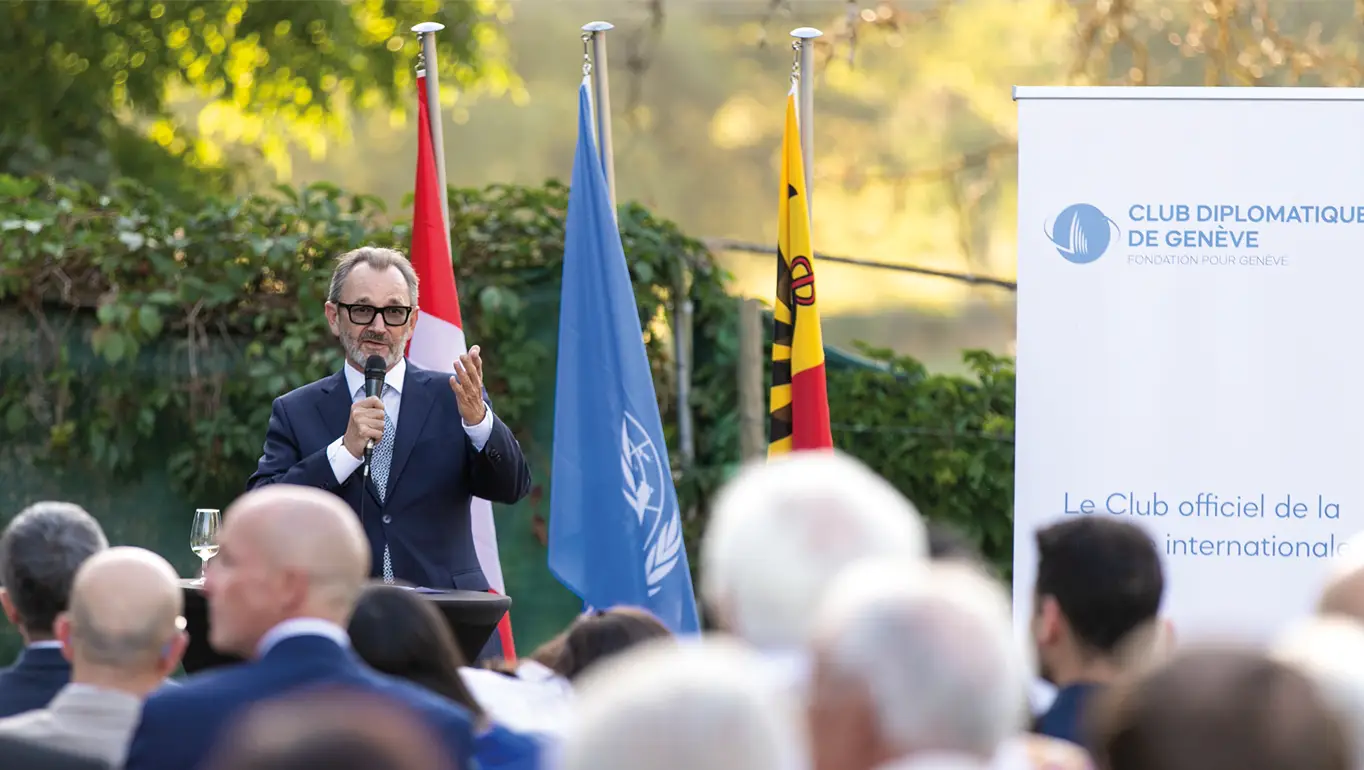
Former Ambassador of Switzerland and current President of the Geneva Diplomatic Club, Raymond Loretan, reflects on the last half century as the Club reaches its golden anniversary.
What is the Geneva Diplomatic Club?
Founded in 1976, the Geneva Diplomatic Club has, for half a century, established itself as a privileged platform for dialogue, exchange, and conviviality at the heart of International Geneva. Recognized as the official club of this community, it benefits from the support of the Swiss and Geneva authorities, as well as the United Nations Office at Geneva.
Its mission is clear: to break down barriers between the diplomatic, political, economic, and academic worlds by fostering direct, informal, and constructive dialogue. With more than 900 members, it brings together ambassadors, heads of international organizations, representatives of the Swiss and Geneva authorities, as well as leaders from academia and the private sector, forming a unique community where lasting bridges between institutions are built.
Each year, around twenty events — including closed-door discussions, conferences, cultural visits, and excursions — give concrete expression to this dynamic. The Club thus serves as a discreet yet effective laboratory of international dialogue, where personal relationships and mutual trust quietly strengthen institutional cooperation. From this atmosphere emerges a form of diplomacy that is human, pragmatic, and creative, reinforcing Geneva’s role as a global capital of multilateralism.
How has diplomacy evolved since 1976, and how do these changes shape the Club’s role today?
Since 1976, diplomacy has undergone a profound transformation. It has become more technical, faster-paced, and more exposed. Crises now unfold at the speed of social media, artificial intelligence increasingly influences decision-making processes, and non-state actors play a growing role. Diplomacy is no longer confined to chancelleries; it is interconnected, highly visible, and often multisectoral.
The Club has adapted to this transformation. Today, we offer more targeted activities, thematic encounters, and formats designed to explore complex issues in greater depth. We favor human-scale exchanges that encourage strategic reflection rather than formal statements.
We have strengthened our ties with the academic world — with the Geneva Graduate Institute and the University of Geneva now represented on our committee — and developed collaborations with innovation stakeholders, as illustrated by recent visits to EPFL’s technology centers and our projects with Trust Valley.
The diversity of our committee reflects this evolution: representatives of the host state, UNOG, the diplomatic corps, international organizations, NGOs, and the private sector. This plurality mirrors contemporary diplomacy, where solutions are built collectively.
Our ambition is clear: to offer high value-added events that combine intellectual depth, meaningful encounters, and privileged access to key actors within Geneva’s and Switzerland’s ecosystems. In doing so, the Club complements multilateral forums by providing a space of trust and intellectual freedom.
Which moments best illustrate the spirit of the Club?
Each encounter generates memorable moments. I think in particular of our closed-door dialogues, where leading figures agree to share their perspectives with complete openness and without filters. These rare exchanges, marked by candor and mutual trust, allow participants to move beyond institutional postures and engage in genuinely meaningful dialogue.
There are also those unexpected moments that truly capture the soul of the Club. I recall, for example, Lech Wałęsa, former President of Poland and Nobel Peace Prize laureate, who spontaneously initiated an impromptu photo session in the middle of a meal. It was not a protocol-driven moment, but one of genuine sincerity.
It is precisely these moments of humanity and simplicity that best reflect the spirit of the Club: a place where barriers fall, trust takes hold, and dialogue becomes once again deeply authentic.
How does the Club contribute to strengthening International Geneva in the current context?
In a fragmented world, where geopolitical tensions and global crises put cooperation mechanisms to the test, the Geneva Diplomatic Club is determined to fully assume its role as a platform for dialogue. Our responsibility is to offer a space where open and honest conversation remains possible — a place to listen, exchange, and seek common ground.
In 2026, this commitment will take concrete form through a conference series entitled “Geneva Working for the World,” illustrating in a tangible way how Geneva helps shape global solutions. This momentum will be amplified by a series of articles published in leading media outlets, further extending the reach of our message and enhancing the visibility of International Geneva. By highlighting Geneva’s unique strengths — its neutrality, the richness of its ecosystem, and its capacity for innovation — we reaffirm that multilateralism is not an abstract concept, but a daily endeavor embodied by committed women and men. In doing so, we contribute to reinforcing Geneva’s role as the capital of modern multilateralism.
Finally, who is the person behind Raymond Loretan?
Beyond my formal roles, I am guided by a simple yet firm conviction: dialogue remains the most powerful tool for navigating the complexity of the world.
My professional journey — spanning diplomacy, corporate governance, health, media, culture, and civic engagement — has taught me that lasting solutions only emerge when silos are overcome. What truly drives me is connecting worlds, ideas, and people, and helping bring forward projects and solutions that can make a meaningful difference.
As President of the Geneva Diplomatic Club since 2016, I strive to embody and cultivate this spirit: curiosity, respect, intellectual depth, and a strong sense of humanity.