


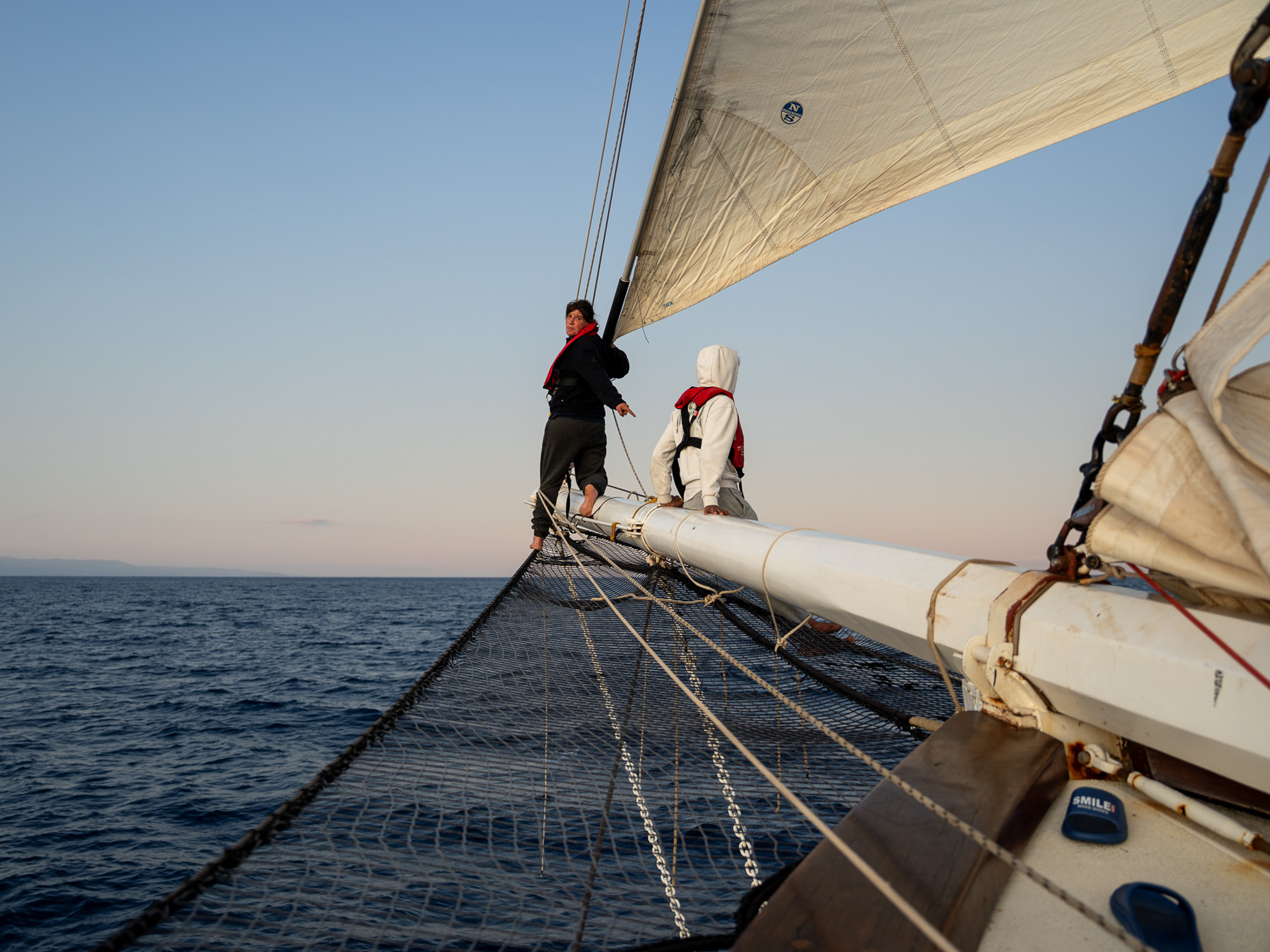
Last week, on May 6, 2026, the historic vessel Fleur de Passion set sail from Portugal to embark on “Au Cœur de Nos Racines,” a multi-year global journey along the world’s equatorial belt with a scientific and social mission.
In the first days of May, a sailing vessel named Fleur de Passion, built in Germany in 1941 and flying the Swiss flag, left the shores of Portimão, Portugal, on a round-the-world journey along the equatorial route. This passage along the “mangrove route” carries the young participants of a socio-educational program for vulnerable youth, with Corto Maltese as its spiritual commander. It sounds like the opening of a new comic strip, but every bit of it is real.
It all begins with Pacifique, a Swiss non-profit organization based in Geneva, created in 2002 in conjunction with the purchase of that sailing vessel. After years of restoration, the foundation launched the socio-educational program Jeunes en Mer (Youth at Sea), aimed at young people in difficulty who spend two months on board to develop personal responsibility and social skills. Alongside this, scientific environmental research programs are conducted in partnership with several universities, as well as artistic projects designed to ensure that all these activities remain part of collective memory. Among its initiatives, Pacifique organizes thematic ventures with defined routes: following a circumnavigation in the wake of Magellan (2015–2019) and four years of exploration in the Arctic Ocean (2020–2024), the organization now opens a new chapter with the mission “Au Cœur de Nos Racines” (To the Heart of Our Roots).
This new adventure aims to be a journey in search not only of the roots of the ecosystem, but of human roots as well. On one hand, it continues the mangrove study project in collaboration with the University of Geneva’s Department F.-A. Forel for Environmental and Aquatic Sciences. On the other, a team of researchers from the University of Geneva’s Faculty of Psychology and Educational Sciences and from the University of Toulouse will conduct a psychological study on the resilience processes of the young people involved on board.
From 2026 to 2030, the ship will navigate along the intertropical belt. Departing Portimão on May 6, 2026, the journey heads through the Gambia to Brazil, Panama, Australia, Southeast Asia, Kenya, and South Africa, before returning to the Mediterranean. It was precisely the choice to explore mangroves that shaped the route of this odyssey. These vital ecosystems protect coastlines and store vast quantities of carbon, yet the 2024 IUCN Red List of Ecosystems reports that 50% of the world’s mangroves are at risk of collapse.
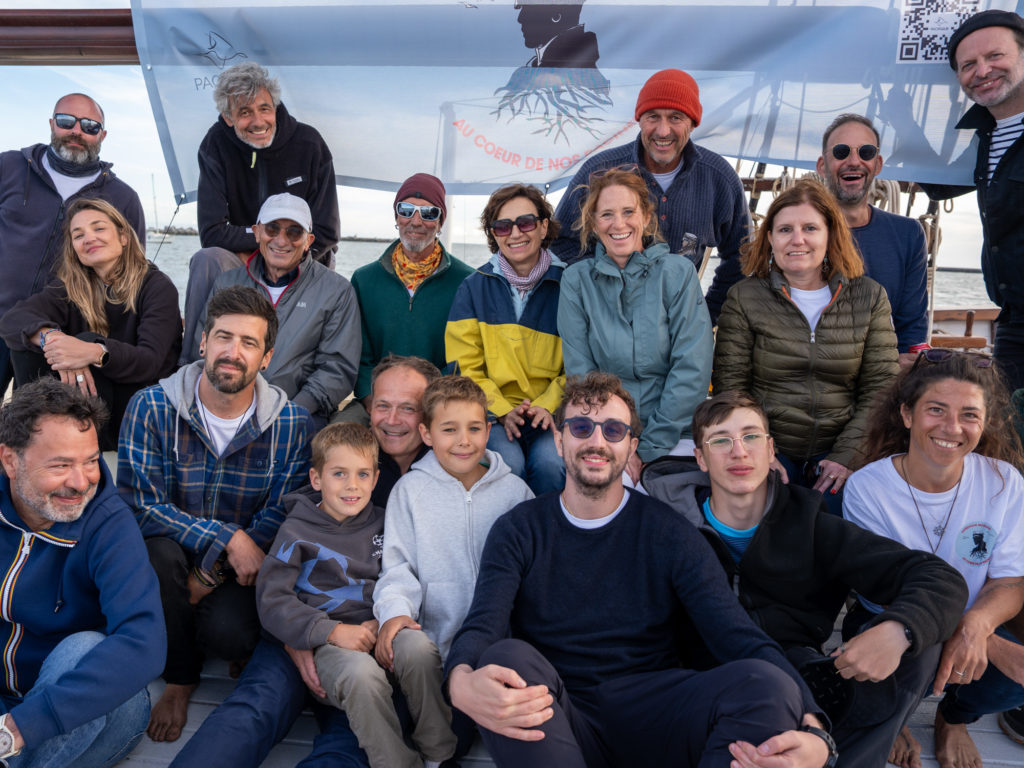
At the heart of this adventure, the program Jeunes en Mer will continue and will see different teenagers joining the boat along this route. Through navigation, working in teams, and taking on responsibilities, the objective is to rediscover oneself, which sometimes means being ready for the unknown, for connection, and for transformation. So that transformation does not remain a purely individual experience but yields clear, measurable findings, a new psychological research project has been put in place. The scientific project is built around a multidisciplinary approach exploring four main axes: the regulation of learning processes, emotional and interpersonal dynamics, referentialization processes, and the dynamics of emancipation. Data will be collected before, during, and after each leg according to a rigorous protocol, through document analysis, observations, and semi-structured interviews.
Openness to transformation begins with the ship itself, as Fleur de Passion carries within its hull a history of successive rebirths. Born in 1941 as a Kriegsfischkutter, a German military motor-sailer, it became French war booty in 1945 under the name Trébéron. In 1976, thanks to the vision of Claude Millot, it changed face and soul to become Fleur de Passion, a ketch devoted to education and science, until Pacifique completed its full restoration and returned it to the sea in 2009. Today, it is no longer merely a sailing vessel, it is a floating refuge, a Noah’s Ark where different worlds coexist in a spartan, purposeful space where every centimeter is designed for the essential. In this distraction-free environment, the essence of travel and human connection is rediscovered. It looks like a vessel straight out of Hugo Pratt’s comics, and so it could only have Corto Maltese as its spiritual captain. In fact, he is a sailor who has always sailed toward the unknown in search of himself and the world.
The collaboration between Pacifique and CONG, the rights holder of Hugo Pratt’s work, was born from this shared vision of travel as a formative experience. On board for some legs in 2026 on Fleur de Passion are Patrizia Zanotti, director of CONG, and the writer Marco Steiner, both long-standing collaborators of Pratt. Together, they bring Corto’s spirit to the project. In particular, Steiner is developing a new novel featuring Corto Maltese to be published by Rizzoli. This work carries forward Hugo Pratt’s narrative legacy while updating it to face the environmental and social challenges of the 21st century.
So, while Pacifique’s crew explores the mangroves of the outer world, it also traverses the intricate “mangroves” of the inner world. In this voyage between land and sea, the only certainty is to let oneself be surprised by life. And if at first it seemed like merely the imagined opening of a new comic strip, Corto Maltese truly accompanies the mission on this quest, offering an invitation to dream, today more than ever, of another world. Because this transformation does not belong only to the young people of the program, it touches anyone who sets foot on that boat.