


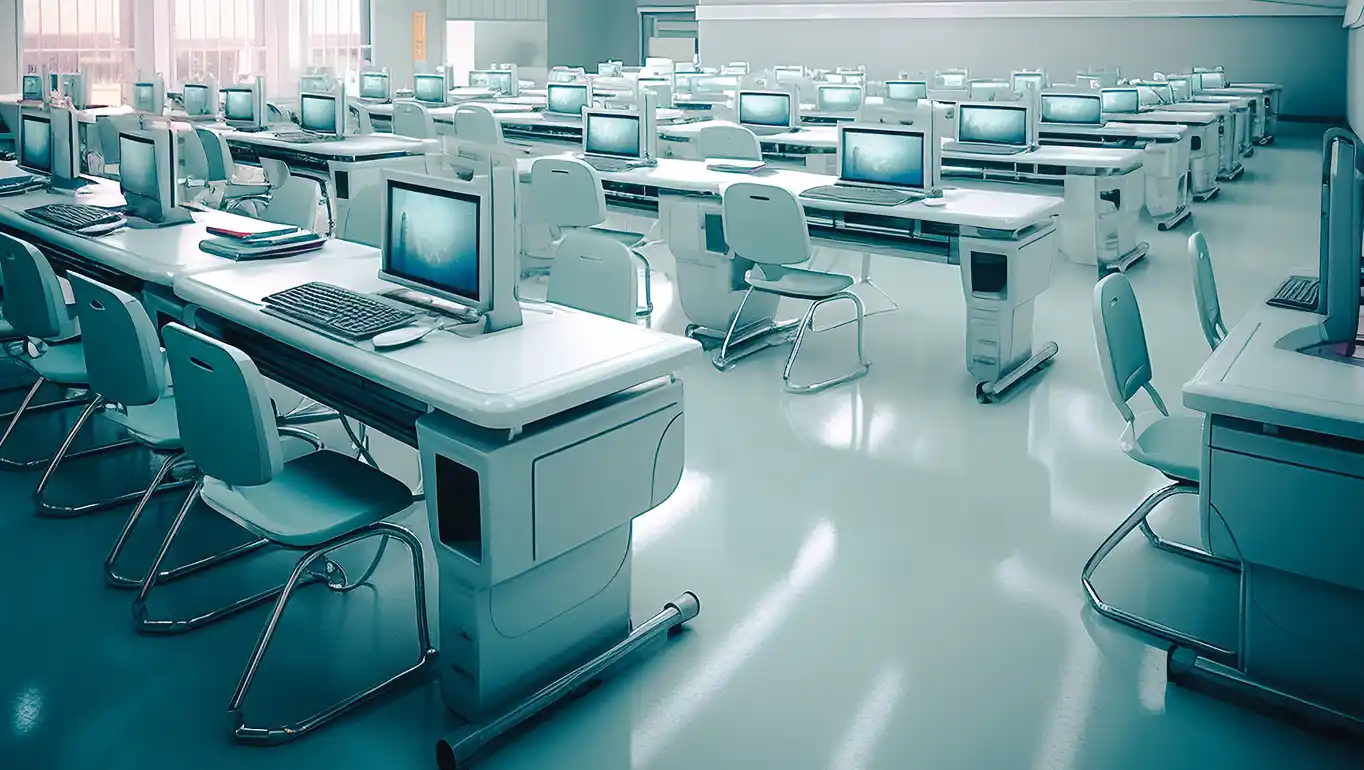
Throughout time, technological advances have shaped educational programs.
From wax tablets to paper, from ink wells to ball point pens, from blackboards to whiteboards and from notebooks to computers.
Digital evolution has not been smooth and uniform: technology moves in stops and starts and will be accelerated in some systems, slowed down and even reversed in others. Nor have advances in technology always been celebrated by philosophers and reformers. In fact, some of the more critical voices have questioned the idea of progress quite strongly: Socrates believed that writing would drain the mind of its agility and acuity and Nietzsche saw enthusiasm for science as a mere recreation of religious dogma. Hannah Arendt believed that we were heading to a world where technicality and efficiency would take over from the world of political reflection, discourse and action.
It’s important to situate techno-skepticism historically because it’s easy to believe that the recent anti-technology craze sweeping over the media is something new, but it isn’t, it’s just that the technology is far more powerful than ever before and the effects of screen use on cognition are starting to be questioned much more seriously than before. However, the big idea, which is that advances in technology might not help us educate but actually get in the way of an education, is quite old.
The Anxious Generation and Dopamine Nation
These are the titles of recent best-selling books that point to research and stories about how screen use, excessive reliance on social media and 1:1 computing programs in schools have created addiction, attention deficit, and low self-esteem. Whereas IQ scores were going up year on year (known as the Flynn effect), from the 1970s they started to go down, with a notable dip from 2010 and some correlate this more recent dip with screen addiction. A strongly researched project at MIT showed that there is significantly less cognitive activity when using Large Language Models than manual searches.
Some of the most significant technological development expansion concerning education started about 20 years ago and has augmented exponentially ever since. This has included the widespread adoption of 1:1 programs using cloud computing, mass implementation of whiteboards in classrooms, and the digitization of textbooks and curriculum support materials.
The most problematic dimension of technological expansion has no doubt been the release of touch screen devices onto the market, leading to children carrying their own Androids or iPhones. Interestingly, in the USA, almost 9 teenagers out of 10 will use an iPhone rather than an Android device, whereas that statistic is almost reversed for young adults in Brazil and India. There is presently a strong ‘Phone Free’ movement sweeping across countries and districts with particularly emphatic dialing back of technology in France, Sweden and the Netherlands. Much of this comes in the wake of a 2023 UNESCO report on the dangers of excessive phone and technological use in an educational context.
The double-edged sword
However, as I wrote back in 2021, technology is a double-edged sword.
The dangers of excess are palpable, of course, but what about the advantages? When COVID-19 struck, it was those systems and structures that could flip online overnight that suffered the least, and the experience of COVID-19 revealed a digital divide that questioned inequality across the globe. The extent to which we can access information, do research, learn without teachers through tutorials and adaptive online tutors is very powerful, and it would be disingenuous to pretend that this is not the case. In China, through the New Generation Artificial Intelligence Development Plan, investment into technology for learning has expanded massively in recent years and the use of artificial intelligence in the classroom is now a core part of the educational approach. There are reported educational gains in rural China due to the integration of AI and technology into teaching. A separate study this year conducted a systematic review on AI use in literacy programs and found positive gains whereas in rural India, AI was used to translate content into several languages and to adapt curriculum content to more local examples with good results. For engineering students in China, 41.89% use Generative AI multiple times per week and only 4.73% of students reported never using it.
It’s a tricky situation: we have opened the Pandora’s box of incredibly powerful computing which has the potential to boost learning in a manner that we have never seen before but at the same time, interfere with learning and also slow down cognitive development by allowing students easy shortcuts and, therefore, less working memory exercise.
So where exactly should schools stand?
First, I think that we need to stop oversimplifying the role of technology in learning. Yes, excess screen time is bad for you; yes, enslaving oneself to social media is in no way good for critical thinking; yes, asking artificial intelligence to do all the thinking for you is not exercising the brain. However, because of technology and social media we are able to access, easily, multiple viewpoints on a single subject, find relatively arcane pieces of knowledge that were almost totally inaccessible beforehand and connect with people from across the globe instantaneously. AI tutoring has been shown to have palpable gains for student learning. So it’s not an either/or scenario but a both/and scenario.
Secondly, from an anti-technology perspective, too much time is spent writing about what not to do as opposed to what to do. We should be reading books, handwriting, walking in nature, engaging in hands-on learning, discussions and debate, the arts and experimental science, sports, and above all, reflecting on what we do. Banning technology will not make these things happen, great schools, great parenting and great teachers will. Furthermore, it is possible to lead a balanced lifestyle where you use cloud computing and screens in your research but still enjoy analog learning and screen-free moments.
Thirdly and finally, the approach should be scaffolded and structured, with a careful and intentional exposure to technology that means that some of the essential psychomotor and cognitive skills are strengthened and in place before using technology. At my school in Los Angeles, starting this August, we are commencing 1:1 computing relatively late with careful guardrails. The school is phone free and teachers are working off a policy on pedagogical practice which puts the emphasis on manual learning, the power of the pen, and using technology when it is actively increasing and augmenting learning (with a critical eye on when it might actually be interfering).
Let’s not forget where this all started, with the fact that technology has always developed alongside education and accelerated it, and that this has never been simple or uniform. What will be important is the quality of learning that is served by technology, and not the other way around.