


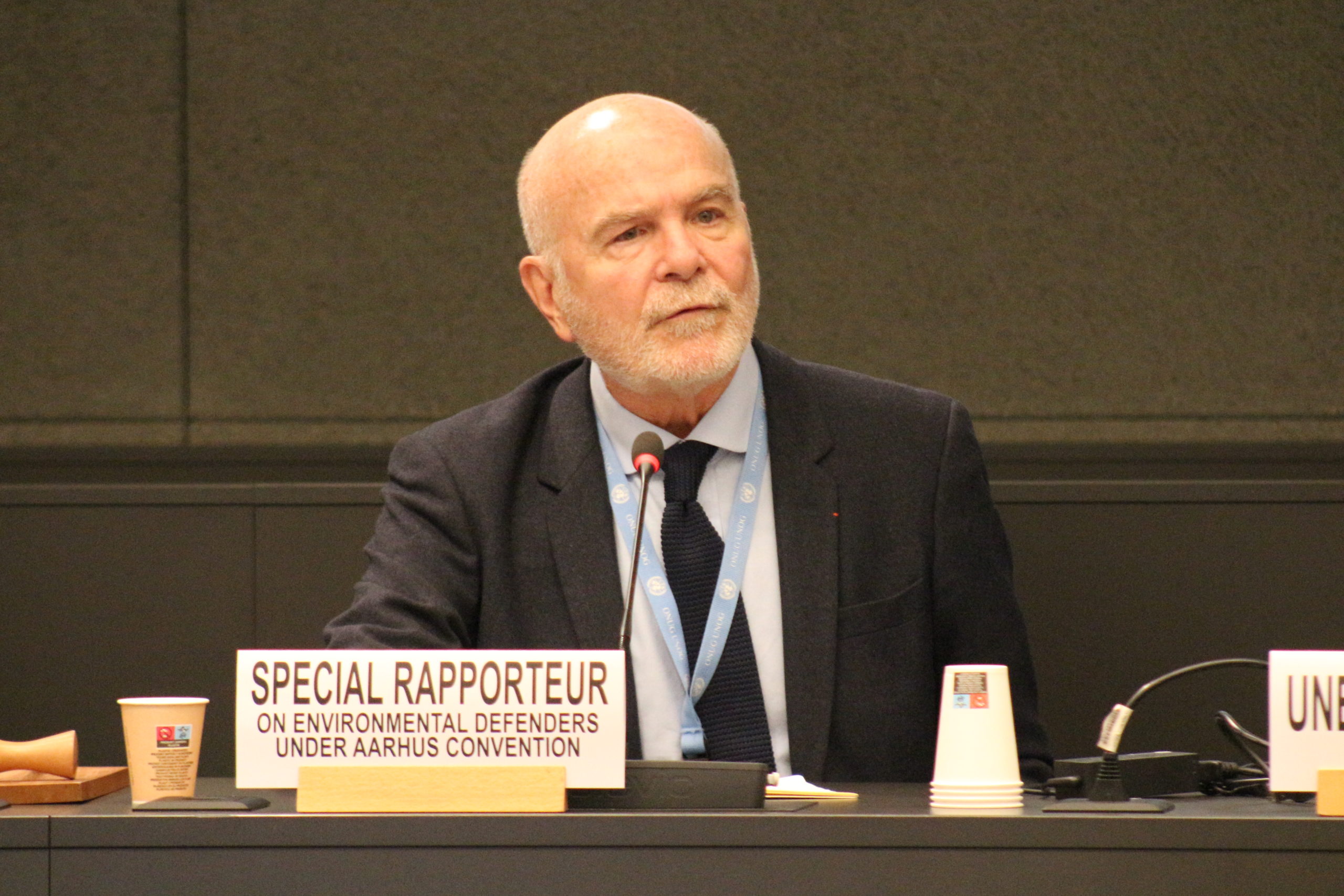
As environmental defenders face growing harassment and criminalization, the Aarhus Convention provides a key framework for their protection. Adopted in 1998, it guarantees access to information, public participation and access to justice. In 2021, it established a rapid-response mechanism, the first international mechanism specifically dedicated to protecting environmental defenders within a legally binding framework. Michel Forst was appointed its first Special Rapporteur in 2022, following his tenure as UN Special Rapporteur on the situation of human rights defenders (2014–2020) and UN Independent Expert on the situation of human rights in Haiti (2008–2013), under the UN Human Rights Council.
You recently issued landmark guidelines on the right to protest for environmental defenders. What prompted you to develop these guidelines at this particular moment?
The urgency stems from a deeply alarming trend we are witnessing globally. Environmental defenders are not just ordinary protesters; they are individuals fighting for the survival of our ecosystems, biodiversity, and climate stability. Yet, across the globe, including in mature democracies, we are seeing an unprecedented crackdown on environmental activism. We see peaceful protestors vilified in public discourse, subjected to heavy-handed policing, slapped with disproportionate criminal charges, and targeted by strategic lawsuits against public participation (SLAPPs). These guidelines were created to draw a clear line in the sand: environmental protest is not a crime; it is a fundamental human right.
What are the key principles underpinning these guidelines, and what are the main messages you want States to take away from them?
The guidelines rest on three essential pillars. First, the duty of protection. States have a proactive obligation to ensure that environmental defenders can exercise their right to peaceful assembly without fear of retaliation, violence, or criminalization. Second, the proportionality of state response. We are seeing a dangerous inflation of penalties, where sitting on a road can lead to years in prison. The guidelines remind states that policing must focus on de-escalation, and penalties must never be used to deter public participation. Third, the recognition of the specific motives of environmental defenders. Their protest is intrinsically linked to the right to a clean, healthy, and sustainable environment, a right recognized by the UN General Assembly.
Although these guidelines were developed under your mandate as Special Rapporteur on Environmental Defenders, do the principles they set out extend beyond environmental activism?
Absolutely. This is an incredibly important point to clarify. Although these guidelines were developed under my mandate to protect environmental defenders, the core principles they contain apply broadly to all peaceful protests, not just those focused on the climate or the environment. The fundamental right to peaceful assembly, freedom of expression, the requirement of proportionality in policing, and the prohibition of criminalizing dissent are universal legal protections. They apply equally to human rights defenders, labor unions, social movements, and any citizens exercising their rights. Safeguarding environmental protests effectively safeguards the democratic space for everyone.
You have warned that even established democracies are tightening restrictions. Which measures or legislative trends are particularly concerning to you today?
I am particularly concerned by the rise of legislation that uses broad, vague definitions of “public nuisance,” “disruption,” or even “terrorism” to target peaceful blockades and civil disobedience. We also see a worrying trend of pre-emptive arrests—detaining activists before a protest has even begun based purely on intelligence or social media posts. Furthermore, the use of facial recognition technology and invasive surveillance against climate groups creates a massive chilling effect. The guidelines explicitly address these tactics, reminding states that minor disruptions to daily life are a normal, protected element of the right to assembly.
Civil disobedience has long been a tool for social change, but it remains highly contentious. How is it defined in the context of environmental activism today?
It is crucial that we define this clearly to counter the dangerous political and media rhetoric we see today. In the guidelines, civil disobedience is understood as a deliberate, public, non-violent, and conscientious breach of law undertaken with the primary aim of bringing about a change in laws, policies, or practices. It is fundamentally an act of conscience. These defenders are not acting out of a desire to commit common crimes; they are acting out of a profound sense of urgency regarding our planetary crisis. Under international human rights law—including General Comment No. 37 of the UN Human Rights Committee—this type of collective direct action is recognized as a legitimate way of exercising the rights to freedom of expression and peaceful assembly.
Recent climate movements have increasingly resorted to direct forms of protest, including road blockades, sit-ins and non-violent actions at industrial sites. How do your guidelines call on States to respond to such disruptive forms of protest?
This is exactly where the guidelines provide crucial operational clarity. International law is very explicit: a protest does not lose its protected, peaceful status simply because it causes commercial disruption, temporary annoyance, or involves an unauthorized entry onto industrial property. Tactics like road blockades or sit-ins are deeply rooted in the history of social movements. When Greenpeace activists or other defenders peacefully enter a high-emission industrial facility to bear witness or halt damage, their intent is purely public interest, not vandalism or violence. My guidelines remind states that such actions must be met with restraint. The state’s response must evaluate the intent of the activists. Treating a non-violent industrial intrusion as an act of “terrorism” or “sabotage” is entirely disproportionate. Public order does not mean the absolute absence of friction. The temporary disruption caused by a roadblock or an industrial sit-in pales in comparison to the catastrophic, irreversible disruption that unmitigated climate change will inflict on our societies.
Beyond governments, what role do corporations and the judiciary have in upholding the principles set out in these guidelines?
They play a massive role. Corporations are often the ones pushing governments to criminalize defenders, or they use SLAPPs to financially ruin activists.
The guidelines call on businesses to respect the UN Guiding Principles on Business and Human Rights and to immediately cease the harassment of defenders. As for the judiciary, judges and prosecutors are the ultimate guardians of human rights. We urge them to dismiss abusive lawsuits at an early stage and to ensure that any bail conditions or sentences imposed on activists are strictly proportionate and do not violate their fundamental rights.
Finally, what is your message to environmental defenders who are currently facing legal pressure or intimidation for standing up for the planet?
My message is simple: you are not alone, and your voice is vital. The international community has recognized the legitimacy and courage of your work. These guidelines are a tool for you, your lawyers and civil society to hold governments accountable. My mandate will continue to monitor, speak out and conduct country visits to ensure that environmental defenders are protected, not persecuted.