


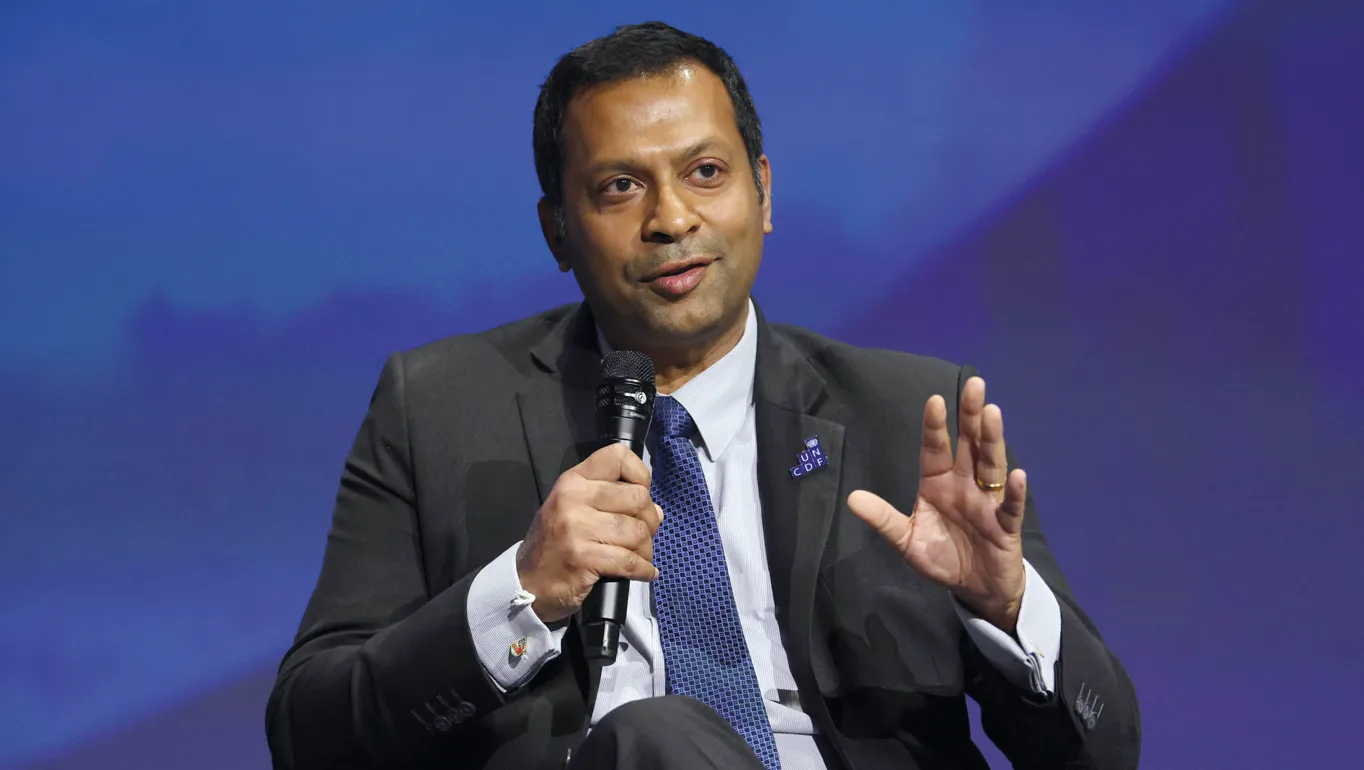
Pradeep Kurukulasuriya brings more than two decades of experience across the UN system and the World Bank to his role as Executive Secretary of the United Nations Capital Development Fund (UNCDF). Appointed at a time of shrinking development resources and rising global challenges, he has led a transformation to refocus UNCDF on its original mandate, using concessional finance to de-risk underserved markets and crowd in much-needed private capital. As UNCDF approaches its 60th anniversary, Pradeep Kurukulasuriya reflects on why the organization matters more than ever and how it is evolving to meet today’s development realities.
You joined UNCDF at a time of shrinking resources and rising expectations. What made you believe the organization was worth transforming, and what did you see as the most urgent change needed?
I came to UNCDF after nearly 25 years working with UNDP and the World Bank, largely through time-bound, grant-funded projects. One reality stood out throughout that journey: while the UN makes real impact through policy reform, capacity building, and piloting solutions, we consistently struggle with scaling those solutions.
The challenge has been linking grant-funded interventions with the larger pools of concessional and commercial finance needed to take them to scale. These parts of the development finance system often do not align. Different cycles, incentives, and risk appetites get in the way.
At the same time, development challenges like climate change, energy access, and sanitation have not diminished. In many cases, they have grown. The financing needed to address them at scale has increased dramatically. Based on IMF data, we estimate the financing gap for Least Developed Countries to reach their SDG targets to be between $246-285 billion every year.
What intrigued me about UNCDF is that it has a unique mandate within the UN system, one that has not been fully deployed yet as per its complete capability. UNCDF is designed to operate in early-stage, high-risk markets that are largely ignored by global capital flows. For traditional multilateral development banks, entering these markets is extremely difficult due to their credit ratings, size and cost of transactions, and balance sheet constraints.
As UNCDF is a non-credit rated entity and a grant-finance organization, anchored to the operational capacity of UNDP, it can fill that gap. It can go in first, absorb risk, change the market profile, and then crowd in larger development finance institutions and private investors. This is exactly what UNCDF was created to do in 1966, to support countries left behind by global capital markets. The question for me was not whether UNCDF was relevant, but why it had not yet been used at the scale the moment demands and how to unlock its full potential. I felt the time was right to change that.
As UNCDF approaches its 60th anniversary, how are you refocusing the organization on its original mandate, and why is it more relevant than ever today?
Over the past 60 years, UNCDF has played a critical role in areas like financial inclusion, microfinance, and local infrastructure, particularly in Least Developed Countries. But we have also learned a great deal about the limitations of the broader development finance architecture.
Today, those limitations are widely recognized. Official development assistance is shrinking, while the scale of global challenges is growing. Even if public finance were not declining, it would still be insufficient to meet needs related to climate, energy, sanitation, and economic transformation.
That reality forces us to rethink our approach. Except for the most extreme instances and need of humanitarian support, countries must move beyond grant-only dependency, and private capital must play a much more active role. UNCDF’s value proposition is precisely in providing financial de-risking in LDCs, SIDS, conflict and post-conflict settings so that private and public investors, both domestic and international, are willing to engage.
We have therefore restructured UNCDF to operate as a financial derisking Fund in the truest sense. We now have a front office focused on investment and implementation, a middle office overseeing financial instruments such as loans – at 0% or very low interest – guarantees, and investment grants, and a back office managing operations.
We are led by a Chief Investment Officer, Chief Financial Officer, and Chief Operations Officer. This is very different from a traditional UN structure, but it is fit for purpose, given our mandate.
This evolution has been recognized externally as well. The European Union has Pillar Six assessed UNCDF, making it only the second UN entity, after IFAD, to meet standards relating to managing and deploying investment instruments such as guarantees and loans. What is special about this is that UNCDF is a UN platform and non-credit rated. We are present on the ground through our close collaboration with UN Country Teams and especially UNDP. We have in-house expertise in investment capital deployment and portfolio management capacity. And on top of that, we are much more risk tolerant than traditional financial institutions. Put together, that makes UNCDF a hidden gem in the UN development system.
UNCDF is meant to support, not compete with, other UN entities. How does this work in practice, and what difference does it make on the ground?
From the very beginning, UNCDF was designed to augment the UN’s collective impact. Its concessional loans and guarantees cannot operate in isolation. They must be embedded within the policy and capacity-building work of the broader UN system.
In practice, this is exactly how we are designed to work following the restructuring. We do what others in the UN system cannot do. The UN80 Initiative aims for greater agility and efficiency. To achieve that, competition within the UN system is out of the question. We instead need to focus on our specific mandates and find more opportunities to bring them together in a systemic manner for scalable and sustainable impact. For example, in Kenya, UNCDF is working with UNDP to provide a financial guarantee to a local bank, unlocking credit for smallholder farmers to improve productivity. In Nigeria, we are working with UNICEF to de-risk a company producing ready-to-use therapeutic food for malnourished children, enabling it to scale production and source inputs locally rather than rely on imports. In Rwanda, we are working with WFP on small holder agriculture. These are a few examples – but watch this space! As we work to scale up our contributions to the UN offer at the country level, we will see more of it in the months ahead. These interventions address immediate development needs while harnessing market forces that drive job creation, income growth, and long-term sustainability.
Importantly, many of our financial instruments are repaid or not drawn down (for example, guarantees), allowing resources to return to UNCDF and be redeployed. Even considering portfolio losses – which are standard for these kinds of markets – the majority of capital is recycled. This means we can use the same dollar multiple times, which is an extremely compelling value proposition for donors trying to do more with less, and for private actors who are looking for a return. Of course, in high-risk market segments resources will ultimately be absorbed over time. But the core point remains: we can recycle each dollar at least two to three times, and with each cycle we can mobilize an additional three to four dollars. That mobilized capital can then catalyse further investment – again by a factor of three to four. We have already seen this dynamic begin to emerge, albeit at a limited scale, over the past four years. We believe it can now be scaled significantly, creating a win-win and enabling donors to optimize scarce ODA while helping countries unlock the domestic and external investment needed to deliver sustainable development outcomes.
Your career spans many sectors including climate, development, and finance. How have these experiences shaped your leadership style at UNCDF?
Like many in the UN system, I am here because I believe deeply in multilateralism and its ability to address global challenges. My academic background, field experience, and years at UNDP have shown me that change is possible. I also grew up in Sri Lanka in the 1970-90s – a turbulent time – which inculcated in me a desire to help solve complex problems and make the lives of those less fortunate somewhat better than we initially find them.
When you see firsthand how a small contribution within a larger UN effort can improve lives, it becomes incredibly motivating. You want to do more, and you realize just how powerful the UN platform can be if used effectively. I have seen that first-hand with UNDP over the years, working in partnership with the Global Environment Facility, the Green Climate Fund, with colleagues at UNEP, World Bank, and WHO to name a few. I strongly believe in the power of the collective, perhaps even naively so sometimes.
What excites me most about UNCDF is its ability to bridge worlds, the UN, multilateral development banks, development finance institutions, the private sector and most importantly, the communities that we serve. This bridging role is increasingly essential. UN reform is pushing us to better connect our capabilities across institutions, because real impact happens when we join the dots. Private capital has and will continue to shape the future of development. UNCDF offers a practical way to engage that capital while strengthening the work of the entire UN system.
Looking ahead, what would success look like for UNCDF, and what legacy would you hope to leave?
For me, success ultimately means becoming irrelevant. If countries no longer need us because their financial systems are strong, inclusive, and their countries are attracting the large pools of capital that are out there, then we have done our job.
That success would look like entrepreneurs and young people, particularly in Africa, having access to better capital and the affordable and accessible finance they need to realize their ambitions. It would mean stronger capital and functioning local capital markets, especially in least developed and fragile contexts. It would mean greater capital, as additional finance flows via unlocking of sleeping domestic capital or increased investment from outside. It would mean job creation keeping pace with demographic realities and youth aspirations.
At a broader level, I hope UNCDF contributes to a more modern UN development offer, one that is faster, more effective, and able to answer the realities of today’s fast moving and uncertain world. One that bridges between the old way of funding development to the necessary way of financing development.
If people say that UNCDF helped modernize how the UN engages with finance, risk, and markets, while delivering greater impact for the most vulnerable communities, then I would consider that a meaningful day or two of work.