


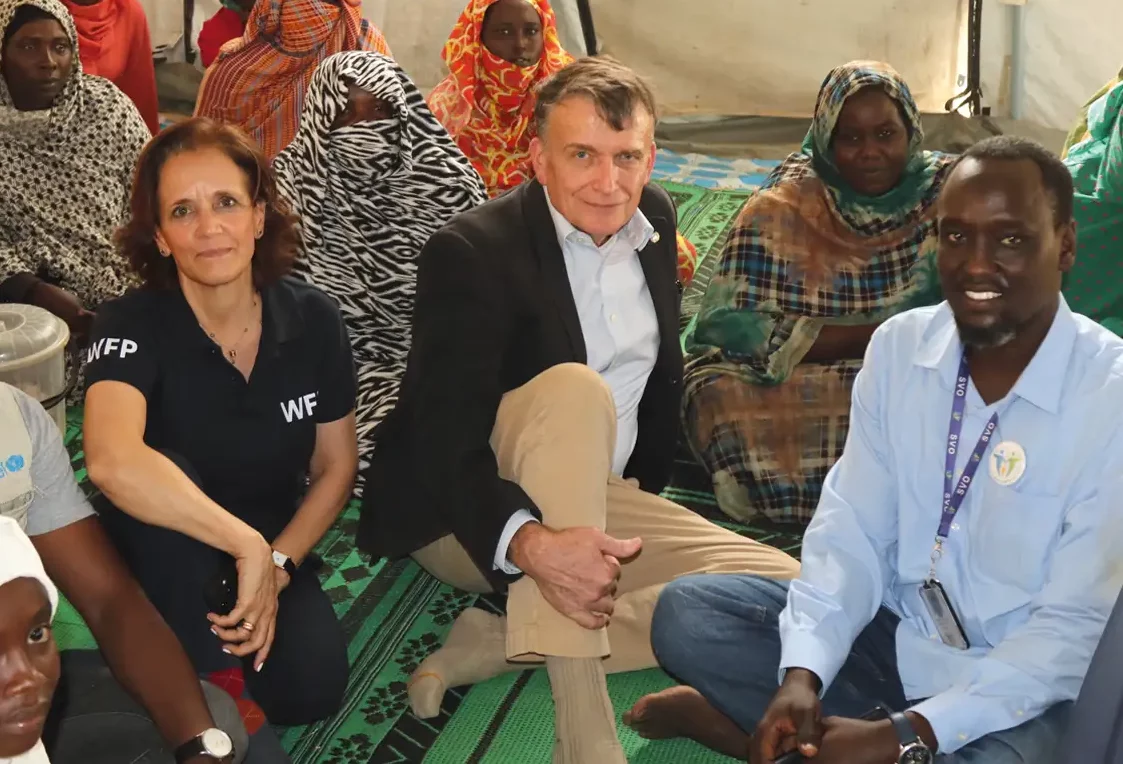
All personnel, in every role and duty station, are accountable for preventing and responding to sexual exploitation and abuse. Ismail Hassan Abakar, Country Director of the Sudan Volunteer Organization reveals how he aims to protect staff and communities from such harm.
Could you tell us about the work of the Sudan Volunteer Organization (SVO)?
The Sudan Volunteer Organization is a refugee-led organization operating in 20 Sudanese refugee camps across eastern Chad. Our mission is to provide diverse forms of support to both refugees and host communities. Guided by our slogan, “Refugee for Refugee,” we have built a network of more than 25,000 Sudanese refugee volunteers. Each volunteer is encouraged to contribute 1,000 XAF per month to assist the most vulnerable refugees—including persons with disabilities, the elderly, and individuals with mental health conditions—living in the camps.
A central part of our work focuses on the prevention of sexual exploitation and abuse (PSEA). We train staff, volunteers, and community members to recognize, report, and prevent SEA; we also conduct awareness sessions, monitor risks, and support survivors through safe and confidential referral pathways. As refugees ourselves, we understand the challenges and sensitivities of our communities. Our work is rooted in empathy, accountability, and mutual trust.
What does a typical day in your role look like?
As Country Director, my days are dedicated to ensuring that protection from sexual exploitation and abuse is more than a policy: it is a daily practice. I am primarily responsible for ensuring that all our programs are safe and free from SEA risks, with mitigation measures in place from the very start of each project, and that all personnel involved in refugee assistance understand the Code of Conduct and uphold the “zero tolerance” policy. Every day, I work with my team to create and maintain a protective environment for the refugees we serve.
My day also includes coordinating with UN agencies, INGOs, and national partners to align our efforts under the inter-agency PSEA network in Chad. As both a trainer and investigator, I mentor staff and volunteers, review case reports, ensure confidentiality, and follow up on recommendations. Every action, no matter how small, contributes to building a safer environment for refugees.
What are the major challenges to protecting communities from SEA, and how do you overcome them?
One of the greatest challenges is changing attitudes and breaking the silence around SEA. In many refugee settings, discussing sexual violence remains taboo. Survivors often fear stigma or retaliation, and some communities lack confidence in the reporting process.
We address this through continuous community engagement and trust-building. We have trained more than 300 refugee leaders, women’s associations, and youth groups to serve as PSEA ambassadors. We have also conducted awareness sessions, reaching over 50,000 refugees, through drama groups performing in local languages, as well as radio programs designed to reach those with limited literacy. However, the sheer scale of the refugee and displaced persons population—which now exceeds two million people—remains one of our biggest challenges.
Another challenge is limited funding. As a refugee-led organization, we operate with modest resources. However, we turn this constraint into an opportunity for innovation by partnering closely with agencies like UNHCR and integrating PSEA into all our work. We are supported by the UN’s Resident Coordinator/Humanitarian Coordinator Circular, a policy that mandates budget lines in every project for four minimum PSEA requirements. Through collaboration, creativity, and the technical support of the PSEA Network, we’ve been able to achieve an impact far beyond our size.
How does the Sudan Volunteer Organization collaborate with the country’s PSEA network, and what achievement are you most proud of?
SVO is an active member of Chad’s inter-agency PSEA Network, contributing to training, joint monitoring, and awareness raising. When cases of sexual exploitation and abuse in Sudanese refugee camps were reported by the Associated Press, we played a frontline role in mobilizing community volunteers and ensuring that refugees were informed of reporting channels and survivor services.
I am most proud of how refugees themselves have become leaders in protection. For example, in three camps, we helped establish women’s associations focused on awareness and referral support. After receiving training from us, their members now lead their own sessions, guide survivors safely through the reporting process, and serve as role models for others. Their courage and leadership prove that when refugees are empowered, they become powerful agents of change.
SVO’s model has since inspired other refugee-led organizations in Chad, showing that safeguarding works best when led from within the community.
If you were granted one wish to strengthen our response to SEA, what would it be?
My wish would be to strengthen the existing national PSEA investigation network in Chad, ensuring it remains survivor-centered and inclusive of refugee-led actors. I also hope for more risk mitigation mechanisms to be led by refugee communities, especially women-led organizations. With sustained technical and financial support, these community-driven structures can make protection efforts more trusted, inclusive, and sustainable.
Why is it important for refugee-led organizations to be involved with PSEA efforts?
Refugee-led organizations bring legitimacy, trust, and cultural understanding that others often lack. We live within the communities we serve; we understand their hopes, fears, and unspoken challenges. When refugees lead protection initiatives, reporting becomes safer, awareness deeper, and prevention more effective. Including refugee voices in PSEA coordination is not just participation: it’s partnership. It helps to ensure that no one seeking protection is harmed by those meant to help them.