


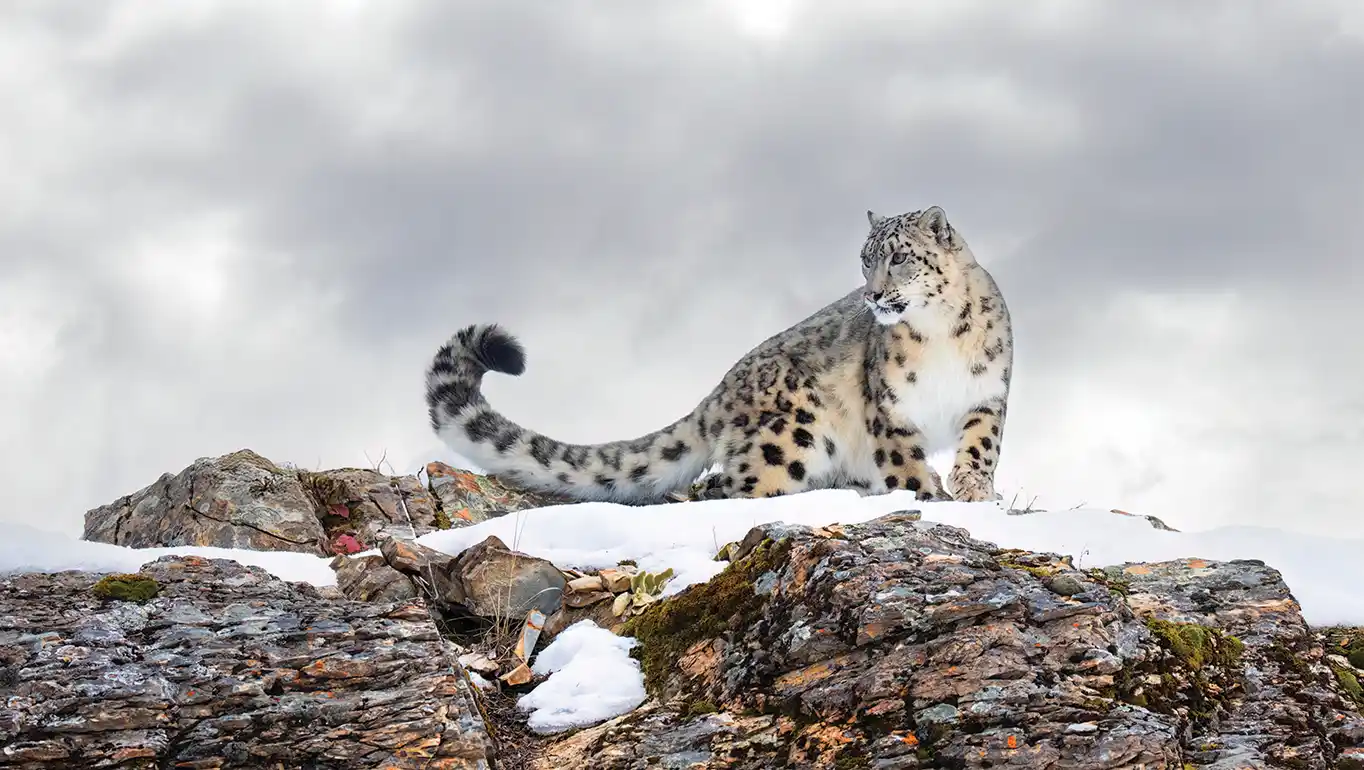
Across the great mountain ranges of Central and South Asia, the snow leopard occupies one of the most spectacular – and formidable – landscapes on Earth. Their range stretches across 12 countries, from the Himalayas and Hindu Kush to the Pamirs, Tian Shan and Altai. Today, the survival of snow leopards is increasingly interconnected with the communities who share these mountain ecosystems. Their future therefore depends not only on conservation, but on partnerships that integrate scientific evidence with local knowledge and experience.
Founded more than 25 years ago, Snow Leopard Conservancy (SLC) grew from the pioneering research of Dr. Rodney Jackson, whose work in the 1980s included the first successful radio-collaring of wild snow leopards. This research brought greater scientific and public attention to a species then known largely through sightings, tracks, and anecdotal accounts. It also pointed toward a broader truth: protecting snow leopards meant protecting the people, wildlife, livestock, and cultures that share their landscape. This vision continues to guide SLC under the leadership of Executive Director Ashleigh Lutz-Nelson, who joined the organization in 2020 and has carried this foundation into a new era, expanding SLC’s community-centered approach through considered partnerships, innovative ideas, and opportunities.
Snow leopard conservation today is shaped by compounding ecological, climatic, and socioeconomic pressures.
The species is classified as Vulnerable, and the exact number remaining in the wild is uncertain. They face retaliatory and preventive killings in response to livestock predation, loss of prey, habitat degradation and fragmentation, poaching, illegal trade, and the effects of climate change. These threats overlap with changing livelihoods, infrastructure, herding systems, and economic pressures in remote mountain populations.
SLC works with partners across snow leopard range countries, offering scientifically informed support shaped by local priorities. Depending on the community, this may involve strengthening livestock enclosures, improving husbandry practices, expanding veterinary care, supporting conservation-compatible livelihoods such as ecotourism, or evolving grazing patterns in areas of frequent predator activity. Determining which approaches will be effective, however, begins with understanding the landscape through the people who know it best. SLC profoundly values this local and indigenous knowledge, integrating it with ecological research to inform conservation planning and decision-making.
In Nepal, these principles are reflected in SLC’s One Health–One Welfare program, implemented in collaboration with International Veterinary Outreach (IVO) and Animal Nepal. In remote mountain regions, veterinary services such as vaccinations, health assessments, and education on disease prevention can improve household resilience while reducing transmissible disease risks and economic vulnerabilities that can intensify human-wildlife conflict.
By supporting the health of livestock and the well-being of the families who depend on them, the program strengthens the conditions for coexistence.
In western Mongolia, SLC and Wildlife Initiative are working with pastoral communities to reduce conflict between people, livestock, and large carnivores. Several families conduct weekly monitoring of snow leopard and wolf activity and livestock losses, while camera traps track wildlife presence and habitat use across the landscape. These data inform practical coexistence measures, including Foxlight predator deterrents, a livestock-free zone around key snow leopard territories, and bell collars designed to reduce encounters between livestock guardian dogs and wildlife.
The Snow Leopard Sisters documentary offers another example of this community-led approach. Centered on the work of SLC’s partner Tshiring Lhamu Lama in Dolpo, Nepal, the initiative combines women’s leadership, predator-proof livestock corrals, deterrent tools, and training for a new generation of stewards. Tshiring’s aim is not only to end retaliatory killing of snow leopards following livestock losses, but also to create professional opportunities that make conservation beneficial to those sharing the landscape.
Elsewhere in Nepal, SLC’s partnership with Upper Karnali Landscape Initiatives (UKALI), led by Rinzin Phunjok Lama, helped conduct the first comprehensive snow leopard population assessment in Namkha Rural Municipality, using 55 camera traps across more than 4,700 trap-days and identifying 25 individual snow leopards—research that contributed to Nepal’s first national population estimate. Beyond monitoring, UKALI utilizes participatory wildlife mapping, engages more than 3,000 students through school eco-clubs, strengthens local research capacity, and supports ecotourism and regionally produced goods.
The snow leopard is a compelling symbol for conservation in 2026 precisely because it cannot be protected in isolation. They embody cultural, spiritual, and symbolic meaning, reminding us that any true attempt to conserve them requires more than documenting their numbers and ecology; it requires understanding the human relationships, histories, and values that surround them. SLC supports this ethos by mobilizing funding, research, technical resources, and international collaboration for communities to implement their own solutions while building long-term trust.
Protecting the “ghost of the mountains” is not only about ensuring that snow leopards remain in the wild. It is about creating the conditions in which people and predators can continue to share the same landscape – and in which both have the opportunity to thrive. This shared future is ultimately the crux of conservation.