


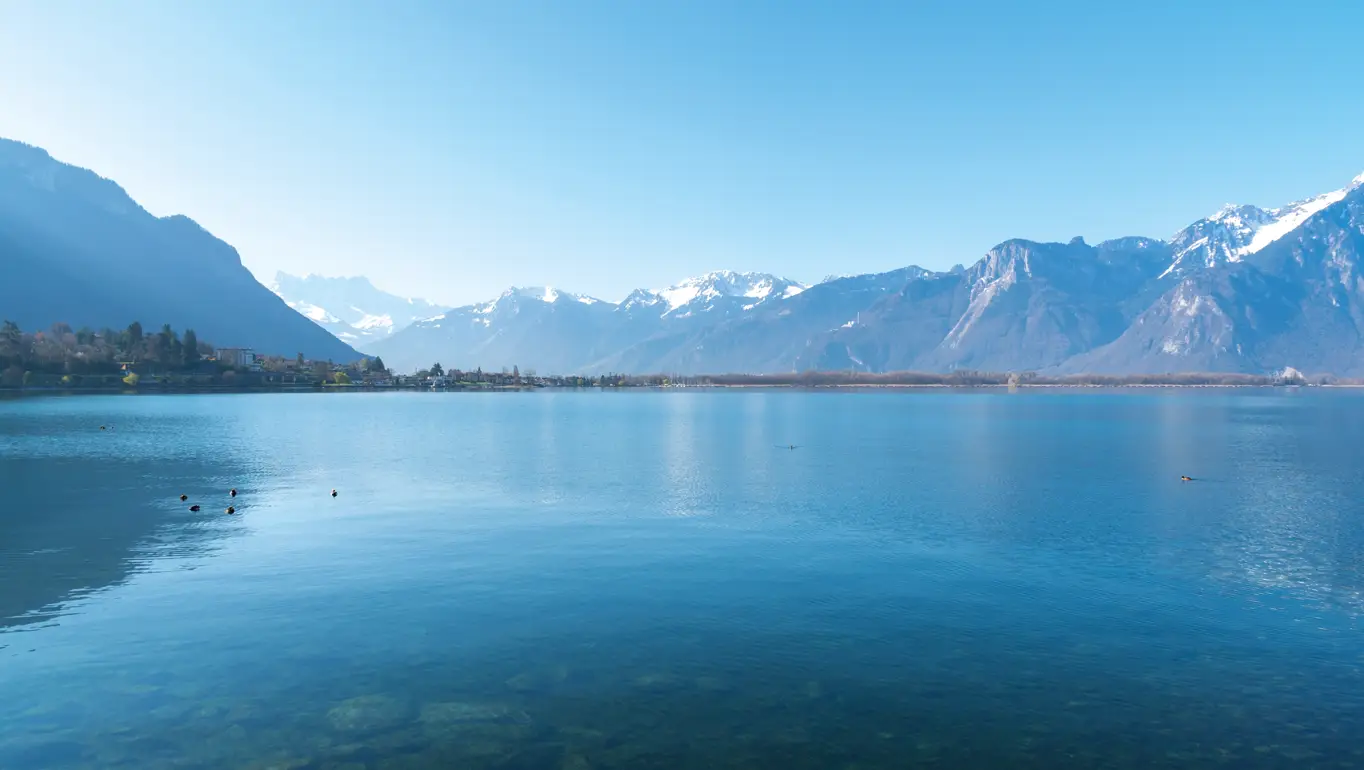
Ask any Genevan resident for a classic local outing and you’re sure to be pointed toward a walk, a tranquil dip, or a simple sit-and-ponder session by the impossibly peaceful waters of Lake Geneva (more often called Lac Léman).
For many of us arriving in this region by air, we are first greeted by the aerial view of the lake’s expansive blue waters as we descend. Being the largest inland lake in Switzerland, Lac Léman is framed between the Swiss alps and wrapped snugly along the French border in its signature crescent shape.
What fascinates me most about this body of water is the spectrum of colours it wears, sometimes in the span of a single day.
As an artist, I’ve photographed these moments many-a-time, entranced by their subtle allure. As a scientist, I can’t help but ask why.
It is widely accepted that oceans and lakes appear blue because they reflect the color of the sky. While this is partly true, it’s more accurate to say that water absorbs longer wavelengths of visible light such as red, orange, yellow, while scattering shorter ones like blue, indigo, and violet. This is what gives oceans, lakes, and seas their varied blue hues.
Alongside this however, variables such as weather, time of day, our viewing point, suspended particles, microscopic organisms, and pollution can all influence the apparent surface color of the water. Depending upon these, Lac Léman’s waters may appear to take on different hues of green, blue, grey and at times, even pink and purple.
The lake’s surface acts as a mirror. On clear days, it gleams vibrant blues, whereas during periods of cloud cover it takes on steelier, grey tones. Some of the most spectacular pinks and oranges I’ve seen shimmering on the lake’s surface have been during high-summer sunsets between June and August. Additionally, atmospheric particles such as smoke, dust, and other forms of aerial pollution may also subtly influence the reflected sky, giving the lake new shades entirely.
Particles suspended in the water after natural weather events also shape its colors. Earthier brown plumes may occasionally emerge with the introduction of silt and clay sediments being carried into the lake by the in-flowing Rhône River after snow melt, or heavy rainfall.
In contrast, a milky blue tint may be more visible closer to the Rhône delta, which is fed by surrounding glaciers. Yet another more apparent influence is one’s viewing point over the lake.
From the shore, the lake’s surface tends to look a more crystalline aquamarine compared to its more opaque, navy depths. This is why Geneva’s waters often look entirely different from Montreux’s.
Of course, we cannot discuss Lac Léman’s vibrant disposition without mentioning its many inhabitants. Besides the numerous species of fish it houses, according to the Association pour la sauvegarde du Léman, approximately 15 different aquatic plants inhabit Lac Léman, as well as several microscopic species of plankton and algae.
While many are native and part of the lake’s natural flora, some species of algae bloom excessively due to nutrient imbalances and phosphorus pollution, mainly from agricultural runoff and waste, contaminating the waters. These blooms can be harmful to wildlife, as well as to local swimmers and visitors. Unfortunately, other forms of anthropogenic pollution also affect the lake’s temperament. Studies mapping plastic pollution in Lac Léman have found it to contain microplastic levels comparable to those found in oceans.
As indulgers of the lake and its many mystical moods, we must find ways to give back to it, or at the very least, avoid causing harm and disturbing its delicate balance. On a more personal note, I turn to the Islamic principle of khilāfa (Arabic for stewardship): the belief that we have been entrusted as caretakers of our environment, and that we should strive to return the benefit we gain from it.
Indeed, Lac Léman is a reflection of the sky, but it also reflects us. I feel it’s a blessing to witness its charm as often as I do. And as I continue to fill my camera roll with perhaps one-too-many photos of its ever-changing face, I’m reminded that awe should come with responsibility. Practically, this could mean fewer plastic wrappings and cigarette butts bobbing in its waters, along with a little more care and kindness towards its gentle tides, and the many curious little creatures that call it home.