


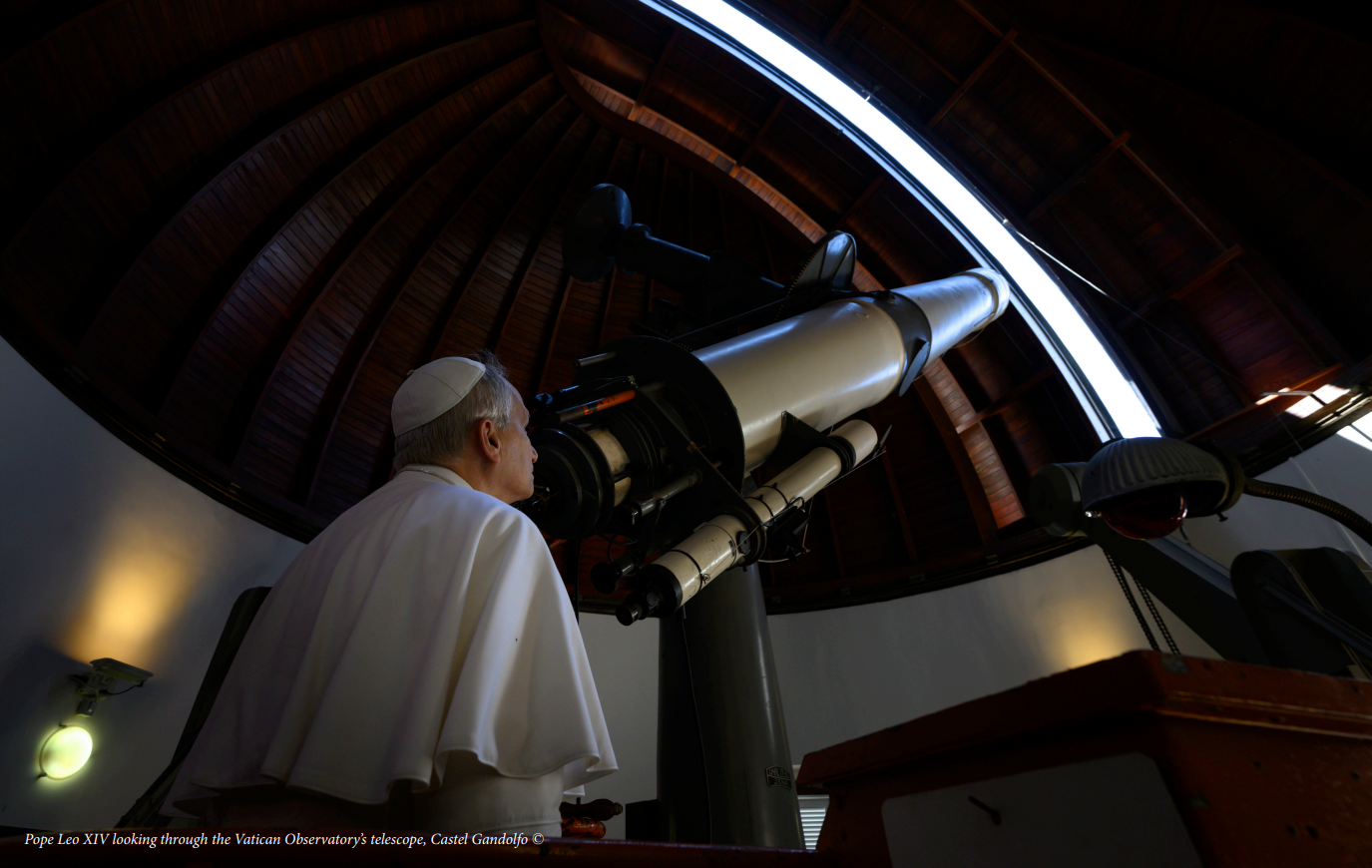
On Friday, 13 February 2026, the Palais des Nations in Geneva will host an important international conversation on the future of humanity beyond Earth. Organized by the Permanent Mission of the Holy See to the United Nations and other International Organizations in Geneva, together with the Caritas in Veritate Foundation, the event titled “Outer Space: A New Frontier of the Common Good” will bring together diplomats, experts, scientists, ethicists, and representatives of civil society to reflect on the ethical, political, and social implications of humanity’s expanding presence in outer space.
Outer space has become a domain of growing strategic importance. It underpins vital aspects of modern life, including global communications, climate and environmental monitoring, disaster prevention, transportation networks, and security-related activities such as arms control verification. Looking ahead, sustained human presence in space could enable access to rare minerals, new sources of energy, and novel environments for data storage and processing. As such, space is no longer a distant frontier reserved for scientific exploration alone; it is rapidly becoming an integral part of global economic and geopolitical systems.
Humanity now stands at a crossroads. More than 12,000 active satellites orbit the Earth, with several thousand more expected to be launched in the coming years. The global “space economy” is projected to reach a value of $1.8 trillion by 2035, driven increasingly by commercial actors alongside traditional state programs. This rapid expansion has led to growing congestion in low-Earth and geostationary orbits, raising concerns about unequal access between industrialized and developing countries, as well as between early entrants and latecomers to space activities. At the same time, the accumulation of space debris threatens the long-term usability of orbital environments, including for scientific research and astronomy.
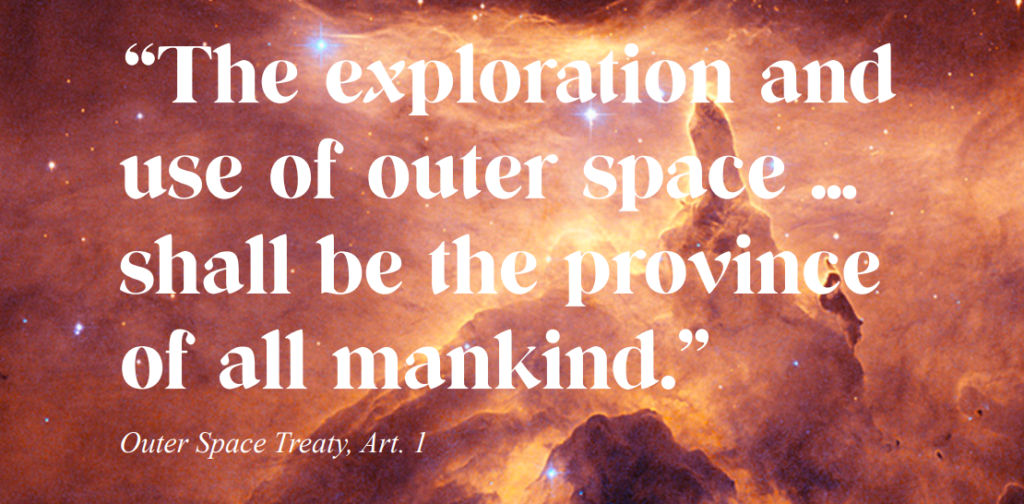
These challenges are compounded by mounting concerns over the potential weaponization of outer space. The risks associated with an arms race beyond Earth underscore the urgent need for collective action, renewed trust, and stronger international cooperation. As discussions continue within the Conference on Disarmament and the Open-ended Working Group on the prevention of an arms race in outer space, the international community is called to reaffirm its commitment to the peaceful use of space as a common good for all humanity. Central to this effort is the 1967 Outer Space Treaty, a landmark legal framework that has guided responsible conduct and “healthy” competition since the dawn of the space age.
The Geneva event seeks to contribute to this global reflection by fostering dialogue between experts in space science, security, ethics, and policy. A panel discussion will explore the moral and political responsibilities associated with human activities in outer space, while a former NASA astronaut will offer a unique personal perspective shaped by months spent aboard the International Space Station and the transformative experience of viewing Earth from orbit.
The event will also mark the presentation of a new publication by the Caritas in Veritate Foundation, “Outer Space and Humanity at a Crossroads: Reflections on a New Frontier of the Common Good.” With a preface by His Eminence Cardinal Pietro Parolin, Secretary of State of His Holiness Pope Leo XIV, and an editorial contribution by Dr. Fabiola Gianotti, Director-General of CERN from 2016 to 2025, the volume examines how ethical principles can and should guide humanity’s expanding footprint in space.
Featuring an introductory keynote by Ms. Doreen Bogdan-Martin, Secretary-General of the International Telecommunication Union, and moderated by H.E. Archbishop Ettore Balestrero, Permanent Observer of the Holy See to the United Nations in Geneva, the event promises a rich and timely exchange. As outer space becomes ever more central to life on Earth, the discussions in Geneva will highlight a crucial question for our time: how to ensure that this new frontier is governed not by rivalry and exclusion, but by cooperation, responsibility, and the pursuit of the common good.