


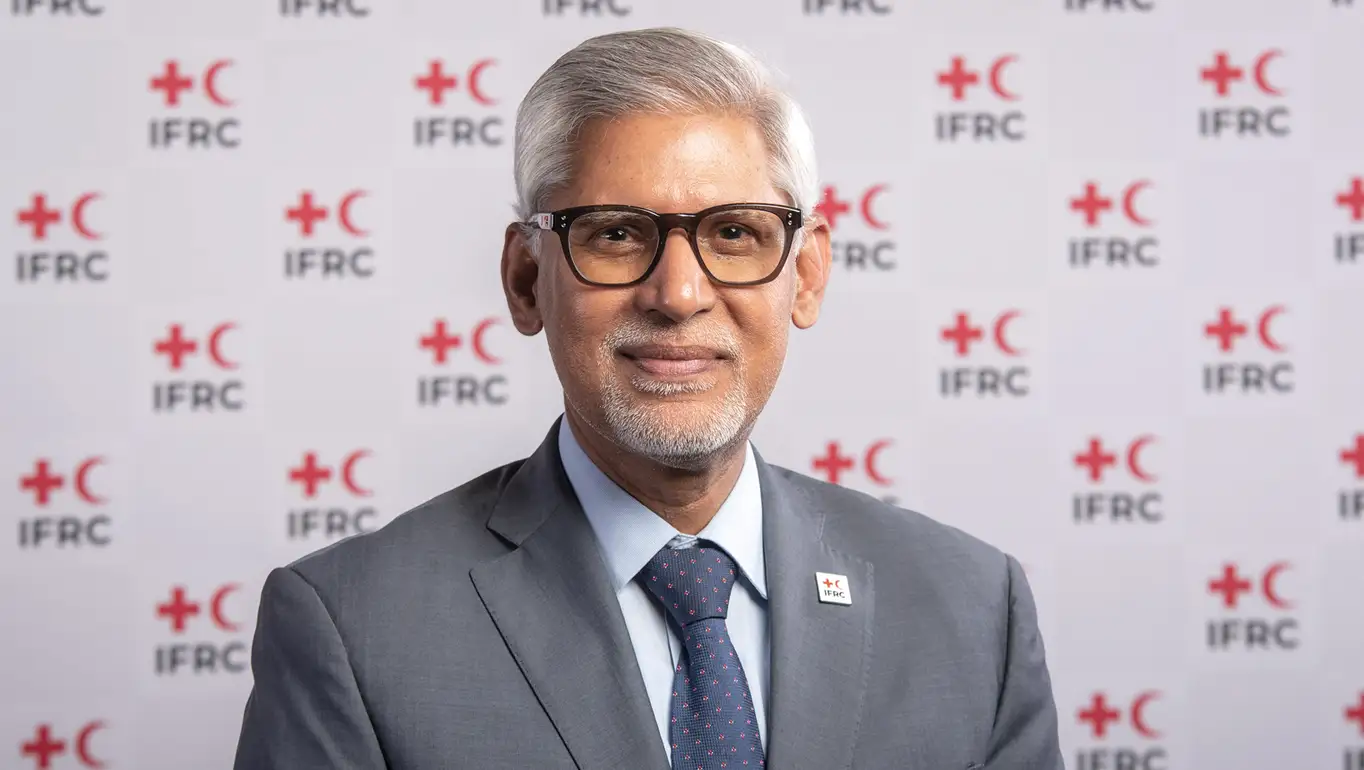
At a time of increasingly complex humanitarian challenges, Secretary General of the International Federation of Red Cross and Red Crescent Societies (IFRC), Jagan Chapagain, stands at the helm of the world’s largest humanitarian networks. Read how he is guiding efforts to deliver timely, principled, and effective assistance across diverse crisis settings.
You’ve led IFRC through overlapping crises: pandemics, conflicts, climate disasters. What kind of leadership do these times demand that traditional humanitarian models didn’t?
Today’s crises are no longer linear. They are interconnected, overlapping, long-lasting, and fast-evolving. This is very different from the more stable and predictable environments that traditional humanitarian models were designed for.
One of the biggest lessons has been the need for highly adaptive leadership. Leaders must respond quickly to constant change and uncertainty. It is also essential to take a systemic view. Issues like climate change, migration, and health crises are not isolated. They are deeply interconnected and must be addressed in that way.
Collaboration is critical. No single organization or government can tackle these challenges alone, so leadership must create space for partnership rather than competition.
At the same time, incremental improvements are no longer enough. With crises multiplying and resources shrinking, humanitarian organizations must be willing to transform and reimagine their approaches.
Digital fluency is another key requirement. With rapid advances in technology and artificial intelligence, leaders must understand and use these tools effectively.
Finally, humility is essential. No one has all the answers in such a fast-changing world. Accepting this allows leaders to collaborate more openly and effectively.
In short, today’s leadership must be adaptive, systemic, collaborative, transformative, digitally fluent, and grounded in humility.
In an increasingly polarized world, how does IFRC maintain trust and neutrality on the ground?
Maintaining trust and neutrality has become significantly more challenging in recent years, particularly as conflicts intensify and polarization grows.
For the IFRC, everything starts with anchoring actions in its fundamental principles: humanity, neutrality, independence, and impartiality.
While some question whether neutrality is still relevant, it is more important than ever. Without it, access to vulnerable communities and the safety of staff and volunteers would be at risk.
Trust is also built through consistency. This means doing what you say and not overpromising. Keeping commitments over time is essential.
Another key factor is localization. Trust is built within communities, not from global headquarters. With millions of volunteers embedded locally, the IFRC relies on these connections to maintain credibility and access.
Transparent communication is equally important, particularly in combating misinformation and disinformation, which can erode trust and undermine humanitarian work.
Finally, the IFRC practices quiet diplomacy. While this approach is sometimes criticized for not being vocal enough, it allows for more effective engagement behind the scenes without adding to already heightened tensions.
Together, these approaches help sustain trust and neutrality in a highly polarized world.
Humanitarian needs are rising faster than funding. Is the current funding model still fit for purpose?
The short answer is no. The current funding model is not fit for purpose, and this has been recognized for some time.
One major issue is that funding is often short-term, tightly earmarked, and reactive. This limits flexibility and reduces impact. In contrast, many crises, especially climate-related ones, are predictable, making pre-arranged and multi-year funding both possible and necessary.
Another challenge is that funding rarely reaches those closest to the crisis. Local organizations, which are often the most effective responders, receive only a small fraction of total funding despite global commitments to increase their share.
The system is also fragmented. Humanitarian, development, and climate funding operate in silos, while communities experience these challenges as interconnected issues.
Additionally, funding flows through multiple intermediaries.
This reduces efficiency and shifts risk downward. By the time resources reach local actors, a significant portion has already been absorbed, while those actors carry the greatest risk.
Solutions are well known. These include more flexible, predictable, and locally directed funding, better integration across sectors, and fewer intermediaries.
There is also a need to move beyond grant-based funding alone. Partnerships with the private sector, innovative financing models, and mechanisms like insurance can all play a role.
Ultimately, the challenge is not a lack of solutions, but a lack of collective resolve to implement them.
As IFRC relies heavily on volunteers, how do you keep younger generations engaged amid burnout and crisis fatigue?
Volunteers are at the heart of the IFRC, both emotionally and economically. Their contribution is immense.
To keep them engaged, the most important factor is impact. Volunteers want to see that their efforts make a real difference. Demonstrating this impact clearly is key to sustaining motivation.
At the same time, organizations must recognize that volunteers themselves need support. The COVID-19 pandemic highlighted the importance of investing in volunteer safety, training, and psychosocial wellbeing.
Burnout is a real risk, especially because volunteers are highly motivated. Strong volunteer management systems are essential to ensure they are protected and supported.
This includes providing safety equipment, offering mental health support, and supporting families of volunteers who lose their lives.
A sense of belonging is also vital. Volunteers should feel they are valued partners, not just a workforce.
For younger generations in particular, purpose matters deeply. Aligning volunteer opportunities with issues they care about, such as climate change, health, and migration, helps maintain engagement.
Ultimately, motivation is not the problem. Support, recognition, and meaningful impact are the keys.
What strategic priorities are guiding IFRC’s evolution in response to increasingly complex emergencies?
One major shift has been moving from reactive response to anticipatory action. With many crises now predictable, investing in preparedness is both more effective and more sustainable.
Closely linked to this is a stronger focus on resilience, helping communities withstand and adapt to shocks rather than repeatedly responding after disasters occur.
The IFRC is also working to integrate climate, health, and migration into a unified approach, reflecting how these challenges intersect in reality.
Another priority is strengthening trust and ensuring respect for humanitarian principles, particularly in a polarized and conflict-affected world.
Localization remains central. Empowering local actors to lead responses ensures more effective and sustainable outcomes.
In parallel, the organization is modernizing its financing approaches, exploring innovative and blended funding models, and engaging more deeply with the private sector.
Finally, digital transformation is a key priority. Ensuring that all parts of the organization can use digital tools effectively is essential to avoid widening inequalities and to respond to modern crises.
Looking back on your journey from your early career to your current role as Secretary General, what values have remained constant in guiding your decisions?
From the very beginning, as a young volunteer, the core belief has been that every person deserves dignity and compassion. This understanding of people has remained a constant guiding principle.
Trust has also been fundamental. It must be earned through integrity and consistent action. Leading with integrity is important, but succeeding with integrity is what truly matters.
Another enduring principle is the importance of adaptability, captured through the idea of listening, learning, and leading. Effective leadership requires the courage to listen, the willingness to learn, and the ability to adapt based on that learning.
These values, dignity, compassion, integrity, and the courage to adapt, have shaped the journey from a young volunteer to a global leadership role, and continue to guide decisions today.