


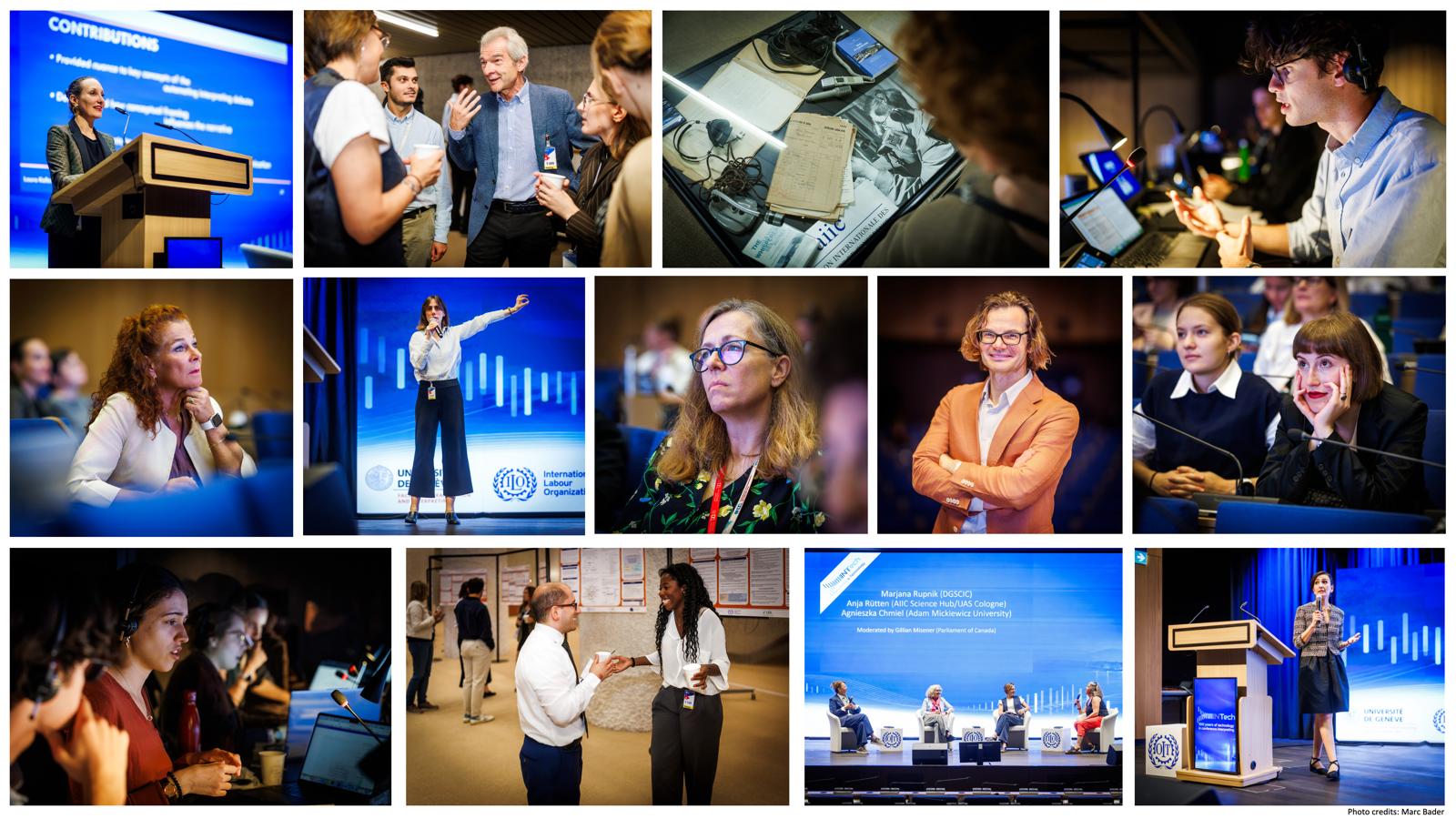
The world of multilateral diplomacy is undergoing a profound transformation, driven by severe financial pressures and shrinking budgets that intensify demands for greater efficiency. At the same time, artificial intelligence is driving technological advances. Automatic speech recognition, combined with machine translation and speech synthesis, promises to make multilingual communication, which to date has been an unavoidable operating expense on most organizations’ balance sheets, more affordable. The undeniable appeal of automating multilingual communication, therefore, extends beyond mere fascination with technological innovation. Yet the discussions at InTTech100, a multi-stakeholder conference co-organized by the University of Geneva’s Faculty of Translation and Interpreting and the International Labour Organization earlier this autumn, reveal a much more complex picture.
The question of whether we can automate multilingual communication is particularly relevant given the financial pressures facing many multilateral institutions, including budget cuts and unpaid contributions. Cost-saving measures have had a direct impact on conference services, leading to restrictions on meeting capacity and the availability of interpreting services. The pressure to sustain international dialogue with fewer resources has therefore created an incentive to explore automated solutions, particularly as conference interpreting services are essential to communication but resource-intensive. This is where systems capable of providing interpretation across multiple languages without placing further demands on language-service staffing may seem to offer a way to square the circle. But do they?
The research presented at InTTech100 provides a useful basis for examining these expectations in light of recent empirical evidence. The latest direct comparisons between human and machine interpreting show that, while the accuracy gap is narrowing, problems with the delivery and reception of machine interpreting persist. Prof. Tomasz Korybski and his team at the University of Warsaw found that errors tend to accumulate across the different stages of machine interpreting systems, which often rely on a sequence of speech recognition, machine translation and speech synthesis. He also concluded that, from the listener’s perspective, long delays, monotonous delivery and unnatural pauses make comprehension difficult. In a comparison of machine interpreting performance across seven languages, meanwhile, Dr. Anne Catherine Giesshoff and her team at the Zurich University of Applied Sciences found stark differences in these systems’ ability to segment speech into meaningful units and produce coherent and comprehensible output. They caution that expanding language coverage and delivering reliable multilingual communication are two distinct achievements, as the former does not necessarily ensure the latter.
These findings are relevant to the debate about automating communication in multilateral diplomacy, where multilingualism is intended to promote participation across linguistic communities. The mere ability to scale automated interpreting across many languages does not automatically (pun intended) mean that all participants will be able to follow an argument, understand its nuances, and thus respond appropriately. Such differences could therefore create new inequalities even as the number of available languages increases. An automated service might preserve the appearance of multilingual access without necessarily preserving its substance.
In a thought-provoking keynote address, Dr. Laura Keller from Digitalethicsdeliberations.com proposed shifting the focus from what technology can accomplish to whether it improves communication, who benefits and who bears responsibility. Research pitting human interpreters against artificial intelligence, she argued, might establish whether human communication can be automated, but would still leave the more important question unanswered: should it be?
Another major direction of technological development has been the effort to integrate artificial intelligence into the conference interpreting workflow, on the premise that technology can alleviate some of the cognitive demands of interpreting. In other words, rather than replacing human interpreters, computer-assisted interpreting tools aim to improve or “augment” interpreters’ performance, for example, by providing real-time prompts or transcripts. Experiments by Dr. Valentina Baselli and her team at IULM University in Milan confirm that such technology can produce measurable improvements, for instance, in the accurate rendering of numbers. At the same time, however, her research also challenges the assumption that more information necessarily leads to better interpreter output, as speech recognition errors can carry over into the interpretation. Interpreters reported feeling less burdened when using technological assistance, although this was not reflected in brainwave measurements. Prof. Anja Rütten and her team at the Cologne University of Applied Sciences found that listeners recalled more when listening to unassisted human interpreters than when listening to interpreters aided by real-time AI tools.
The findings presented at InTTech100 also resonate with the conclusions of Dr. Özüm Arzık Erzurumlu, who illustrated how technology can deliver operational advantages while also creating new demands on those using it. Additional AI assistance does not always reduce cognitive load, just as greater flexibility does not always translate into better working conditions. Consequently, she encouraged interpreters to be techno-curious by engaging with technological developments and helping shape decisions about their use. This involvement appears particularly important when decisions about technology are influenced by budgetary pressures, given that immediate efficiency gains may receive greater attention than long-term consequences for professional expertise and service quality.
The question today is no longer whether technology has a place in multilateral diplomacy, as it has long been integral to it. The question is how that role should be defined. With reduced budgets and constrained conference services, the temptation to treat automation as a substitute for existing communication resources is understandable. There is a danger, however, of creating the misleading expectation that a structural funding problem can be solved primarily through technology. Automated interpreting could well reduce costs and extend access in certain settings, but neither outcome demonstrates that automated interpreting can provide an equivalent or better service in every situation where human interpreting is currently required in multilateral diplomacy. The risk is not simply that machines may make mistakes; after all, human interpreters make mistakes, too. The risk is that cost reductions could be mistaken for efficiency gains without sufficient evidence that the essential functions of multilingual communication have been preserved. If access becomes less reliable and mutual understanding deteriorates, apparent savings may come at the expense of the very participation that multilingual services are intended to enable.
Ultimately, the return on investment of any interpreting technology should be measured not simply by broader language coverage or lower operating costs, but by whether people are able to understand one another effectively and reliably. Distinguishing technological innovation from genuine progress in communication is therefore more important than ever.