


In 2015, an international museum expert visiting Geneva remarked at a conference that the Protestant Reformation remains one of the city’s most significant tourist attractions. Geneva is renowned for hosting the Reformer John Calvin and for igniting a movement that would spread around the world.
This observation echoed what others had recognized a decade earlier. In 2005, the International Museum of the Reformation (IMR) was founded in an 18th-century building constructed on the site of the Cathedral’s former cloister. It was here, by a show of hands, that the people of Geneva officially adopted the Reformation on May 21, 1536, just two months before Calvin arrived.
Since opening, the IMR has enjoyed remarkable success, even though its entrance was, until recently, somewhat discreet and difficult to find. In 2023, the entrance was moved to Cour Saint-Pierre, greatly improving visibility and access. Today, the museum welcomes around 30,000 visitors each year.
The IMR works to preserve the memory of the Reformation, which began in the 16th century. Its founders created a museum that unexpectedly struck a chord with a wide audience, challenging clichés that Protestantism is a faith without tradition, culture, or humor. With 640 works, audiovisual installations, a grand reception hall, and frequent events, the IMR has won over visitors far beyond the Protestant community.
Between 2021 and 2023, the museum was redesigned without compromising its historical identity. A visit now takes visitors on a journey across time and continents. It begins with Martin Luther and John Calvin and, nine rooms later, concludes with Angela Merkel and a Korean pastor. Visitors can still admire the famous Temple of Paradise, the first depiction of a Protestant church, three exceptional portraits by Lucas Cranach the Elder and his son, and an authentic letter by Dietrich Bonhoeffer. New additions include a clandestine Psalter by Luther illustrated by Cranach, a defaced statue of a Bernese bishop vandalised by Protestant iconoclasts, a striking painting by Ferdinand Hodler, and even the steering wheel of a Peugeot, an iconic emblem of a French industrial dynasty with Protestant roots.
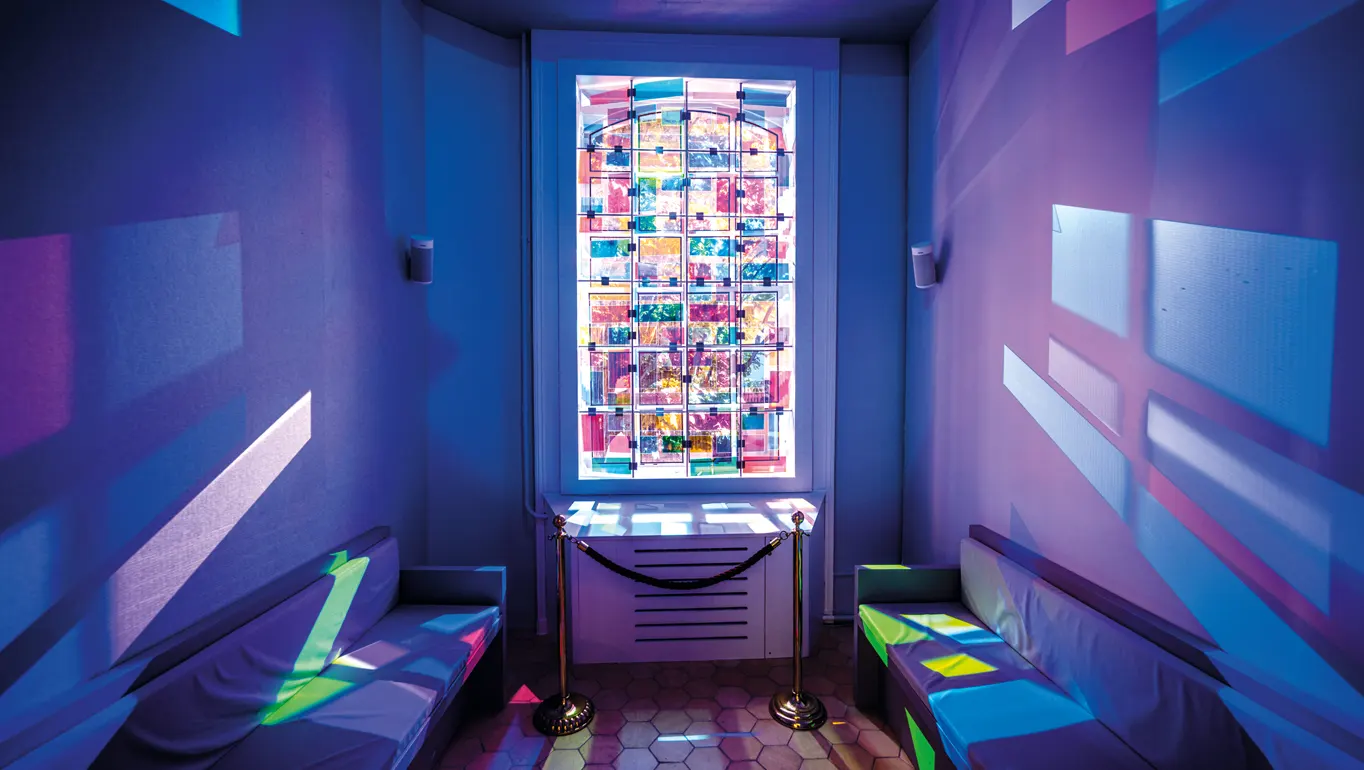
Bright colors now enliven the wood-paneled Mallet House, creating a warm and inviting atmosphere. A large animated map traces the journeys of Pastor Jean de Léry, the passengers of the Mayflower, and Huguenot refugees across oceans and continents. In a music room illuminated by moving stained glass, visitors hear a Hungarian psalm, Aretha Franklin’s gospel, and a blues song by Johnny Cash, while three cinema screens present defining moments of protest: Luther before Charles V in 1520; suffragettes confronting London police in 1910; and climate activists of the 2020s.
In 2024, The Times (London) ranked the IMR among Geneva’s top attractions, praising it as “a secular museum that sheds light on European history through a moving sound-and-light presentation featuring music by the Soweto Gospel Choir and the Dave Brubeck Trio, and an exhibition of 200 Bibles.”
The Bible appears throughout the permanent exhibition. It lies at the heart of the Reformation, which in the 16th century sought to move beyond papal authority by allowing people to test the core teachings of the Old and New Testaments, now translated into languages everyone could understand. Each person, ultimately, is free to believe or not.
This religion of individual freedom gave rise to a remarkable diversity of movements, many of which are presented throughout the museum.
To guide visitors, the IMR provides materials in 14 languages and a tour of 15 works that come to life when viewed with an iPad, an engaging way to grasp the key themes of a complex history.
The IMR is also a museum of art and society, hosting temporary exhibitions linked in some way to the Reformation. In 2024, 70 biblical engravings by Rembrandt drew thousands of visitors, as did an early-2025 exhibition exploring the spiritual inspiration of Art Brut creators. Since 10 September, the museum has turned its focus to the memory of Hiroshima and Nagasaki, destroyed 80 years ago by atomic bombs. The Protestant figure Albert Schweitzer presents these events as a turning point in human history, marking the moment when humanity’s power to destroy itself paradoxically threatened its humanity.
His Nobel Peace Prize acceptance speech from 1954 can be heard at the entrance to the exhibition.
Throughout the galleries, the immediate memory and long-term legacy of the bombings unfold through more than 450 photographs, artefacts, images, artworks, and audiovisual testimonies. The exhibition runs until 1 February 2026.
In the museum’s basement, a gallery dedicated to 21 Protestant figures from the 19th to the 21st centuries includes the Danish philosopher Søren Kierkegaard, who declares: “We must look back, but in such a way that it precisely accelerates our forward movement.” A fitting motto for a museum devoted to history and the society shaped by it.
This article was written in collaboration with the Diplomatic Club of Geneva.
Open daily except Mondays, from 10 a.m. to 5 p.m.
10, Place
Saint-Pierre, 1204, Geneva
www. musee-reforme.ch