


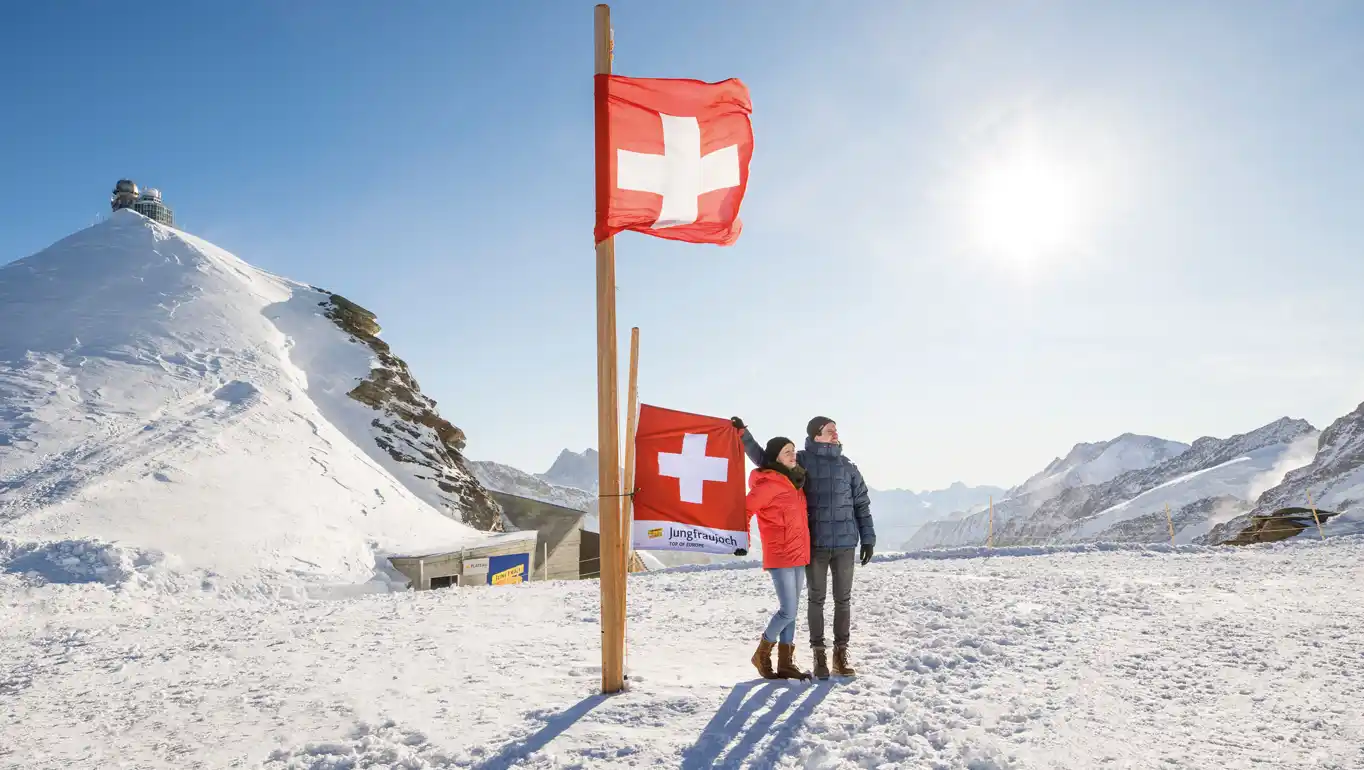
Icy air sweeps over your face, snow crunches underfoot, and the panorama almost takes your breath away. After arriving at the highest-altitude railway station in Europe, you enter a high-alpine wonderland and discover the story behind its development on a multimedia experience tour.
You will find yourself in the middle of the Swiss Alps Jungfrau-Aletsch UNESCO World Heritage Site, surrounded by 4000-meter peaks and eternal snow – even in summer. Standing on the Jungfraujoch at 3,454 meters above sea level, you can feel it with your first step: this is a different world.
It’s one you simply have to experience.
Past the Eiger North Face and through the mountain
The journey to the highest-altitude railway station in Europe is part of the experience. The fastest route begins in Interlaken and leads by rail to Grindelwald Terminal. From there, the Eiger Express reaches Eigergletscher in just 15 minutes, gliding past the world-famous Eiger North Face – the scene of pioneering feats and dramatic moments in mountaineering history, and still a formidable challenge for even the world’s best climbers. With binoculars and a little luck, you might even spot climbers making their way up the face.
At the mountain station, passengers change to the Jungfrau Railway for the final climb through the Eiger and Mönch. The railway has been carrying guests to the Jungfraujoch since 1912 – a pioneering achievement that still feels remarkable today. During the train journey, a short stop at Eismeer station offers a first glimpse through the mountain into the world of eternal ice. It is only a preview of the panorama waiting at the top.
A panorama shaped by ice
An ultrafast lift climbs 108 meters in 25 seconds to the Sphinx observation deck at 3,571 meters. Here, the view opens over the Great Aletsch Glacier, the longest glacier in the Alps, and the surrounding 4000-meter peaks. On clear days, the view extends towards Italy, France and Germany.
The observatory is also an international high-altitude research station – a place where an extraordinary view and scientific work share the same summit.
A few minutes away, the Glacier Plateau brings visitors directly into the snow. The cold air, the silence and the scale of the landscape turn a simple step outside into the defining moment of the trip. At the heart of the Swiss Alps Jungfrau-Aletsch UNESCO World Heritage Site, this is nature on a scale that photographs can only begin to capture.
Inside the glacier – and the story behind the railway
The Discovery Tour reveals another side of the mountain. In the Ice Palace, polished corridors lead through the glacier past sculptures carved from ice. The Alpine Sensation then takes visitors back more than a century, telling the story of the vision, courage and hard work behind the Jungfrau Railway. Light, sound and historic images bring to life the people who made the route through the mountains possible. The experience also commemorates the workers who lost their lives during the construction of the railway.
The 360-degree Jungfrau Panorama adds an all-weather view of the surrounding mountain world, while the digital discovery tour provides stories and background information on visitors’ smartphones. Together, these experiences make the Jungfraujoch more than a viewpoint: it is also a journey into Alpine history, research and the changing world of glaciers.
Snow all year round
While the valleys below are green, the Jungfraujoch offers snow and ice 365 days a year. During the summer season, the Snow Fun Park adds a playful dimension to the high-alpine setting, with a zipline, sledging, tubing, skiing and snowboarding, depending on weather and snow conditions. Afterwards, visitors can warm up over Swiss or international dishes – all served at 3,454 meters.
PLAN YOUR VISIT
Jungfraujoch – Top of Europe is open 365 days a year. Even in summer, temperatures can fall below freezing and the weather can change quickly, so a warm jacket, sturdy footwear, gloves, a hat and sunglasses are essential. A seat reservation secures the preferred connection and is mandatory from 1 May to 31 October 2026. Booking in advance is recommended.