


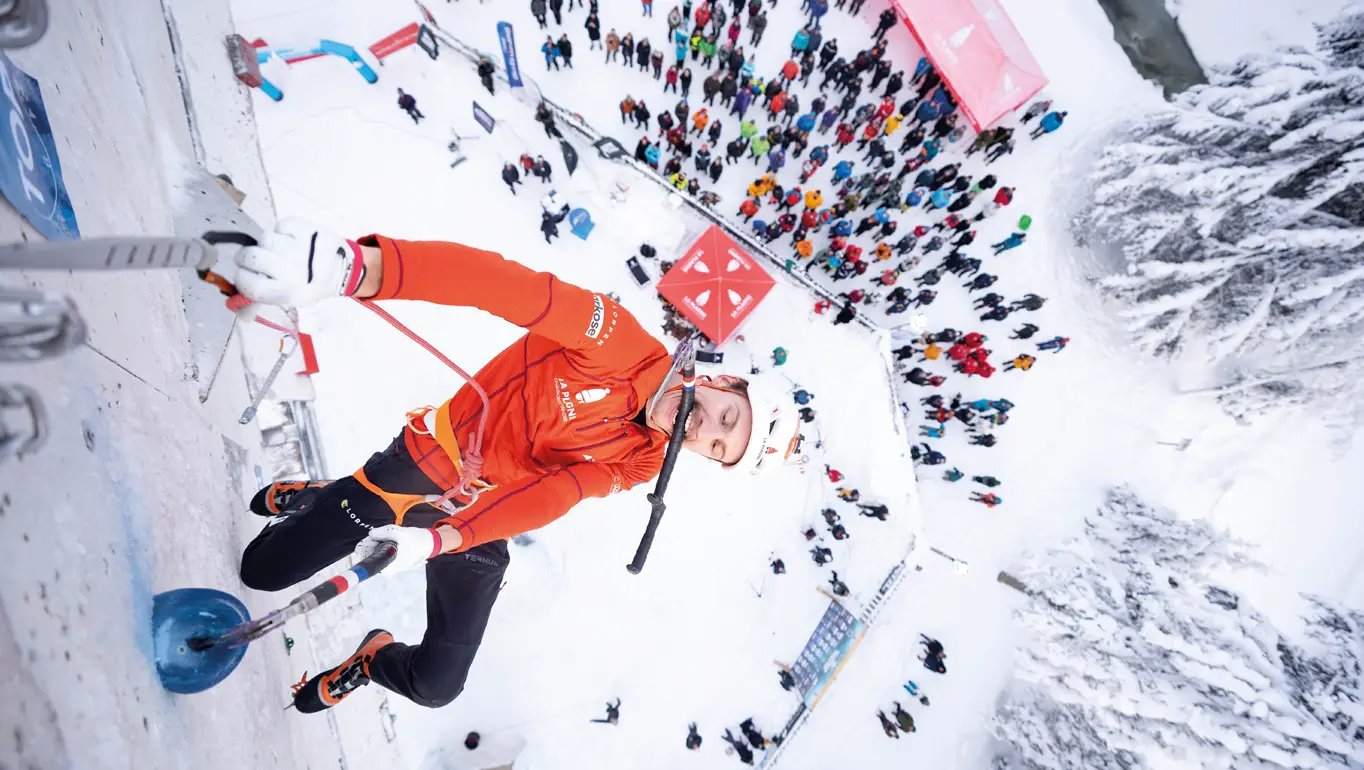
In subzero temperatures with the resident DJ upping the energy, an athlete hangs upside down some 20 meters above the ground from two razor-thin ice axe picks. The crowd holds its breath. One swing. One kick. A controlled explosion of movement. Will they navigate to the next part of the routesetters’ puzzle or fall and face elimination? In competition ice climbing, the margins are minute and the drama intense. Today, it is a global circuit, streamed live to hundreds of thousands of viewers.
The Ice Climbing World Tour is governed by the Union internationale des associations d’alpinisme/International Climbing and Mountaineering Federation (UIAA), supported by the World Ice Climbing Operating Unit. The UIAA has been organizing competitions since the early 2000s.
The UIAA Ice Climbing World Tour is the global circuit for the competitive arm of the sport. The 2025-2026 season is currently underway with the deciding rounds taking place in Colorado, USA and Edmonton, Canada before the end of February.
Some 200 athletes from 25 nations are taking part in the series. The sport stands at a fascinating crossroads: rooted in mountain tradition, sharpened by elite athleticism, and driven by a growing ambition to expand and step onto the Olympic stage for the 2030 Games in the French Alps.
The World Cup events for the current season kicked off in early January.
The first two rounds were in Cheongsong, South Korea, and the World Tour staple of Saas-Fee, in the Swiss Alps.
At each stop, athletes compete in two disciplines, lead (also known as difficulty) and speed, earning points toward the overall World Tour titles.
The format rewards consistency as much as brilliance: climbers must adapt to different structures, route styles, and testing conditions.
What sets the World Tour apart from many winter sports is its intimacy. At some venues spectators stand just meters from the wall, able to hear the scrape of crampons, the sharp crack of picks biting into ice, and the controlled breathing of athletes fighting gravity. It is raw, immediate, and thrillingly human.
The depth of competition has never been stronger. Traditional powerhouses like France, Iran, South Korea, Switzerland, and the United States are joined by emerging nations whose investment in youth pathways and coaching is beginning to pay off. This includes Liechtenstein, Mongolia, Spain, and the United Kingdom.
Roots of the sport
Ice climbing as a competitive pursuit is far older than many people realize. The first recorded ice climbing competition took place in 1912 on the Brenva Glacier in Courmayeur, Italy, an era when axes were heavy, boots were leather, and “competition” was a mere notion. Modern competition ice climbing began to take shape in the late 20th century. During the 1990s, alpinists started testing themselves against one another on purpose-built ice structures, developing alongside sport climbing while retaining the tools and techniques of alpinism. Formal rules emerged in 1998, and by the early 2000s the first international competitions under
UIAA governance were taking place in venues such as Val Daone, Pitztal, Quebec, and Saas-Fee. What began as a European-centered experiment quickly grew into a global circuit. Throughout the past decade there have been numerous competitions in Asia (China, South Korea) as well as across both Canada and the United States.
Crucially, the sport also professionalized. Athletes began training year-round, manufacturers developed specialized equipment, and artificial ice structures allowed competitions to be standardized. Through its international platforms, the UIAA has offered livestreams and video content from competitions.
Lead/difficulty – precision under pressure
The lead (also known as difficulty) discipline is the closest descendant of traditional alpinism. Athletes attempt to climb a complex, overhanging route on an artificial ice structure using ice axes and crampons, clipping quickdraws as they ascend.
Each climber gets one attempt. There are no second chances. Success is measured by the highest point reached on the route, with time used as a tiebreaker when needed.
What makes lead ice climbing so captivating is its blend of power, balance, and creativity. Routes are designed to force athletes into unconventional positions such as figure-four moves, dynamic swings, and precarious hooks on volumes.
Before the final rounds, athletes are given a short observation period to memorize the route. They then head into an isolation tent, unable to watch their competitors. When they step onto the wall, everything comes down to execution under pressure. Lead finals, especially, are slow-burn spectacles.
As climbers inch higher, the tension builds. A medal performance requires a lot of factors to align: preparation, control, finesse and technique.
Speed – no margin for error
If lead is a chess match on ice, speed is a drag race, akin to the 100m sprint in track and field.
Speed ice climbing takes place on a vertical ice wall typically 12 to 15 meters high. Athletes race either against the clock or head-to-head in a knockout duel format. The fastest climber wins.
The margins are brutal. A fraction of a second’s hesitation can mean elimination. There is no room for improvisation, only perfect repetition and explosive movement. Handling sharp tools at such force and speed also requires significant skill.
Speed has its roots in Russia and the former Soviet Union, where rapid ascents of mountain routes were long celebrated. It is the easier discipline in ice climbing to comprehend, instantly understandable even to newcomers. Head-to-head duels are particularly dramatic. Two climbers launch upward simultaneously, picks striking in near-unison, crowds roaring as they race toward the buzzer. It is fast, loud, and unapologetically intense.
2030 Olympic Winter Games ambition
The UIAA is proposing ice climbing’s candidacy as an additional sport for the 2030 Winter Olympics in the French Alps. While final decisions will not be taken by the IOC until June 2026, the UIAA believes that ice climbing has several factors working in its favor. Its President, Peter Muir stated: “In terms of the Olympic Winter Games, we are not in a position to make promises but the World Ice Climbing Board remains in close discussions with the organizers of the 2030 Games in the French Alps. We are continuing to deliver a great UIAA Ice Climbing World Tour and thanks to the professional management, and clear direction within World Ice Climbing, I am confident we will continue to develop competition events as we welcome even more athletes and nations to participate.”
Ice climbing has several factors in its favor – it is visually compelling, has a global appeal with an increasing number of nations joining year on year, and is highly competitive across both the men’s and women’s disciplines. Events are staged in compact and sustainable venues — all key criteria for modern Olympic sports. Furthermore, the French Alps, and specifically the venue of Champagny-en-Vanoise, has been a regular host of UIAA Ice Climbing World Cups for well over a decade.
Historical background and technical information regarding the disciplines is adapted from the UIAA’s PractICE Climbing Guide.
HOW TO FOLLOW THE WORLD CUP
• For each World Cup event, a preview and review press release will be made available. Subscribe here to UIAA ice climbing press releases: bit.ly/3Yn2TyB
• Livestreaming will be made available on the UIAA YouTube channel for all semi-finals and finals, and certain qualification rounds. Watch this here: bit.ly/3N1NmSr
• On UIAA Facebook and Instagram, short-form content such as video clips, behind-the-scenes highlights, livestream updates, podium winner posts, and ‘climbs of the weekend’ clips will be shared.
• Live results are available from the UIAA Results service here: bit.ly/49e1IX7
• The UIAA Ice Climbing website provides full information about each event, including programs and provisional timings. Visit it here: bit.ly/4smtBVD
• Photos from competitions will be available on the UIAA Flickr Channel. A ‘best of’ gallery for media wishing to preview the 2025-2026 season is available here: bit.ly/4qaOsKo