


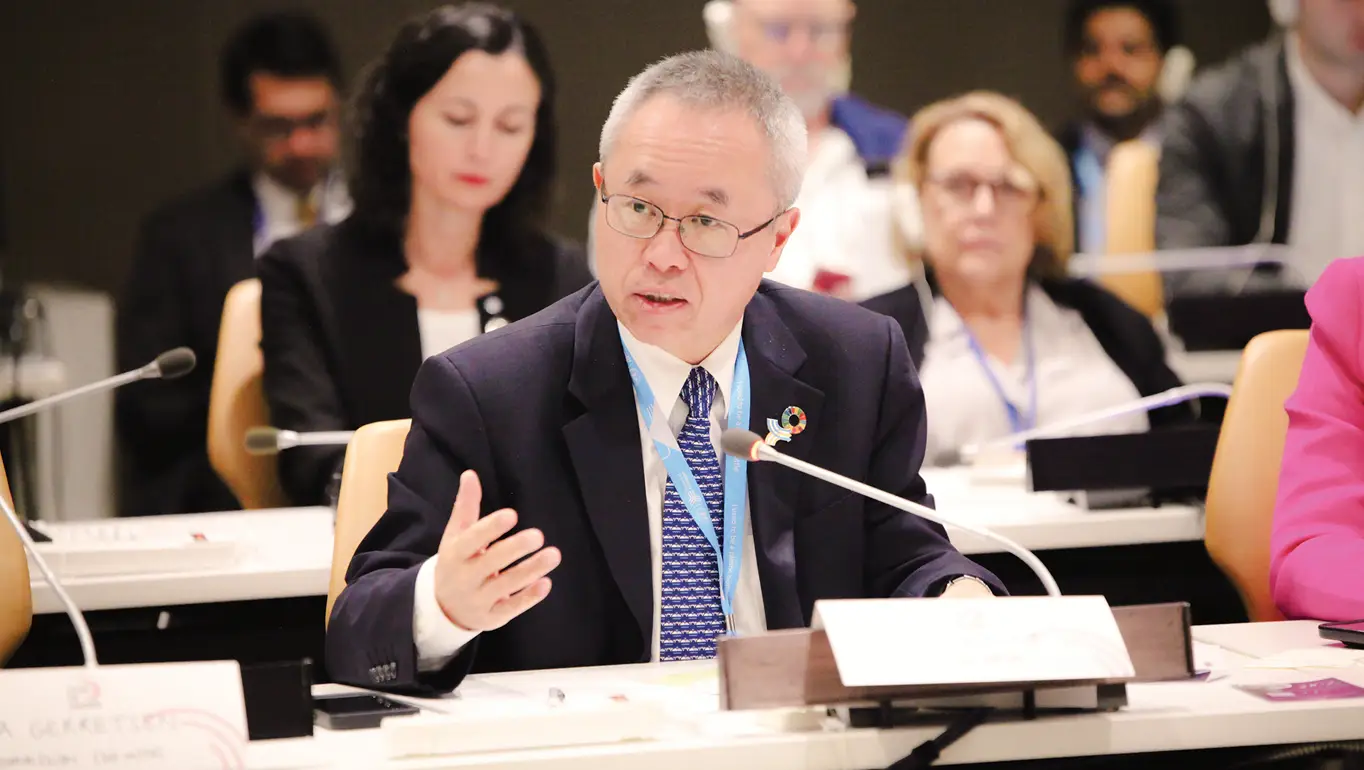
At a time of profound global challenges and rapid change, international cooperation is more important than ever. In this interview, Li Junhua, Under-Secretary-General for Economic and Social Affairs at the United Nations ((who leads the department known as UN DESA), reflects on the evolving global development landscape, the progress and challenges surrounding the Sustainable Development Goals, and the need for stronger collective action to build a more inclusive and sustainable future.
The 2026 High-level Political Forum (HLPF) has been widely regarded as a success. How do you see the HLPF evolving in the years ahead, and how could UN DESA use the Forum to mobilize more financing for development?
The HLPF is the main United Nations platform for central follow-up and review of the 2030 Agenda for Sustainable Development and the SDGs.
At this year’s HLPF, 36 countries presented Voluntary National Reviews (VNRs), bringing the total number presented to 437.
Earlier this year, Member States undertook an extensive review of the HLPF. The resulting General Assembly resolution reinforces the Forum’s role as the central global platform for assessing SDG progress annually and promoting evidence-based, integrated policy action over the four remaining years to 2030. It also encourages countries to make their VNRs more action oriented and focused on delivery, engage a broader range of stakeholders, and showcase progress at the local level.
I therefore see the HLPF evolving into an increasingly action-oriented platform, one that connects national priorities with solutions, partnerships, financing and implementation. Although the HLPF is not itself a financing mechanism, it can help align SDG priorities with the resources needed to deliver results.
As the 2030 Agenda for Sustainable Development approaches its conclusion, what role do you envision for UN DESA in shaping the post-2030 development agenda and when do you expect consultations and intergovernmental negotiations on the new agenda to begin?
At the September 2024 Summit of the Future, Member States agreed that the 2027 SDG Summit would be an important moment to take stock of progress, assess what remains to be done in the final years to 2030, and begin considering what comes next.
As the Secretariat for both the HLPF and the 2027 SDG Summit, UN DESA has a central role in supporting Member States and coordinating the key analytical inputs that will inform their deliberations.
UN DESA will lead or co-lead two major inputs: the Secretary-General’s special edition report on progress towards the SDGs and the Global Sustainable Development Report (GSDR). The Secretary-General’s report will include a dedicated policy section on system-wide lessons from SDG implementation, drawing on recommendations from an inter-agency task force co-led by UN DESA and UNDP. The GSDR, prepared by an Independent Group of Scientists appointed by the Secretary-General and supported by UN DESA, will help guide preparations for the Summit by identifying how integrated and transformative action can be delivered at the speed and scale needed through 2030 and beyond.
UN DESA’s mid-year updates continue to highlight persistent challenges, including slowing growth, inflation, and rising debt. In light of this, how do you assess the global economic outlook for the remainder of 2026 and the prospects for 2027?
The world economy has faced one major shock after another: the COVID-19 pandemic, the war in Ukraine, a prolonged cost-of-living crisis, trade tensions and, most recently, the conflict in the Middle East. Although a severe global downturn has so far been avoided, the effects are clear. Global growth is projected to slow to about 2.5% in 2026, well below the pre-pandemic pace of 3.2%, while inflationary pressures have re-emerged, driven largely by higher energy prices.
For many developing countries, especially fuel- and food-importing economies, the outlook is sobering.
Higher import costs and debt-service burdens are straining budgets and crowding out investment in health, education, infrastructure, and climate resilience. Across much of sub-Saharan Africa, Latin America, and the Caribbean, growth has remained too weak for too long to generate sufficient jobs or meaningful gains in living standards. Continued underinvestment would make it even more difficult to put the SDGs back on track.
UN DESA plays a central role in supporting the Intergovernmental Negotiating Committee on International Tax Cooperation. Looking ahead to the planned adoption of protocols for a global tax framework in 2027, what do you see as the key challenges and opportunities?
A central challenge will be finding common ground among Member States on a Framework Convention that is both ambitious and practical.
Countries enter the negotiations with different tax systems, priorities and capacities. The Convention must reflect those differences while strengthening inclusive and effective international tax cooperation. This means ensuring that all countries can participate meaningfully at every stage, from setting the agenda to negotiating and making decisions.
That challenge is also a major opportunity. The process offers an opportunity to place international tax cooperation on a more equal footing, particularly for developing countries and other countries with limited resources and capacity.
UN DESA will continue to support Member States as they navigate complex technical issues, promote effective participation and maintain coherence across the instruments as the negotiations move towards the submission of final texts in 2027.
Much of UN DESA’s work is ultimately delivered at the country level. Do you see an opportunity for UN DESA to play an even stronger role in supporting UN Country Teams through capacity building, training, and technical assistance?
Yes, definitely. The opportunity lies in how UN DESA, as a non-resident headquarters entity, can bring its distinctive global, normative, analytical and multisectoral expertise into the work of UN Country Teams.
The reform of the Resident Coordinator system and the ongoing reconfiguration of UN Country Teams make this especially timely. UN DESA has a comparative advantage in developing methodologies, analytical models, tools and policy guidance informed by its global perspective. This is supported by its links to intergovernmental processes and its cross-country experience. Resident Coordinators and Country Teams, in turn, are closer to national priorities and implementation realities. A stronger partnership could combine these complementary strengths.
Digital platforms such as the Digital Learning Centre can extend that continuity and reach more countries without requiring a permanent country presence. The UN DESA Digital Social Protection Gateway offers a useful example. It combines self-paced learning with a community of practice, a knowledge repository, and dedicated spaces for country-level and in-person engagement. Given current resource constraints, this partnership-driven, digitally enabled approach is particularly important.
The Joint Knowledge Hubs that my Department is co-leading under UN80 will enable UN Country Teams to draw on the specialized knowledge and expertise from across the UN system, while the UN System Data Commons will provide a unified access point to authoritative data from UN entities across a range of domains. Together, they will significantly strengthen country teams’ analytical capacity and their ability to provide integrated, evidence-based support to governments.