


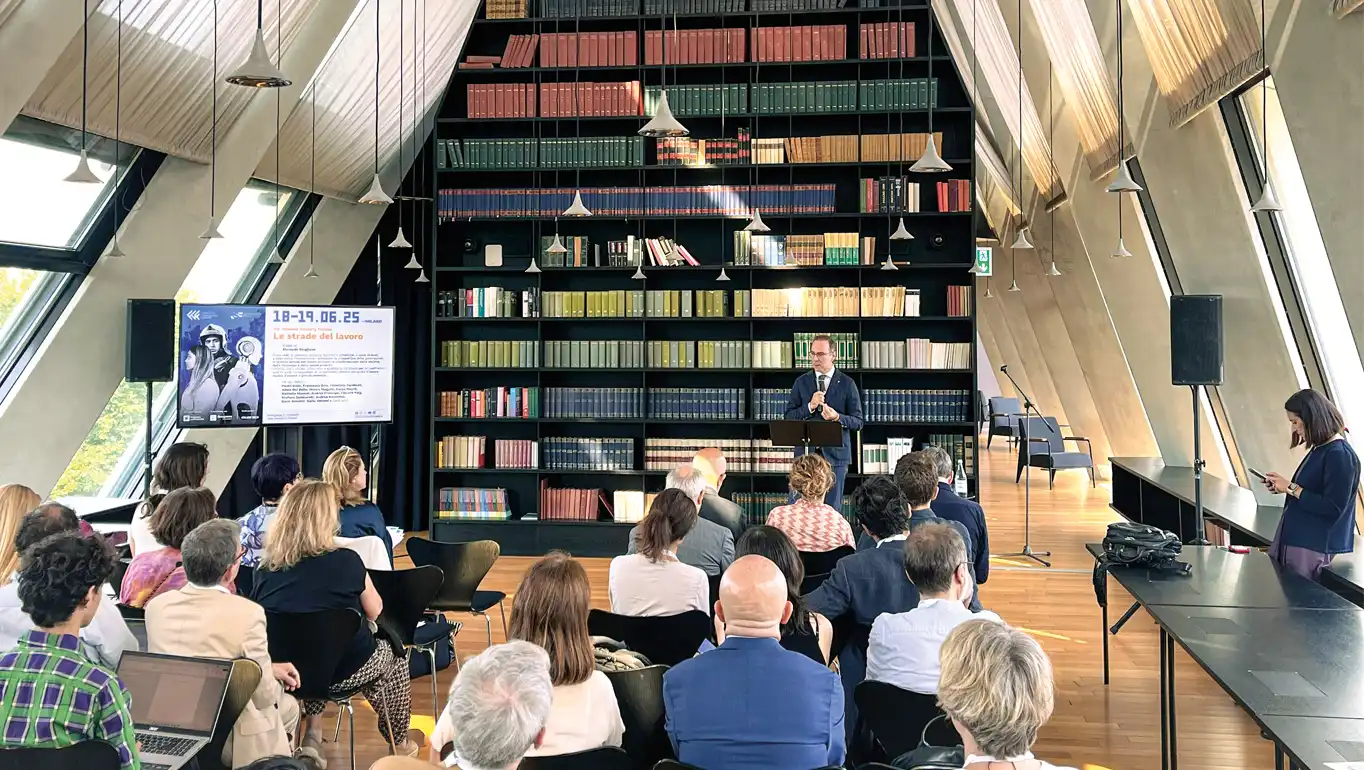
Massimiliano Tarantino has spent over two decades navigating the intersection of institutional communication and public life — from the newsrooms of the Italian press to the corridors of the Scuola Normale Superiore in Pisa, from the corporate communications division of Telecom Italia to the cultural heart of Milan. Since 2013, he has served as Director of Fondazione Giangiacomo Feltrinelli and as Head of Corporate Communications and Sustainability for the Gruppo Feltrinelli, a dual role that places him at the precise point where intellectual heritage meets contemporary relevance.
For Massimiliano Tarantino, the future of cultural institutions depends on a simple but demanding premise: history must never become static. As Director of Fondazione Feltrinelli (an independent cultural and research foundation based in Milan and founded in 1949 by the publisher and intellectual Giangiacomo Feltrinelli), he believes the institution’s greatest responsibility is not merely to preserve its extraordinary archival heritage, but to transform it into a living resource that helps society navigate an increasingly uncertain future.
“The fundamental question that has driven us over the past ten years has been this: how do we give our archival heritage a life that is not confined to a museum, but diffused, critical, and embedded in public discourse?” Tarantino says. “How do we breathe life into history, into the past, into what lies behind us? And what civic responsibility do institutions holding cultural heritage bear, not merely to preserve it, but to make of that heritage a set of traces, of exempla, of stories within which we can construct the future?”
Over the past decade, Fondazione Feltrinelli has embraced digital transformation while resisting the temptation to abandon the importance of physical spaces. At a time when knowledge and human relationships were becoming increasingly dematerialized, the Foundation deliberately reaffirmed the value of place, using technology not as an end in itself but as a means of expanding public access to research.
“The chain, in brief, is: archive, research, content, and digital dissemination,” Tarantino explains. Yet the emergence of artificial intelligence presents a challenge of an entirely different scale. Rather than simply changing how information is distributed, AI raises fundamental questions about whether cultural institutions themselves will remain necessary.
“A profound question mark hangs over cultural institutions, over their purpose, their relevance, and over whether the public may increasingly bypass them altogether,” he says, describing the phenomenon as disintermediation. The central question, he argues, is whether AI will finally accomplish what digital transformation only promised: “the wholesale disintermediation of cultural operators, leaving individuals to navigate their cultural world without editorial guidance, without a compass, with no intermediary other than the algorithm itself.”
Rather than resisting AI, Tarantino believes cultural institutions must learn to work alongside it while safeguarding their authority and public value. “This is the great challenge of our time,” he says. “Meeting it requires competencies we do not yet fully possess, and a genuine complementarity between technical and humanistic knowledge.” The way forward, he argues, lies in “approaching the unknown with intellectual humility, so as to remain genuinely relevant in the future.”
That same spirit of adaptation informs Fondazione Feltrinelli’s identity as what it calls a “civic space,” a meeting point between research, public institutions, and citizens. For Tarantino, this mission demands a fundamental rethink of how culture reaches audiences, particularly younger generations and communities that have traditionally been excluded from cultural life.
“A cultural institution that wishes to be relevant today, and not merely in some crystallized version of the past, must be willing to fill the voids left by politics and to stand alongside it, so that governance may be improved,” he says.
Historically, he argues, cultural organizations operated from a position of authority, creating content and expecting audiences to come to them. “A banquet was laid out, and audiences were required to distinguish and select from what was on offer,” he says. “There is, we must acknowledge honestly, an inherent elitism in this approach.”
Today, that model is no longer sufficient.
“To win the allegiance of marginalized communities and younger generations, we can no longer afford to assume we will be chosen,” Tarantino remarks. “We must instead transform our expertise into products that are genuinely compelling, approaching our work from the perspective of those who, structurally, do not seek us out.”
For him, accessibility is not simply about removing barriers but about building empathy. “It is no longer sufficient to lay the banquet table. We must build empathy between ourselves, our offerings, and those who are meant to engage with them.”
That philosophy has already shaped the Foundation’s work across Italy, taking major intellectual debates beyond traditional cultural centers into communities often overlooked.
“When we have genuinely made this effort, bringing leading intellectuals to the periphery and staging events in Taranto, Naples, L’Aquila, and some of the country’s most vulnerable regions, the response has been extraordinary,” he states.
These same questions underpin the forthcoming ninth edition of the Jobless Society Forum, which will examine AI’s impact on work. Rather than proposing simple solutions, Tarantino insists that the Foundation’s role is to cultivate more sophisticated questions.
Recalling the legacy of the Foundation’s honorary president, the late political philosopher Salvatore Veca, he explains, “Our method is this: place a question mark at the end of a statement. It changes everything.”
Complex challenges, he argues, cannot be understood through a single discipline. “Every phenomenon has a history. Every phenomenon has an impact on society. Every phenomenon transforms the human being.”
The Foundation hopes its work on AI and labor will reinforce its identity as what Tarantino describes as “an anti-inertial institution,” one that encourages governments, businesses, and educators to confront technological change without either romanticizing or rejecting it.
“A Luddite posture toward artificial intelligence serves no purpose,” he insists, adding that “the predominantly censorial approach adopted by the European Union is, in all likelihood, equally ineffective.”
Instead, he believes policymakers must confront both the concentration of technological power and the geopolitical transformations that AI is accelerating. The defining question, he suggests, remains unanswered: “Will those who hold this technology behave as techno-feudal lords, controlling and subjugating others, or as agents of collective research and innovation, capable of generating shared development for the planet? We do not yet have that answer.”
Throughout the Foundation’s work, however, one concern remains constant: ensuring that the costs of technological transformation are not borne solely by workers.
“Is it truly acceptable that the entire burden of this transformation should fall on the individual worker?” Tarantino asks. “That the imperative to retrain, to adapt, and to absorb the disruptions these processes generate should rest on the worker alone, rather than on businesses and, above all, on public institutions?”
Ultimately, he believes AI must be understood not simply as a technological revolution but as a cultural one. Cultural foundations, civil society organizations, and international institutions all have a role to play in helping citizens understand the profound changes reshaping society.
Tarantino hopes that “these sweeping technological transformations are treated not merely as a technical matter, but as a profound cultural one.” Citizens, he argues, must develop genuine literacy around AI and its implications, enabling them to understand “the relationship between the individual, the worker, and the forces of transformation, so that these changes may be experienced not as a source of trauma, but as an opportunity for individual and collective growth.”