


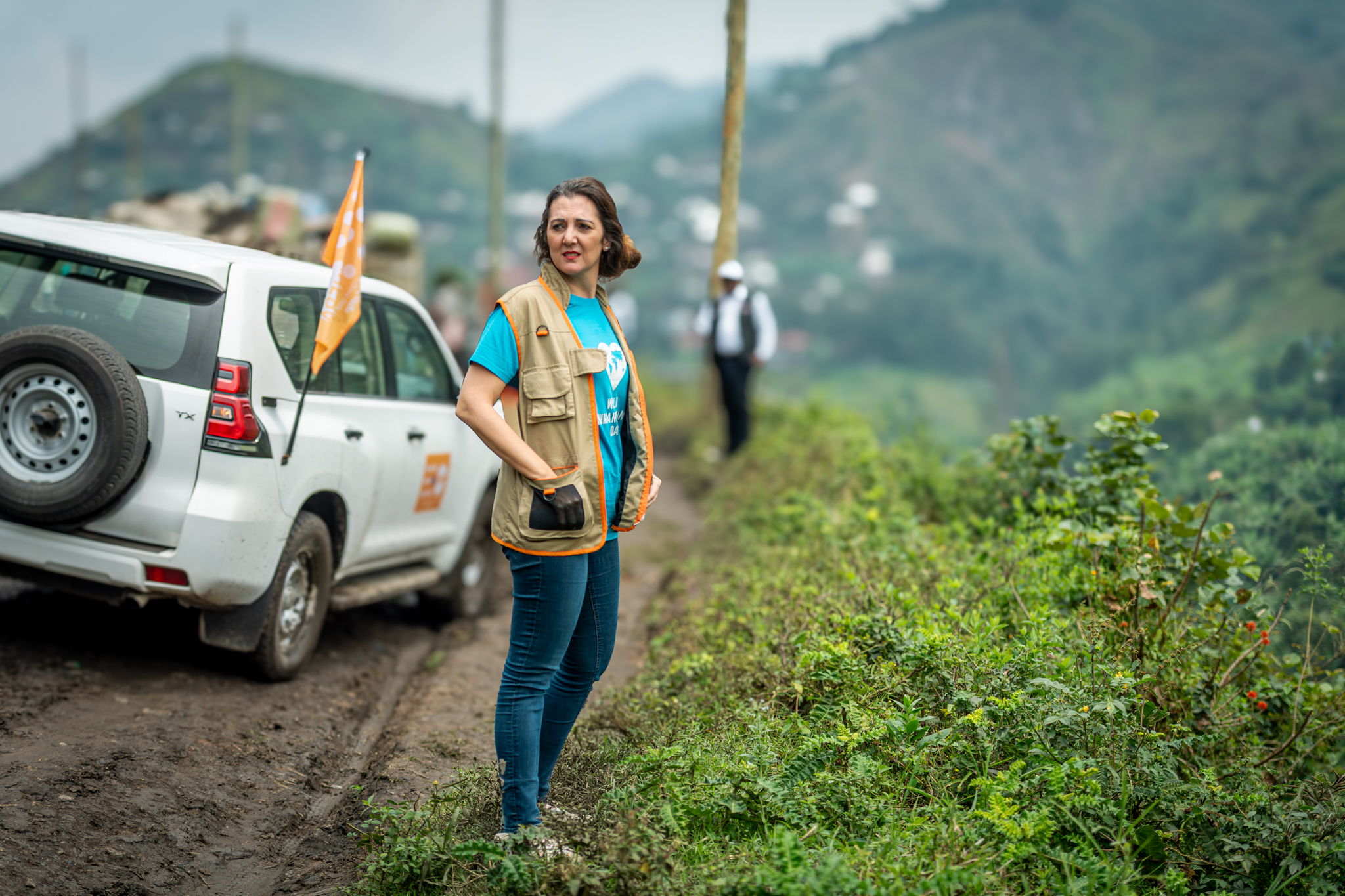
For nearly three decades, conflict-related sexual violence has profoundly affected communities in eastern DRC. In response, national institutions, local organizations and UN partners have developed approaches combining prevention, protection, survivor support, access to justice and reparations.
During her stay in Geneva, Dalmonte took part in a side event at the 63rd session of the Human Rights Council, alongside Congolese Minister of Human Rights Samuel Mbemba Kabuya. Organized by the Ministry, the meeting sought to raise awareness of the International Alliance for Preventing Sexual Violence in Conflict (PSVI) and highlight the DRC’s role as the Alliance’s 2026 president.
Drawing on almost two decades of work addressing gender-based violence, Dalmonte explains in this interview how Congolese authorities, local organizations and United Nations partners have developed approaches rooted in local realities, from community-based protection mechanisms and “one-stop centers” to support for children born of sexual violence and new approaches to reparations.
Drawing on its long experience in addressing conflict-related sexual violence, what are some of the main practices the DRC has developed on the ground?
The DRC was one of the first countries to experiment with joint United Nations programming on sexual violence. As early as 2002, a first joint program was launched, implemented by the United Nations Population Fund (UNFPA) with funding from Belgium. Over the years, the Office of the United Nations High Commissioner for Human Rights, the United Nations Children’s Fund (UNICEF), the United Nations Development Programme (UNDP), UN Women and other United Nations agencies progressively joined these efforts.
This long experience has made it possible to test different approaches to prevention and community-based protection. In some conflict-affected areas, efforts rely on local protection committees. In others, women’s organizations play a central role. Being close to the communities, they have a particularly good understanding of the risks faced by women and can help identify responses adapted to local realities.
How can protection mechanisms be tailored to local realities and the specific risks faced by women and girls?
Protection mechanisms must start from local realities. In Goma, the capital of North Kivu, for example, organizations mapped the routes used by women to collect firewood. Based on this assessment, they engaged in dialogue with municipal authorities to improve lighting in certain neighborhoods, organize travel in groups and identify safer times for travel. These measures are sometimes very simple. But when they are adapted to realities on the ground, they can have a concrete impact on the safety of women and girls.
What role do local organizations and communities play in preventing violence and strengthening the protection of women and girls in conflict-affected areas?
Community-based protection is no longer limited to responding after violence has occurred. It also aims to anticipate risks and develop solutions together with the populations concerned. Local organizations play a key role, particularly in dialogue with armed groups, by reminding them of their obligations under international humanitarian law and negotiating the access required to provide assistance to women and girls.
The United Nations must support and protect these frontline actors, whose expertise is essential in areas where international organizations cannot intervene directly. Communities themselves are also changing. In several regions, men are now taking part in tasks that were previously considered exclusively women’s responsibilities. This evolution strengthens both women’s empowerment and collective protection.
The “one-stop center” model has become an important approach to supporting survivors of sexual violence in the DRC. How does it work, and what does it offer survivors?
What is also referred to as a “one-stop center” brings together in one location the main services a survivor may need: medical care, psychosocial support, legal assistance and socio-economic support.
The aim is to provide survivors with a streamlined pathway to care, without requiring them to travel from one service to another or repeatedly recount their experience. In the DRC, Panzi Hospital in Bukavu, the capital of South Kivu, played a major role in making this approach an international reference for responding to survivors of sexual violence, before it was subsequently developed with various partners.
Other mechanisms complement this approach. In humanitarian settings, safe spaces for women and girls provide psychosocial support, activities and spaces for healing. They are an essential entry point for women and girls who cannot or do not wish to leave their homes immediately.
How should the needs of children born of sexual violence be addressed, alongside those of their mothers?
Support cannot stop with the survivor; it must also include the child and the relationship between mother and child. Some women choose to keep a child born of rape, but may subsequently experience great difficulty accepting the child because the child can revive memories of the violence or remind them that he or she was born as a result of an assault by the perpetrator.
Support must therefore address both mother and child, sometimes from the earliest years of the child’s life. In this context, I like to speak of “children of resilience”. The expression reminds us that these children should not be defined by the circumstances of their birth, but should be given the opportunity to build their own future.
Access to safe abortion must also be addressed. The Maputo Protocol (Article 14 of the Protocol to the African Charter on Human and Peoples’ Rights on the Rights of Women in Africa, adopted by the African Union in 2003 and entering into force in 2005) and Congolese legislation allow for safe abortion when a pregnancy results from rape. On the ground, however, services are not always available and information does not necessarily reach women in time.
Established by law in 2022, the National Fund for Reparations for Victims (FONAREV) is a distinctive Congolese mechanism for addressing the legacy of conflict-related violence. What makes its approach to reparations different from traditional models?
Whereas reparative justice often comes years after conflicts have ended, FONAREV changes the equation by providing an immediate administrative response to victims of conflict-related sexual violence and other serious crimes, without waiting for judicial proceedings to conclude. For some survivors, this support provides an initial, tangible form of relief.
Another highly symbolic feature of this model is that part of the Fund’s financing comes from mining royalties (11%), in a country where the exploitation of natural resources has been closely linked to conflict and serious human rights violations.
Reparation, however, is not limited to financial compensation. FONAREV’s primary mandate is to identify victims of conflict-related sexual violence and crimes against peace and human security, support victims, finance collective reparations and contribute to preserving memory. Recognizing crimes, supporting those affected and preserving their memory are all essential pillars of the reparations process.
The Congolese Minister of Human Rights has identified strengthening the visibility of the PSVI Alliance and broadening its membership as priorities for the 2026 presidency. Drawing on the DRC’s experience, what can it contribute to the Alliance?
The Congolese presidency can give renewed momentum to the PSVI Alliance by highlighting the lessons learned from several years of action on the ground. The Alliance’s four priorities, justice and the fight against impunity, prevention, support for survivors, and coordination, directly correspond to the areas in which the DRC has developed substantial experience in addressing conflict-related sexual violence.
It also provides a framework for coordinating efforts, sharing tools and strengthening practices, particularly in the documentation of cases and the collection of forensic evidence.
For the DRC, this presidency is therefore an opportunity to showcase this experience and foster new cooperation among States, with one central imperative: to place survivors, their needs and their dignity at the heart of every action.