


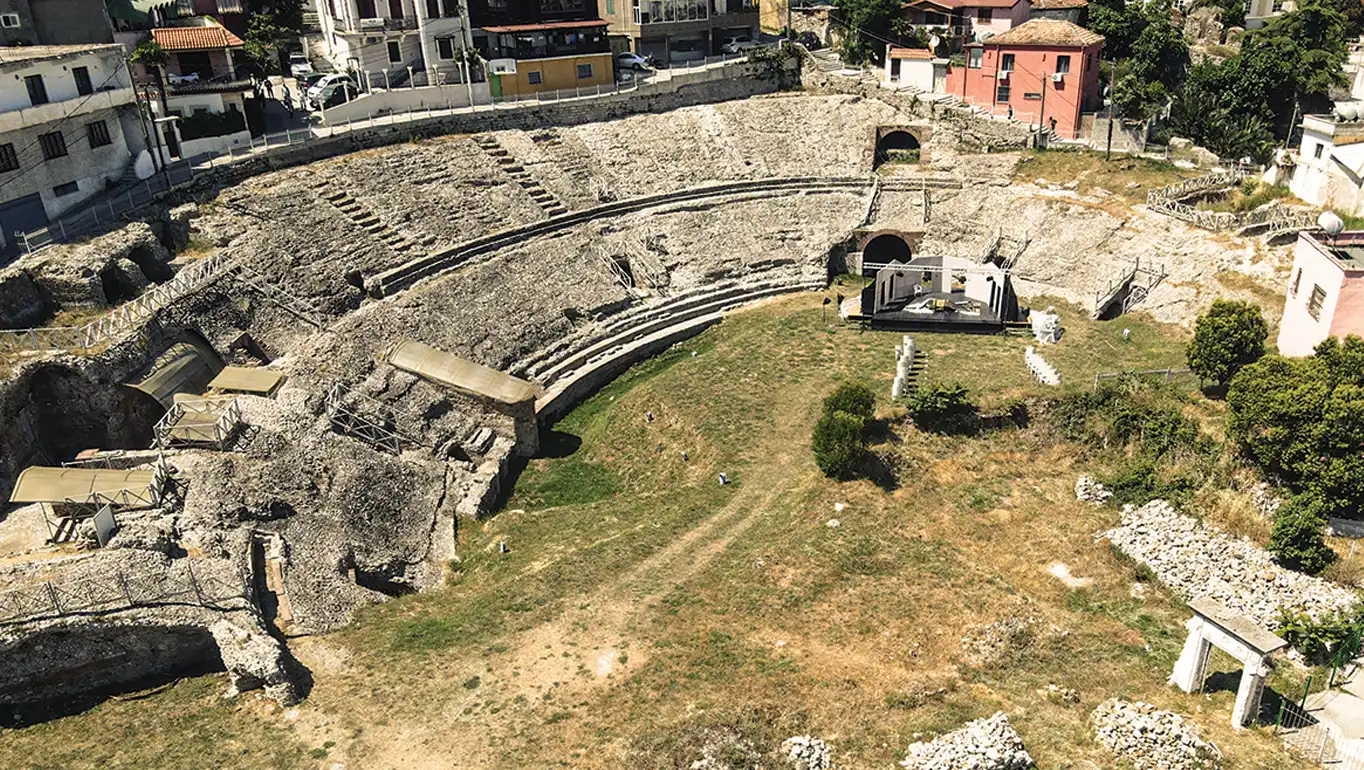
History is, and will remain, a gem that is uncovered by the dust of time. Through the careful work of those that live to see it come to light, each nation learns more of what happened to those that walked before them. The story of Durrës’ amphitheater discovery is as remarkable as the structure itself.
The discovery of the Amphitheater
In 1966, archaeologist Vangjel Toci stumbled upon it after a fig tree collapsed near the Durrës Castle, revealing the ancient ruins. Initially, its purpose was unclear, but further excavation confirmed it as one of the largest amphitheaters in the Balkans.
Dr. Elida Miraj joined the excavation efforts in 1983, continuing her work until the year 2000. She described the discovery as a “pleasant surprise,” a testament to the unexpected treasures hidden beneath the streets of Durrës.
The amphitheater, measuring 126 by 106 meters, reflects the Roman preference for northern-southern urban planning. Its design aligns with nearby Roman structures, such as the water thermae in whose side lays a road leading to the north. A gallery in the amphitheater, dug like a tunnel, possesses the same direction. Its purpose, however, remains a mystery, though its orientation is consistent with Roman architectural practices.
During the Ottoman period, the amphitheater was buried under layers of earth as the Ottomans constructed the defensive walls, a part of which still stands near the amphitheater. Dr. Miraj explained in our conversation that the Ottomans avoided the sea, building walls that separated the city from the coastline. By the 16th century, the amphitheater was completely hidden, only to be rediscovered centuries later.
Unearthing the past: key findings
Dr. Miraj’s research has uncovered significant archaeological and historical findings, including an ossarium in a sealed gallery of the amphitheater. This repurpose of the place occurred after 345 AD, when the amphitheater was slowly abandoned due to an earthquake. By the late 4th century, a Byzantine chapel was built nearby using repurposed amphitheater stones, reflecting Durrës’ economic decline. Initially adorned with frescoes, the chapel was later embellished with 6th-century mosaics. Beneath these mosaics laid an earlier layer of frescoes, though their details are obscured by time and burial.
The amphitheater then became a burial ground, and by the fifth century, overcrowding led to older remains being moved to the ossarium, which contained 40 skeletons that were studied by Aleksander Dhimaj. Graves in surrounding galleries further highlight the site’s transformation into a sacred space.
The mosaics within the chapel are particularly noteworthy. They depict Saint Stephen, two angels, and what are believed to be the donors of the mosaic underneath them. Speculations have been made that one of the figures might represent a human form, and not a holy figure. However, Dr. Miraj emphasized the importance of concrete evidence in historical interpretation, an avid supporter of not telling history through “what ifs.”
A third mosaic, which once depicted multiple figures, has suffered significant damage over time, with many of its tesserae lost. This one portrayed a large central figure flanked by two angels and two haloed female figures with the written inscriptions of Peace on the left and Wisdom on the right. The technique used in these mosaics suggests a later period of creation, characterized by larger tesserae.
In 1986, another chapel was discovered on the opposite side of the amphitheater. This chapel, accessed through a well-like entrance, contained 13th-century frescoes depicting Saint Mary and the Archangel Gabriel. Tragically, these frescoes were damaged due to an unfortunate accident, thus ruining the high quality and beautiful artwork.
Challenges and hope for the future
Despite its historical significance, the amphitheater faces preservation challenges. In 2013, Europa Nostra identified the amphitheater as one of Europe’s most endangered heritage sites. Dr. Miraj shares a positive outlook, however, despite the bleak state of current research being committed.
There have been previous attempts at igniting social interest through cultural events organized in these heritage sites. The Byzantine tower (or as the locals call it, Torra), with surprisingly incredible acoustics, once hosted a memorable concert in 1989 organized by the great Mojkom Zeqo, featuring the music of Jan Kukuzeli, a renowned Byzantine composer born in Durrës. This event demonstrated the site’s potential as a venue for cultural events, blending history with contemporary use. Something similar has happened more than once within the amphitheater too, as the city continues to be familiar with concerts held within the monument.
The potential of a cultural revival remains laying in the grounds of the amphitheater, unhidden and willing to be embraced by those that aim to keep the flame of history alive. History is the future waiting to be discovered with the same desire as the past. Durrës’ amphitheater stands as a symbol of resilience, a testament to the city’s ability to rise from its ruins. While it is too early to consider the present of the city as a time to speak of, one can admit that it is a time which holds immense potential for the future. With dedicated efforts, the city’s rich history can continue to inspire and educate, ensuring that the legacy of Durrës endures for generations to come.