


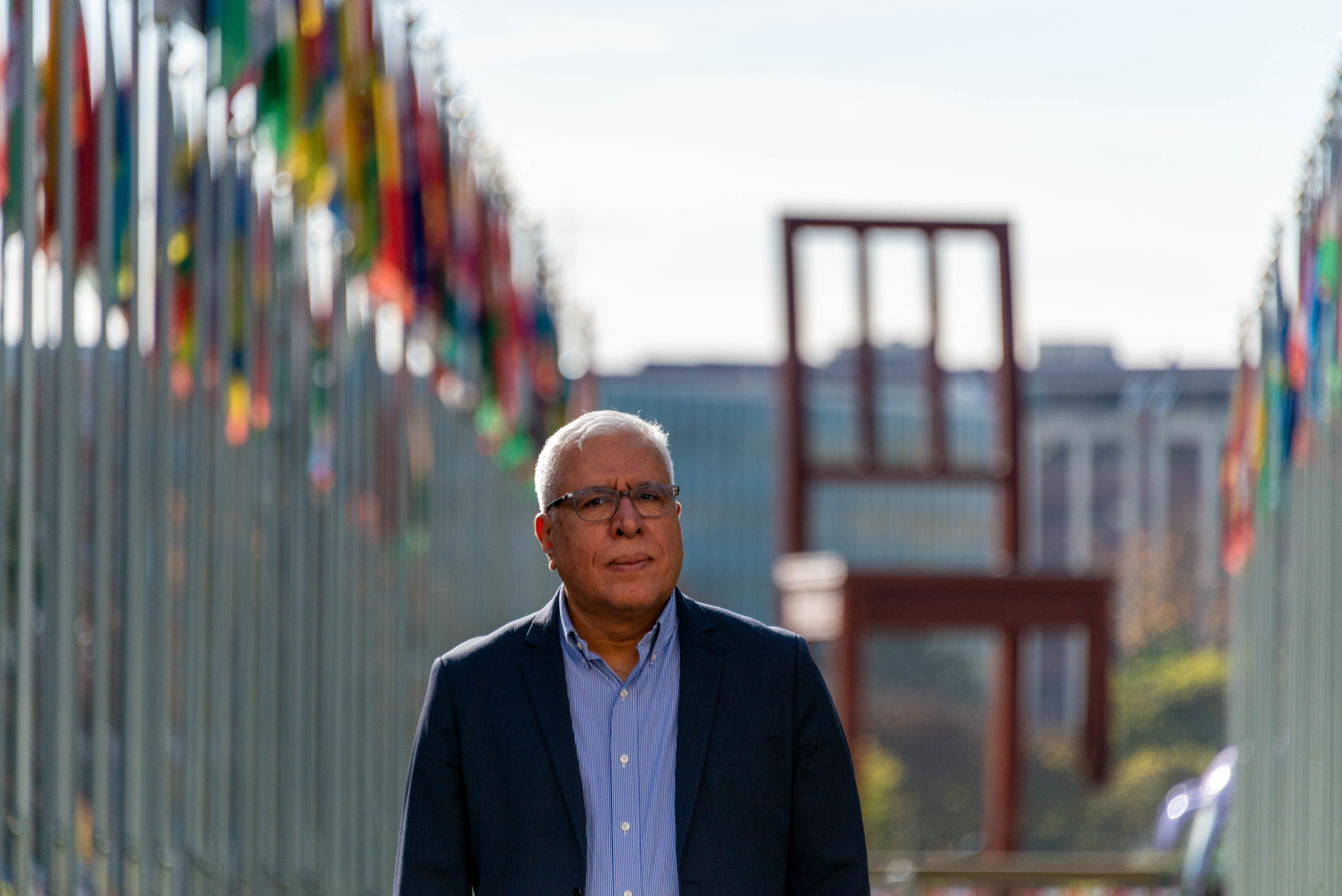
For Mohamed Ougammadan, language has always been more than a tool of communication. It is a vessel of culture, a reflection of the divine, and a bridge between worlds. Born in Morocco’s High Atlas, his journey to becoming Chief of the Arabic Translation Section at the United Nations Office at Geneva began with a childhood shaped by both faith and words.
“My passion for languages has been a constant thread throughout my life,” he reflects. “Although I was born and raised in an Amazigh family, I was exposed to Arabic from an early age. My father, a devout Muslim, was deeply committed to ensuring that my brother and I memorize the Quran and master the Arabic language so that we could fully grasp the subtleties of the sacred text and appreciate its spiritual depth.”
At the Islamic Institute of Taroudant, Ougammadan’s relationship with Arabic deepened. Immersed in the works of great Arab writers from Egypt and the Levant, he discovered how language could unlock entire civilizations. Through Arabic, he first encountered translations of French and English literature such as Homer’s Iliad, the poetry of Lamartine and Victor Hugo, texts that sparked a desire to translate and reinterpret beauty across languages.
This fascination led him to study French literature at Université Cadi Ayyad in Agadir. When he learned of a new translation school opening in Tangier, he saw his future clearly. “I immediately recognized this as a unique opportunity to fulfill a long-held dream: to master several languages and become a professional translator.” The global nature of translation, its promise of travel and cultural exchange, drew him in. His career at the United Nations would later become the culmination of a lifelong dedication to language, precision, and cross-cultural understanding.
The sacred language
Arabic, for many, is not just a language. It is a living testament to history, spirituality, and creativity. Initially, Mohamed’s motivation to learn Arabic was rooted in filial duty as he wanted to make his father proud by mastering the language of the Quran. Over time, this duty evolved into love.
“As I delved deeper into the language, I discovered the richness of its literature, particularly its exquisite poetry, which stirred in me a profound admiration for its beauty and expressive power,” he says. Through Arabic, he encountered the world’s greatest literary treasures and developed a passion for understanding them in their original tongues.
The Arabic language is both ancient and ever-evolving. Its history stretches back more than a millennium, with inscriptions dating to the sixth century CE. The expansion of Islam spread Arabic from the Arabian Peninsula to the Levant, Iraq, Egypt, North Africa, and al-Andalus, where it absorbed and transformed a multitude of linguistic influences.
“Within only a few centuries, it became the shared language of a mosaic of peoples and cultures,” Mohamed notes. The Abbasid period in particular saw an explosion of intellectual creativity, as scholars translated Greek works into Arabic and expanded vocabulary in philosophy, medicine, astronomy, and other sciences.
Arabic thus became a vehicle for knowledge, theology, and artistic expression, adopted by people of many ethnic and religious backgrounds. It is, Mohamed says, “a language whose richness and diversity reflect the very history of human civilization.”
Evolution throughout time
While Arabic has remained remarkably stable over the centuries, its adaptability has ensured its survival as a modern, vibrant language. Mohamed points out that its grammatical and morphological stability, rooted in the need to stay close to the language of the Quran, has not prevented innovation.
“To meet the expanding needs of the early Arab empires, scholars created thousands of neologisms in fields as diverse as theology, linguistics, law, philosophy, medicine, and astronomy,” he explains. “They also borrowed technical terms from Greek and Persian. Thus, Arabic has displayed remarkable creative vitality since the Middle Ages.”
That tradition continues today. From the 19th century onward, Arabic scholars and linguists produced vast bilingual and multilingual dictionaries to keep pace with modern science and technology. “We, Arabic-speaking translators and interpreters, owe an immense debt of gratitude to the linguists, lexicographers, and encyclopedists of both the golden age and the modern era,” Mohamed says. “Without their pioneering efforts, the Arabic language would not have attained its current status as a modern, living, and dynamic language, nor its recognition as one of the official languages of the United Nations.”
A language of endless creativity
Arabic’s creativity, he believes, lies not only in its literature but in its very structure. The language’s root-based system allows it to generate meaning through subtle variations of vowels and patterns. “Unlike modern Romance or Germanic languages, Arabic does not form technical terms by attaching Greek or Latin suffixes,” he explains. “It draws almost exclusively on its own linguistic resources, harnessing rich morphological and semantic processes.”
This capacity for internal invention has fueled centuries of artistic and intellectual expression. From poetry to philosophy, from Andalusian prose to contemporary thought, Arabic continues to nurture a civilization that thrives on imagination. Mohamed implores that “Across the Arab world, great thinkers and writers have borne witness to the richness and enduring vitality of their language and the millennial culture it embodies.”
Technology and the human element
In a world increasingly shaped by digital tools, Mohamed remains steadfast in his belief that languages, and Arabic in particular, are irreplaceable.
“The digital revolution has profoundly transformed our lives,” he concedes, “but I do not believe technology can render languages obsolete. Far from it.” For him, languages are more than instruments for transmitting information. They shape our vision of the world, our thought processes, and our creativity.
“To abandon our language would be to sever our ties with the past, to cease questioning the world around us, and to extinguish the curiosity and intellectual creativity that our language sustains,” Mohamed warns. “Defending the teaching and promotion of Arabic is to defend our right to maintain a living connection with our past while continuing to think, to imagine, and to build a future that is deeply human and authentically humanistic.”
Through his work at the United Nations, Mohamed Ougammadan continues to embody the essence of translation through connection, understanding, and respect for linguistic beauty. For him, Arabic remains not only a professional medium but also a moral compass, a living bridge between cultures and across centuries.
“It is through language that we discover ourselves and one another,” he reflects. “Arabic has taught me that words are never just words. They are the breath of our humanity.”