


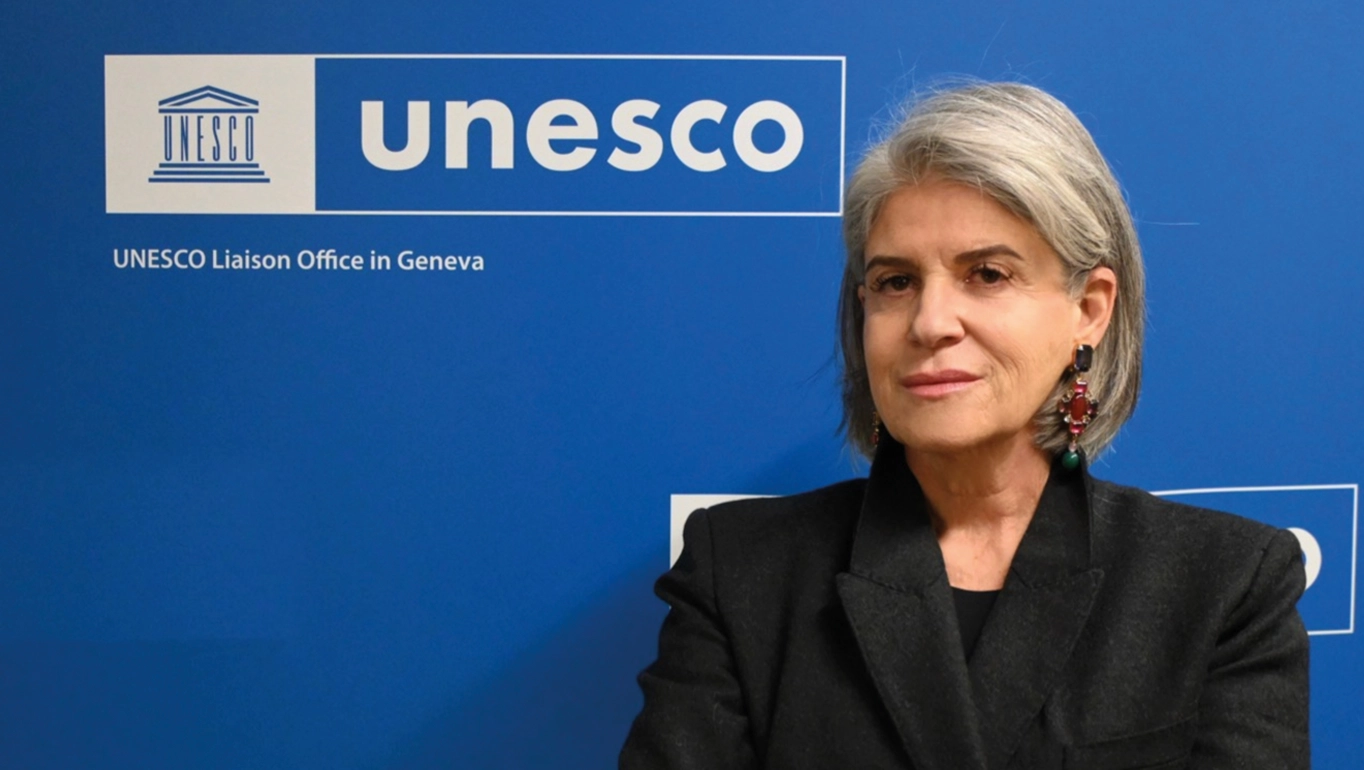
Ana Luiza Thompson-Flôres moves easily between diplomacy and ideas. Now the Director of the UNESCO Liaison Office in Geneva, she has built a career at the crossroads of multilateral cooperation, human rights, and global governance, shaping how education, culture, and freedom of expression are defended on the world stage. Known for her clear-eyed pragmatism and commitment to inclusive multilateralism, she works behind the scenes to turn global principles into concrete action. Hear how she is helping to steer one of the UN system’s most values-driven institutions through an era of rapid change.
UNESCO speaks of “building peace in the minds of men and women.” What does that mission look like in practice in today’s fragmented and polarized world?
UNESCO’s founding principle resonates strongly in today’s fragmented world, marked by radical technological and information shifts. Lasting peace must be built on participation, empowerment, and mutual understanding, far beyond temporary political or economic agreements.
We see this daily amid digital upheavals, misinformation, climate change, and geopolitical tensions, alongside the urgent need for quality education, critical thinking, skills to counter hate speech and disinformation, and a strong ethical compass to ensure technology benefits all.
This is precisely UNESCO’s mission: to equip people with the capacities to meet today’s challenges through education, shared knowledge, scientific research, culture, and freedom of expression. Tomorrow’s peace and development begin in people’s minds.
For 80 years, UNESCO has built an unparalleled network of sites and policies, strengthening bonds among Member States through fact-based, depoliticized cooperation. Despite turbulence, UNESCO has proven the power of these programs to unite 194 Member States, 12 associate members, and partners across NGOs, IGOs, and the private sector. We have a responsibility to reaffirm these achievements and preserve an impartial, trusted space for constructive dialogue.
What is UNESCO doing to support Member States strengthening inclusive and equitable education systems?
Education is the most powerful force for peace, and it is under pressure everywhere.
As the UN’s lead agency for education, UNESCO works daily to uphold this fundamental right. Across continents, from Cameroon to Chile and Chad to Cambodia, we support governments with reliable data, tested policies, and practical solutions to reform education systems. We also provide teacher training, scientific guidance, and tailored policy advice.
The stakes are high: financing is declining, and millions of children remain left behind. UNESCO helps countries develop innovative models, including debt-swap mechanisms that turn financial pressure into educational investment.
At the heart of every system are teachers. Strengthening their training, status, and support is essential. As digital tools reshape learning, UNESCO offers guidance and resources to help countries harness technology responsibly.
What role do young people play in shaping UNESCO’s education agenda?
Youth under 30 represent over half of the global population, a driving force for sustainable development and innovation, yet they remain disproportionately affected by poverty, inequality, and limited access to education and decent work.
At UNESCO, young people act as co-designers, decision-shapers, and advocates, ensuring education policies are inclusive and future-oriented. They amplify our priorities through campaigns, global events, and awareness efforts. This year’s International Day of Education on 24 January is themed “The Power of Youth in Co-Creating Education,” highlighting their leadership in shaping learning worldwide.
The SDG 4 Youth & Student Network, hosted by UNESCO, is another example, a global community advancing Quality Education (SDG 4). It empowers youth to influence policy, advocacy, and innovation through workshops, conferences, and collaborative projects promoting inclusive education for all.
Given the speed of the changing climate, how can UNESCO’s science programs help to inform climate discussion?
Science is one of UNESCO’s greatest assets. Our programs bring together expertise across disciplines, from hydrology and biodiversity to ethics and Indigenous knowledge. With more than 2,000 biosphere reserves, natural World Heritage sites, and geoparks, UNESCO hosts the world’s largest climate change observatory. This network not only monitors and provides real-time scientific data on the impacts of climate change on glaciers, forests, and soils, but also implements tangible solutions in key areas.
Throughout history, UNESCO has launched and hosted some of the world’s most influential scientific institutions, including the European Organization for Nuclear Research (CERN) and the Abdus Salam International Centre for Theoretical Physics (ICTP). Through this global scientific ecosystem, comprising training centers and institutes, we train thousands of researchers and journalists every year, improve the reliability of climate information, and combat misinformation that undermines public trust. Today, we lead the Ocean Decade through UNESCO’s Intergovernmental Oceanographic Commission and support Member States in addressing key innovations, from artificial intelligence to neurotechnologies.
Equally important is UNESCO’s ability to connect science with education, culture, and public information programs. Linking research to policy and society is essential, and it is one of UNESCO’s comparative advantages when advising governments.
How has UNESCO’s role evolved in recent years to remain relevant amid rapid geopolitical and technological change?
UNESCO serves as the UN’s laboratory of ideas, with a long-standing tradition of shaping tools and concepts for the future. In 2021, we adopted the first-ever global agreement on the ethics of artificial intelligence, followed by the first international recommendation on the ethics of neurotechnology in 2025. These are not mere texts. They are global instruments designed for a world in transformation.
By fostering respect for both natural and social sciences and promoting consensus-building, UNESCO provides a unique space where diverse perspectives converge around shared priorities. Preserving this space, one of the few in the multilateral system where broad agreement is still regularly achieved, is essential to ensuring that our programmes remain effective and deliver tangible benefits to the people we serve.
In a rapidly changing world, UNESCO has strengthened its engagement with civil society and local actors, from teachers and artists to journalists and researchers, while continuing to work with governments and national authorities. We have expanded partnerships with the private sector, leveraging collaborations with LVMH, Prada, Microsoft, and others. Our outreach now extends to wider audiences through innovative communication tools, from social media to AI. Recently, we worked with over 10,000 content creators to reduce harmful content and promote free, independent, and pluralistic information on digital platforms. These are just a few examples of the new ways we are working to amplify our impact.
How is UNESCO adapting the UN80 internal review led by the UN Secretariat to UNESCO’s reality to strengthen governance, efficiency, and results delivery?
The newly elected Director-General, Khaled El-Enany, has promptly taken on the task of leading a UNESCO80 process, aligned with the three pillars of UN80, in close consultation with Member States and UNESCO’s rich ecosystem of partners and interlocutors. He has established an internal task force to provide guidance on efficiency and results-oriented initiatives, while ensuring UNESCO’s closer integration within the broader UN80 framework. Our aim is to bring the perspective of specialized agencies and draw on the wider reflection led by the UN Secretariat to strengthen governance, enhance efficiency, and improve delivery.
UNESCO has valuable experience to share, having already faced the impact of the suspension of one of its major contributors in 2011. Over the past decade, the Organization has undertaken significant efforts to streamline operations, sharpen strategic focus, and diversify its donor base, lessons that can benefit the UN system. We had a record biennium in 2024–2025 with over 860 million US dollars in voluntary contributions, testifying to the trust and support of our Member States and partners. We remain committed to advancing reforms and continuously improving our working methods to better serve people everywhere.