


Long before craftsmanship became a category worth defending, Venice had already made it a way of life: a city stitched together not only by its canals but by its botteghe, the workshops where master and apprentice worked side by side, where the line between “artist” and “artisan” was not yet a line at all.
In the medieval and Renaissance city, the Arti, or guilds, organized almost every trade that touched beauty: glassmakers, gilders, woodcarvers, weavers of damask and velvet, makers of lace and mirrors. Painters trained inside workshops that were, in every practical sense, artisanal enterprises: pigments ground by hand, panels prepared by apprentices, techniques passed down through repetition long before they were theorized. Titian ran a bottega, not a studio in the modern, solitary sense of the word.
Craft in Venice was never purely local. For centuries, the city was the hinge between East and West, the port where Byzantine, Ottoman, Arab, and European worlds met, traded, and quietly taught one another how to make things. Murano glassmaking owes debts to techniques and materials that traveled from Byzantium and the Levant; the city’s mosaics carry the hand of Byzantine craftsmen; and its textiles, patterns, and architecture absorbed motifs carried along trade routes through Alexandria, Constantinople, and beyond.
Venice’s wealth was not only in what it bought and sold, but in what it learned to make differently because of whom it traded with. That refusal to separate maker from artist is precisely the spirit that Homo Faber 2026: An Island of Light carried into its fourth edition, on the island of San Giorgio Maggiore earlier this year in September. Organized by the Michelangelo Foundation for Creativity and Craftsmanship together with the Fondazione Cologni dei Mestieri d’Arte and the Fondazione Giorgio Cini, the exhibition transformed the Palladian cloisters and monastic halls of the Cini Foundation into a stage for hundreds of master artisans and emerging talents from around the world.
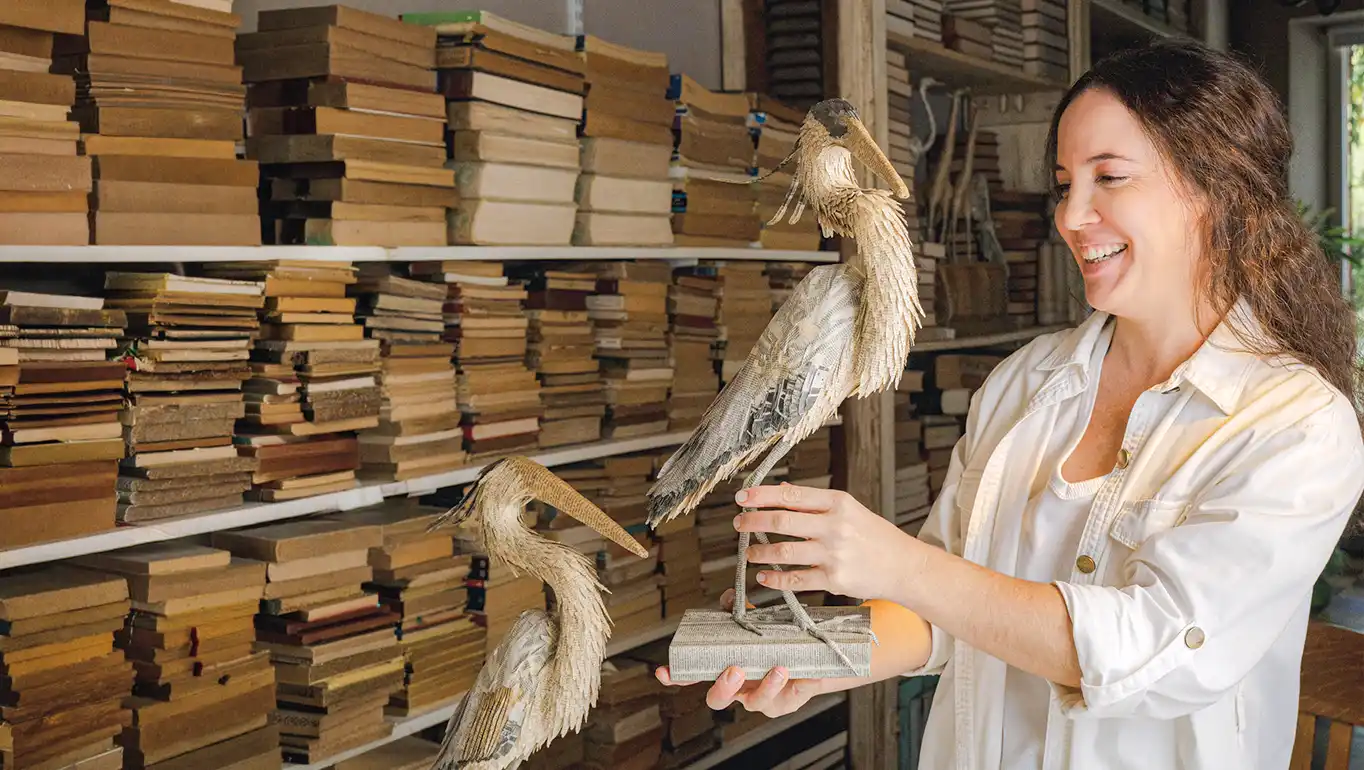
Among the artisans that exhibited this year was Josefina Stagnaro, a paper artist whose work reconstructs animals of the Argentine Pampas, including herons, ñandú, and gray foxes, feather by feather and fiber by fiber, out of paper.
Many of her subjects belong to the Pampas ecosystem where she grew up, and not all are thriving.”The ñandú is threatened locally because of habitat loss,” she said. “However, whether a species is threatened or not, I like to think of my work as a tribute to nature.”
She chose the ñandú at the beginning of her path as a paper artisan, drawn to the way “its rich plumage textures allowed me to explore different ways of working with the material.” Native species of the Pampas remain at the center of her practice today.
“I learn much more during the process of creation,” she explained, “because in the making of the structures, I need to think about how the parts are anatomically assembled in the animal and try to represent them in the most accurate yet aesthetic way possible. This results in a deep study of animals anatomically, physiologically, and behaviorally. Even though not all the acquired knowledge ends up being represented in the piece, it is more fun to learn this way.”
On where she believes craftsmanship itself is heading, Stagnaro was equally direct: “I believe a great future lies ahead for craftsmanship. Handcrafted work, which takes time to make, will be increasingly valued, in contrast to a culture of the immediate, the ephemeral, and the disposable.”
Her answer, that patience itself is becoming a form of knowledge, could stand as a motto for Homo Faber as a whole. Her ñandú, assembled feather by paper feather, is not so different in spirit from a Murano glassblower’s decades of apprenticeship or a Venetian gilder’s inherited, undocumented technique. All three treat time not as an obstacle to the work, but as part of what the work means.
Venice built its identity on the premise that beauty and utility, art and labor, could share a workshop, and that encounters between cultures could be worked into the material itself rather than kept at arm’s length. Homo Faber, nine centuries later, makes the same argument from a stage overlooking the lagoon.
Between the glassblowers of Murano and the paper ñandú of the Pampas, the message is consistent: what the hand makes slowly, it also makes lastingly; craftsmanship has always traveled between cultures more easily than borders would suggest; and in an age optimized for speed and division, that may be its most radical and necessary lesson of all.