


A former refugee in Lebanon, Maysa Jalbout brings a deeply personal perspective to her role as Director of Education Cannot Wait (ECW), which she took up in April 2026. Drawing on nearly three decades of experience in education, philanthropy and international development, she is dedicated to ensuring that children affected by conflict and crisis can continue to access learning opportunities.
UN Today spoke with her about the funding momentum, the challenges ahead and the urgent need to keep education at the heart of humanitarian action.
Education Cannot Wait has just held its High-level replenishment conference in Geneva. What does this moment mean for the organization?
It is a defining moment. Governments and partners came together to reaffirm that children affected by conflict, displacement and climate-related disasters cannot be left behind. The new pledges, combined with US$135.8 million already secured through previous multi-year commitments, bring us to US$541.6 million, 90% of our US$600 million goal.
This is more than a financial result. At a time of growing humanitarian needs and shrinking aid budgets, it is a powerful demonstration of international solidarity and confidence in ECW’s mission.
Which partners made these commitments?
Germany, the United Kingdom, Norway, Canada, Switzerland and Ireland were among the governments that stepped forward. Switzerland, which hosted the conference, also pledged CHF 35 million for 2027 to 2030. Their support sends a clear message: even in difficult times, the world cannot afford to turn its back on children’s education.
Despite the success of the conference, you did not reach the full US$600 million target. Is the campaign over?
The Geneva conference is a major milestone, but not the conclusion of the “Hope starts here” campaign. We will continue engaging existing and prospective partners to close the remaining funding gap and convert this momentum into results for children. The true measure of the conference’s success is not how much we have raised. It will be the difference we make in children’s lives. Our work starts now.
What does ECW’s 2027-2030 strategic plan aim to achieve?
Our goal is to reach 10 million children, half of them girls, including one million children with disabilities. The strategy will strengthen our ability to respond rapidly to emergencies while providing more sustained support in protracted crises. We will invest in quality learning, protection, inclusion and the resilience of national education systems. Access to school remains essential, but it is not enough: children must be safe, supported and actually learning.
What are the three main priorities?
First, ensuring that children are learning, with greater attention to quality, safety, mental health and well-being. Second, strengthening national and local leadership by bringing decisions and resources closer to affected communities; we aim to channel at least 50% of program financing through national and local partners by 2030. Third, broadening the coalition that finances education in emergencies, complementing government contributions with philanthropy, businesses, development banks and investors.
How can ECW diversify its funding base?
Government contributions will remain the backbone of our work, but we are also exploring innovative mechanisms with the International Finance Facility for Education, the Education Bridging Fund and Swiss cantonal banks.
Discussions with Enosis Capital, BNP Paribas and MetLife Investment Management also examined the potential of an education continuity outcome bond, currently under development. These initiatives could help mobilize development finance and private capital for children affected by crises, subject to further design and institutional approvals.
ECW is marking its tenth anniversary. What promise is being renewed?
Ten years after ECW was established in 2016, the commitment remains the same: children living through crises must not be left behind. Since its creation, ECW and its partners have reached more than 16 million children in crisis-affected countries.
But the challenge continues to grow. An estimated 258 million school-aged children and adolescents are affected by crises worldwide. That is why we must translate today’s commitments into action, so that no child has to wait for a crisis to end before they can learn.
You became Director on 1 April. What was this day like?
I was in Lebanon on my first day. I flew from Dubai to Beirut when the skies were largely closed and only Middle East Airlines was flying. I landed at an empty airport, on a road that had been bombed the day before. So it was not April fool’s Day. It was a very real introduction to this work.
Which countries are your top priorities?
Sudan, Afghanistan, Palestine, the Democratic Republic of the Congo, Rohingya refugees in Bangladesh, Myanmar, Nigeria, Yemen and Syria are among the places with the greatest needs.
You visited Sudan in August. What did you see?
Sudan is one of our top three priorities. The country has 8 million children out of school, and the crisis extends to neighboring countries hosting displaced families. In August, we announced about US$22 million in additional funding to reach several hundred thousand children in areas where populations have begun to return.
Schools are not only about learning. They provide psychosocial support to help children recover from traumatic experiences, and they offer access to food, vaccinations and protection. Where ECW works, schools are the heartbeat of the community.
I met girls who had lost three years of schooling. Some had become mothers at 13 or 14 after early marriage, yet they were returning to school because they saw no future without education. Boys who had been drawn into armed groups also saw school as a way out.
How does ECW operate in Afghanistan, where girls face severe restrictions on education?
We work with many organizations. We have supported UNICEF in primary education, and we also fund non-formal education through networks of women’s organizations.
We speak to everyone to understand what is possible within existing limitations. But it is essential that we do not walk away simply because we cannot deliver education in the traditional way. There are astonishingly brave women and girls in Afghanistan.
Your family history is closely linked to displacement and education. How does that shape your work?
My grandmother, Ghazale, a name meaning “deer”, was my greatest inspiration. She was illiterate, but she was the strongest advocate for education I have ever known. Like many refugee mothers, she made sure all her children went to school.
My mother became a teacher and told me, “You will not get married before you finish university.” She attended an UNRWA school in southern Lebanon in its earliest days, when children were taught in tents before permanent schools were built.
Why does education matter so deeply to refugees?
When you have experienced war, displacement, instability or migration, you understand the value of education. In a world where your passport may not be recognized or valued, education is a passport that cannot be taken from you. That conviction has always driven me. I also worked in this field through research, policy work, a donor aid agency in Canada and philanthropic organizations. Coming to ECW feels like coming full circle.
GLOBAL AFFAIRS
Keeping education alive amid conflict and crisis
Following Geneva’s pledging conference, Education Cannot Wait campaign reached 90% of its US$600 million target
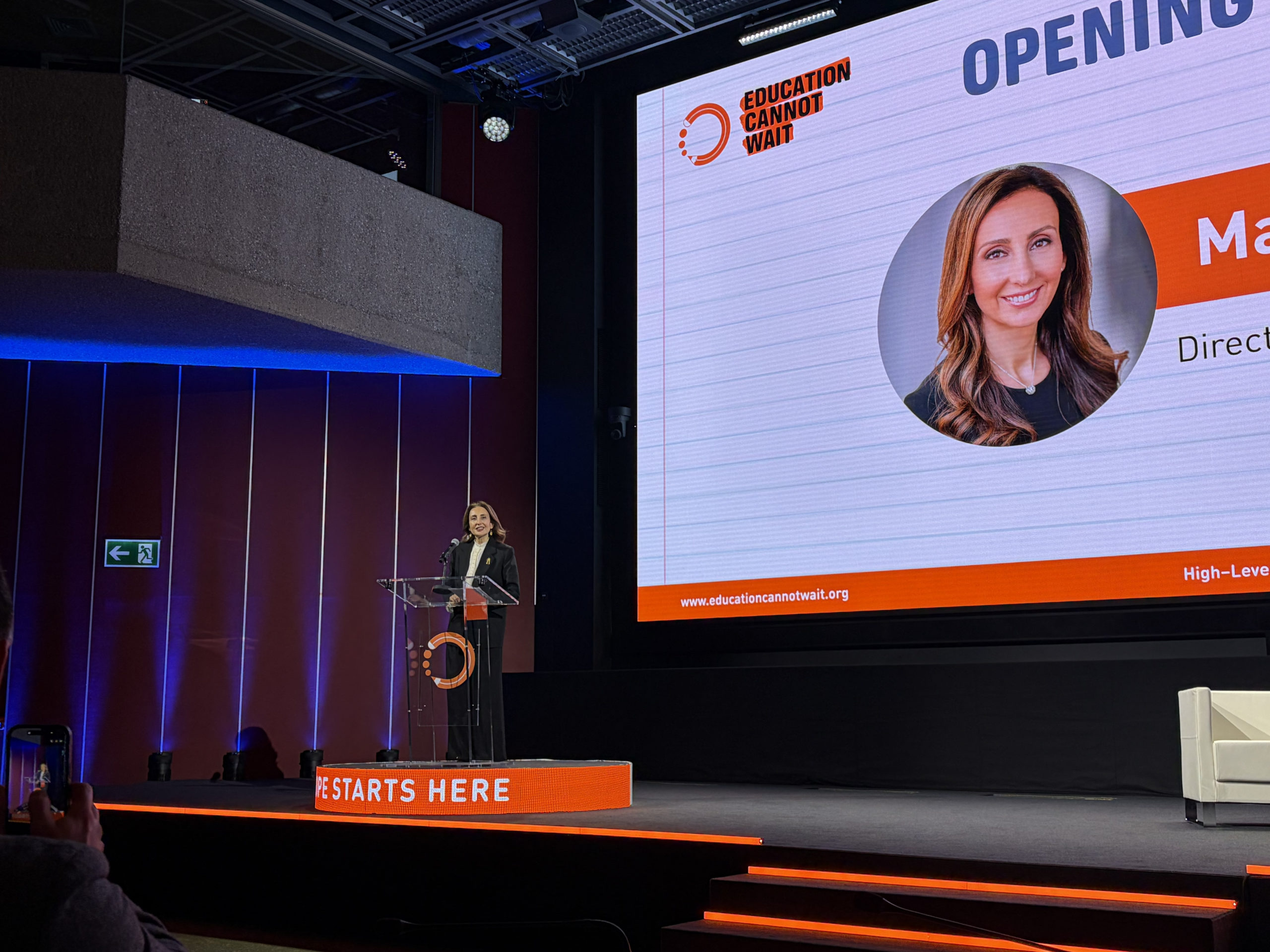
Following Geneva’s pledging conference, Education Cannot Wait campaign reached 90% of its US$600 million target © ECW