


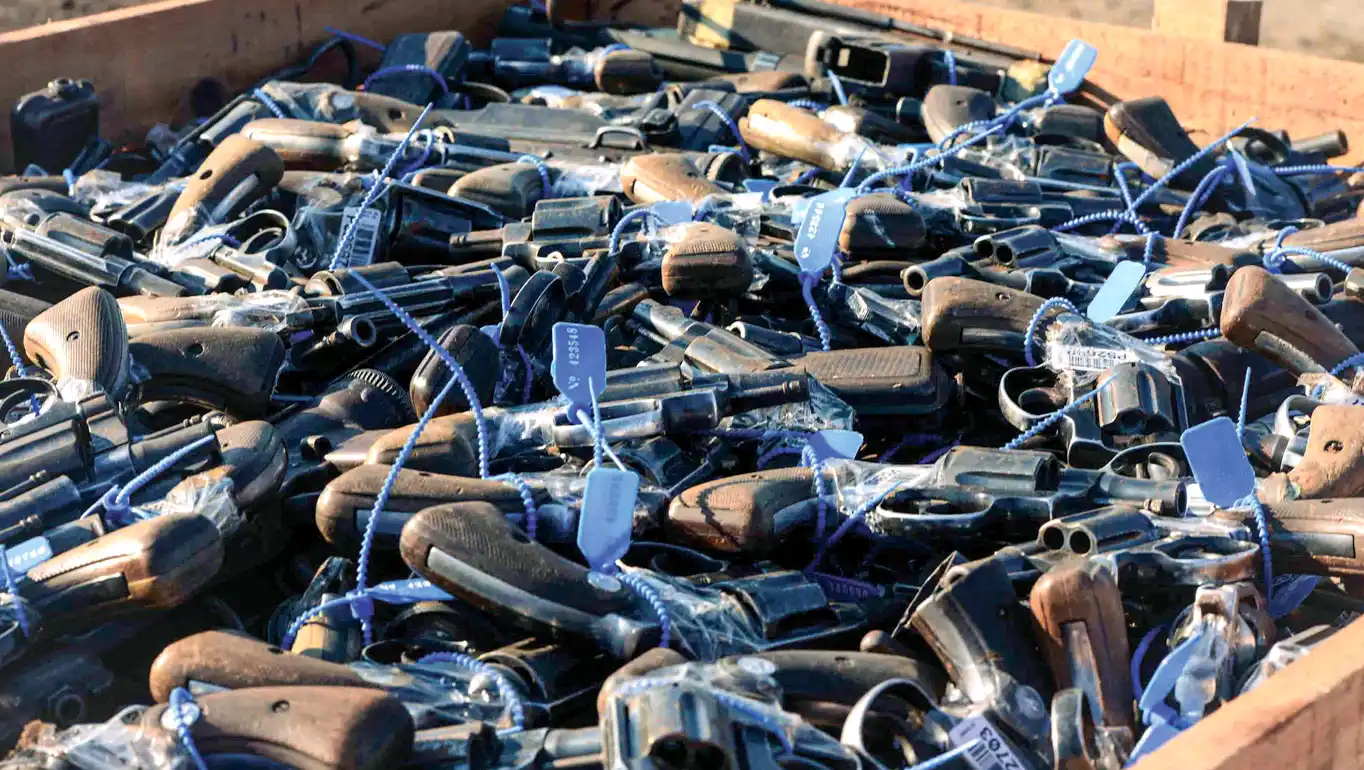
From trafficking of drugs, weapons, wildlife and people to cybercrime, money laundering, smuggling of migrants and other illicit activities, the threats of transnational organized crime are growing.
Organized crime fuels violence, conflict and instability across borders. No country is immune, and the rapid development of technology is only intensifying the scope, scale and profits of organized crime.
The actors may differ – and range from mafia-style groups, criminal networks, gangs, terrorist groups, private sector actors and more, yet share some common characteristics.
All are agile and adapt quickly to evade law enforcement initiatives. They are quick to exploit new technologies or opportunities, as seen with the increasing use of “service providers”, or specialized entities that handle a part of the supply chain or cater to money laundering or cybercrime needs. Corruption also remains essential to their business models, with organized crime groups abusing legal business structures, including financial systems, and infiltrating State institutions to facilitate their crimes and access profits.
The growing toll
According to research by the UN Office on Drugs and Crime (UNODC), one fifth of global homicides is perpetrated by an organized group each year.
But the impacts of organized crime extend far beyond violence. Their gargantuan profits – drug trafficking alone is estimated to generate hundreds of billions of dollars a year – gives these criminals immense power to infiltrate State institutions or distort legal economies, including by driving up the cost of basic goods and services while creating an unfavourable environment for foreign investment. Such activities can weaken countries’ economic outlook, with the Inter-American Development Bank estimating the cost of crime in Latin America at 3.4% of gross domestic product.
Cybercriminals and fraudsters, meanwhile, are bilking individuals and businesses out of their profits and savings, causing economic pain at the individual and community level.
Drug use facilitated by drug trafficking, as well as trafficking in medical products, also threatens public safety and health.
To take just one example, as many as 267,000 deaths per year in sub-Saharan Africa were linked to falsified and substandard antimalarial medicines.
Meanwhile, crimes like illegal logging, illegal natural resource extraction, wildlife trafficking and waste trafficking can destroy ecosystems and pollute our water, air and food.
Altogether, the impact of these crimes, and the corruption and financial crimes that enable them, can erode public trust in institutions, shrink civic spaces and deepen inequalities.
UNODC is the UN entity mandated to support Member States to prevent and tackle organized crime. UNODC is Secretariat to the UN Convention against Transnational Organized Crime (UNTOC), which provides the means for states to cooperate on combating organized crime threats, namely through extradition requests, joint investigations, mutual legal assistance and more. By helping to align legislation and support cross-border information sharing and coordination, UNTOC is strengthening international cooperation and closing the loopholes that criminals seek to exploit.
UNODC also assists countries on the ground to disrupt criminal operations and confront new threats. Examples of support include helping 192 border units in 94 countries secure ports, airports and land border crossings against trafficking. Trainings on digital evidence, digital forensics, virtual assets and more help practitioners stay up to date with new technologies and methods to investigate and prosecute crimes. Additionally, information on the latest identifications, seizures and distributions of synthetic drugs helps provide the precise scientific information and alerts needed for countries to respond swiftly to emerging health and security dangers.
A joint UN response
Transnational organized crime is an increasingly complex, multi-dimensional and hyper-globalized challenge, impacting all countries and regions, driving violence and insecurity and harming people and the planet.
Responding to the call of the Secretary-General and the Chief Executives Board for Coordination (CEB) for the UN system to work together more coherently to tackle all components of organized crime, UNODC led the development of a UN System Common Approach to Prevent and Address Transnational Organized Crime. Endorsed by the CEB in October 2025, the common approach contains recommendations and joint actions to address challenges and response gaps in the fight against transnational organized crime and to strengthen coordinated and integrated
UN support to countries. Furthermore, the common approach outlines six specific joint actions to be undertaken over the next four years, including to enhance data collection and sharing and build capacities to tackle financial crime.
UNODC and UN partners are also working together in regions around the world to strengthen comprehensive responses to organized crime and related threats. For instance, in Haiti, UNODC partnered with the UN Office for the High Commissioner on Human Rights (OHCHR) to support the opening of two specialized judicial chambers: one for complex financial crimes (including corruption and money laundering), and another for mass crimes (including arms trafficking, organ trafficking and sexual violence). In Ecuador, meanwhile, UNODC partnered with the UN Development Programme (UNDP) and UN Women for the “Construimos Paz” project aiming to address the structural causes of violence.
In addition, UNODC developed both a tool to enable law enforcement to identify and map out vulnerabilities, threats and capacities influencing the likelihood of crime within a territory, as well as guides for the design of local security and citizen co-existence plans.
Another recent project in Thailand brought together UNODC, the UN Office on Disarmament Affairs (UNODA) and the UN Office on Counter-Terrorism (UNOCT) to improve illicit firearms tracing and evidence collection to help such weapons from being diverted to non-state armed groups, organized crime groups or terrorists.