


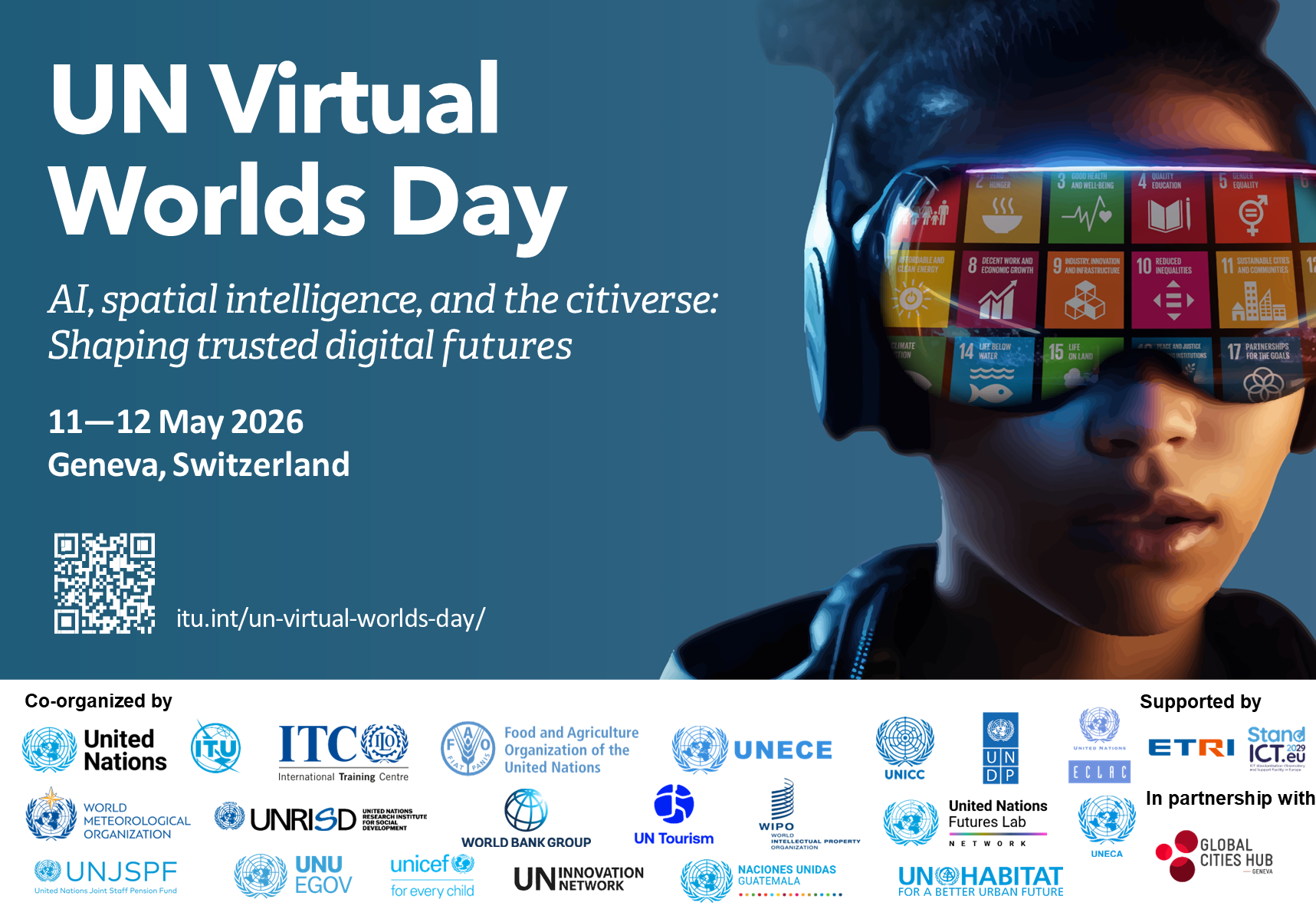
On 11–12 May 2026, Geneva hosts the 3rd UN Virtual Worlds Day, the global forum where artificial intelligence, spatial intelligence and the AI-enabled citiverse converge to reshape how cities govern, plan and serve their people.
What if a mayor could walk through a live digital model of her city, watching traffic, emissions and crowd flows shift in real time, before committing to a major infrastructure decision? What if a minister could stress-test a housing policy before a single dollar was spent or a single family displaced? This is already happening in Rotterdam, Valencia and Dubai. And on 11–12 May 2026, these cities will bring their experience to ITU Headquarters in Geneva for the 3rd UN Virtual Worlds Day.
A new word for an urgent idea
The “citiverse” is the AI-enabled digital twin of a city, a living, learning model that fuses artificial intelligence, real-time data and immersive environments to help urban leaders govern more effectively. Think of it as a flight simulator for city decision-makers: a space to test, simulate and decide before consequences are irreversible.
More than half the world’s population lives in cities. By 2050, that figure will be two-thirds. If those cities are built on fragmented systems and unequal access to technology, the Sustainable Development Goals will remain out of reach. But built on trusted, AI-powered foundations, the potential is transformational.
The UN’s Premier Forum on cities and AI
Now in its third edition, the UN Virtual Worlds Day has become the defining multilateral platform on these questions. Co-organised by the International Telecommunication Union (ITU) alongside 19 UN entities, including the UN Secretariat, FAO, ITC-ILO, UNDP, UN Guatemala, UN-Habitat, UNJSPF, UNICC, UNECA, UNECE, UNECLAC, UNICEF, UNRISD, UN Tourism, UNU-EGOV, WIPO, WMO, and the World Bank, the event convenes ambassadors, ministers, UN leaders, mayors and technology pioneers for two days of high-level dialogue under the theme: AI, Spatial Intelligence, and the Citiverse: Shaping Trusted Digital Futures.
Diplomacy meets delivery
A centrepiece of Day 1 is an Ambassadors’ Roundtable on the Global Digital Compact, the landmark 2024 agreement committing member states to an inclusive and trustworthy digital future. Ambassadors from Kenya, Italy and Azerbaijan will address one direct question: how are we turning these commitments into outcomes people can actually feel?
Tanzania’s Minister for Information and Communications Technology, H.E. Ms. Angellah Jasmine Mbelwa Kairuki, will offer a candid account of what national delivery really demands. City leaders from Rotterdam, Quelimane, Valencia and Tampere will then show what AI and digital twins look like when deployed in practice, from Europe to sub-Saharan Africa.
Across the opening discussions, UN leaders from ITU, UNECE, UNICC and UNJSPF will frame the delivery of AI‑enabled cities as both a policy and institutional challenge, emphasising trust, accountability and long‑term sustainability as essential foundations for translating digital commitments into real‑world outcomes.
Rights, trust and the digital economy
The programme does not shy away from hard questions. Who governs AI systems embedded in urban infrastructure? Who owns the data? A dedicated session on Trust by Design examines how to build security, accessibility and interoperability into these technologies from the outset. Experts from the European Commission, Universitat Autònoma de Barcelona, IDC and Egypt’s telecoms regulator will join the debate.
A parallel session on the digital economy asks who captures the value as AI and digital assets reshape sectors from tourism to agriculture. Specialists from the UNECLAC, WIPO and FAO will explore how to ensure the benefits are shared widely.
Geneva as a Launchpad for Global Action
The UN Virtual Worlds Day is not an end point; it is a springboard. Its outcomes will feed directly into three major global gatherings: the AI for Good Global Summit (Geneva, 7–10 July 2026), the High-Level Political Forum on Sustainable Development (New York, 7–15 July 2026), and the World Urban Forum (Baku, 17–22 May 2026). Three events, three arenas and one agenda for trusted, inclusive, AI-powered cities.
For UN staff and diplomats based in Geneva, this is a rare opportunity to be at the intersection of technology, diplomacy and city governance at a decisive moment. Registration is open on our website here.