


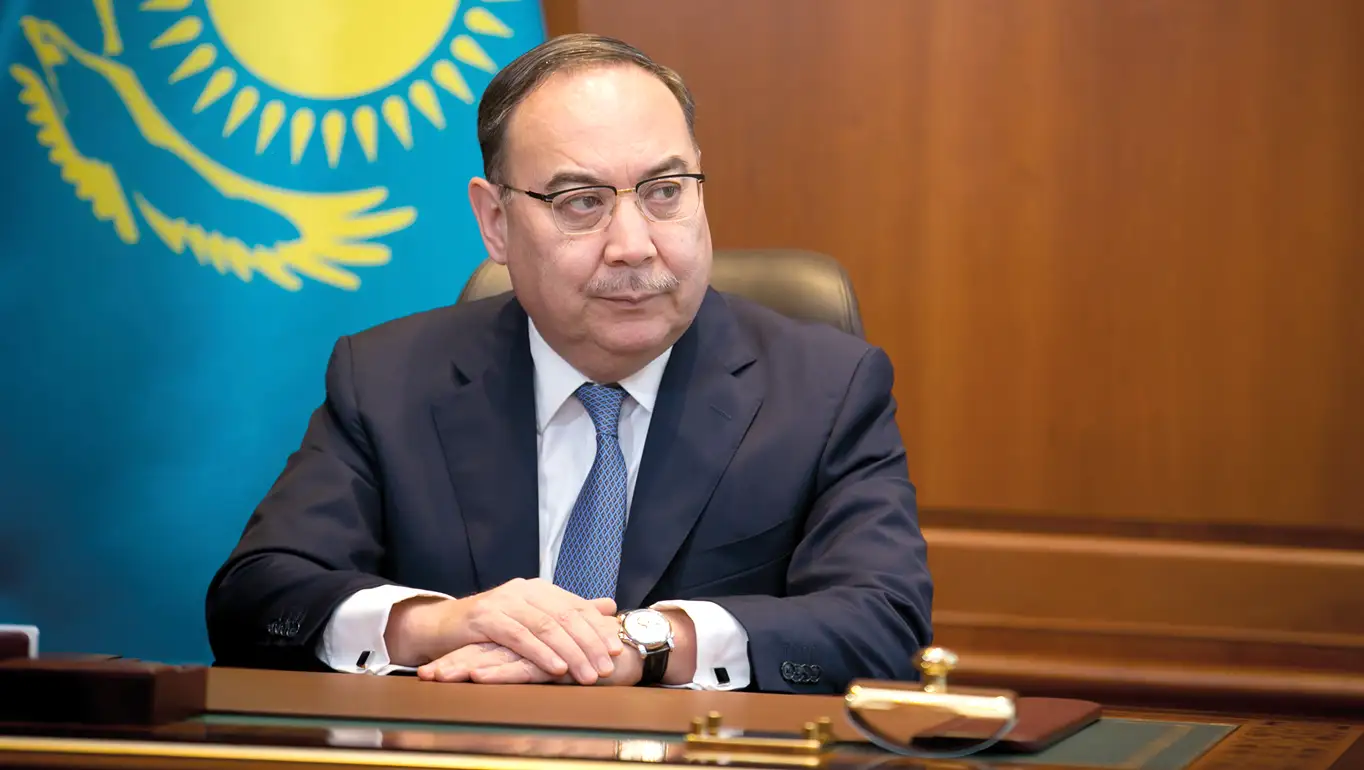
Erzhan Kazykhan has served Kazakhstan in a wide range of capacities, including as Minister of Foreign Affairs, Deputy Foreign Minister, Assistant to the President, and Ambassador to the United Nations in New York, as well as to Austria, the United Kingdom, the United States, and international organizations in Vienna.
He currently serves as the Permanent Representative of Kazakhstan in Geneva and Special Envoy of President Kassym-Jomart Tokayev, which means he sits at the intersection of foreign policy, international cooperation, and national reform priorities. Read on to hear about the challenges at the diplomatic helm of Kazakhstan in an era of global tension.
Ambassador, could you briefly introduce your background and outline your priorities as Kazakhstan’s Permanent Representative in Geneva?
My professional background spans more than three decades in diplomacy, multilateral affairs, and public service. In Geneva, my role is to ensure that Kazakhstan’s engagement with the United Nations and other international organizations is strategic, principled, and forward-looking. A key priority is aligning our domestic transformation – including political and constitutional reforms – with our international commitments in areas such as human rights, humanitarian law, health, climate, and sustainable development. Kazakhstan is committed to contributing constructively, building partnerships, and promoting dialogue that strengthens trust in multilateralism.
President Tokayev has launched far-reaching constitutional reforms. How would you explain this transformation to an international audience unfamiliar with Kazakhstan’s political system?
Kazakhstan is undergoing a profound and deliberate political transformation aimed at building a more balanced, accountable, and human-centered state. These reforms represent a shift away from a super-presidential model toward a presidential republic with a stronger, more influential Parliament and clearer checks and balances among the branches of government.
A defining feature of this reform process is its nationwide and participatory character. Over six months of public debate, a broad-based Constitutional Commission consolidated proposals from across society, reflecting an unprecedented level of openness and civic engagement. Given the scope of the changes, the decision was made to adopt a new Constitution, which was supported by the people at the nationwide referendum on 15 March 2026.
Human rights are at the core of the reforms. Constitutional guarantees are being strengthened, including judicial independence, the establishment of an autonomous Constitutional Court, enhanced protections for the legal profession, and reinforced principles such as the presumption of innocence and the non-retroactivity of laws.
At the same time, the reforms place strong emphasis on the principle of ‘Law and Order,’ underscoring that political modernization must go hand in hand with the rule of law, public security, and zero tolerance for corruption and impunity.
In a period of growing global polarization, where does Kazakhstan see its role in the international system?
Kazakhstan sees a clear role as a bridge-builder committed to inclusive dialogue, respect for international law, and effective multilateral cooperation. We believe that global challenges – whether related to peace and security, development, health, or climate – can only be addressed through cooperation rather than confrontation. As a middle power, Kazakhstan seeks to help translate global commitments into practical action by working closely with the United Nations, Geneva-based institutions, and partners across regions. Our strategy is grounded in pragmatic diplomacy, economic openness, and sustained political reform.
What role does Kazakhstan play in promoting interreligious and interconfessional dialogue globally?
Interfaith and intercultural dialogue has long been a pillar of Kazakhstan’s contribution to global peace and multilateralism. More than twenty years ago, Kazakhstan initiated the Congress of Leaders of World and Traditional Religions, which has since evolved into a unique and respected global platform bringing together leaders of major faiths.
In 2025, Kazakhstan hosted the Eighth Congress in Astana, reaffirming its role as a global hub for dialogue among religious leaders, policymakers, youth, and civil society. The main outcome, the Astana Peace Declaration 2025, reaffirmed a commitment to multilateralism, condemned extremism and the misuse of religion to justify violence, and emphasized dialogue as the only sustainable path to peace.
The Congress also highlighted the ethical dimensions of climate change, sustainable development, and emerging technologies, and recognized the vital role of women and youth as agents of dialogue and resilience. Looking ahead, Kazakhstan will host the Ninth Congress in 2028 and continue strengthening cooperation between the Congress Secretariat, the UN system, and international partners to promote dialogue as a cornerstone of global stability.
What is Kazakhstan’s approach to advancing international humanitarian law through the Global Initiative launched with the ICRC?
Kazakhstan views the Global Initiative to galvanize political commitment to international humanitarian law (IHL) as a timely and inclusive effort to reinforce respect for existing IHL norms amid growing armed conflicts and humanitarian crises.
Launched jointly with the International Committee of the Red Cross and five partner States – Brazil, Jordan, China, France and South Africa – on 27 September 2024 in New York, the Initiative is open to all countries. To date, 103 States have joined, reflecting its broad, cross-regional support and shared recognition of the need to strengthen compliance with IHL.
Importantly, the Initiative does not aim to create new legal instruments or additional mechanisms, nor does it single out specific countries. The process will culminate in a High-Level Conference in 2026 in Jordan, preceded by preparatory discussions in Geneva, with the objective of adopting an ambitious, balanced and action-oriented political declaration focused on preserving humanity in armed conflict and strengthening respect for international humanitarian law.
How can Geneva-based health institutions engage with Kazakhstan’s Global Coalition on Primary Health Care?
Geneva-based health institutions and partners play a central role in advancing Kazakhstan’s Global Coalition on Primary Health Care. The Coalition is conceived as an open and voluntary platform that complements WHO’s normative and technical leadership, while reinforcing sustained political commitment to PHC implementation at the highest levels.
Engagement can take several practical forms. Partners can participate in informal policy dialogues and briefings hosted in Geneva, contribute evidence, research and country experience through WHO-led platforms, and help shape joint messaging that links PHC to universal health coverage, health security and system resilience. There is also scope for collaboration on side events, thematic discussions and coordinated statements in the lead-up to key global milestones, including the 2027 UN High-Level Meeting on Universal Health Coverage.
Kazakhstan works closely with WHO and Geneva-based stakeholders to ensure that the Coalition acts as a bridge between political leadership, technical expertise and country-level action.
What outcomes does Kazakhstan seek from the Regional Ecological Summit in Astana?
This April, Kazakhstan will host the Regional Ecological Summit in Astana, the first climate and environmental forum of this scale in Central Asia. Endorsed by the UN General Assembly in 2023, the Summit aims to articulate a shared regional vision and translate it into practical cooperation with international partners.
Our objective is not another declaratory forum but agreed political commitments and an actionable regional program that strengthens resilience, attracts international support, and positions Central Asia as a constructive contributor to global climate efforts.
How does Kazakhstan view the future role of the United Nations and multilateralism?
Kazakhstan considers the United Nations indispensable and views its reform as a strategic necessity. A key contribution is the UN Regional Center for the SDGs in Almaty, which strengthens the UN’s field presence in Central Asia and Afghanistan.
We believe the future of multilateralism lies in initiatives that deliver tangible results on the ground, rebuild trust among nations, and demonstrate that the UN can remain an effective anchor of stability, dialogue, and shared responsibility in an increasingly fragmented world.