


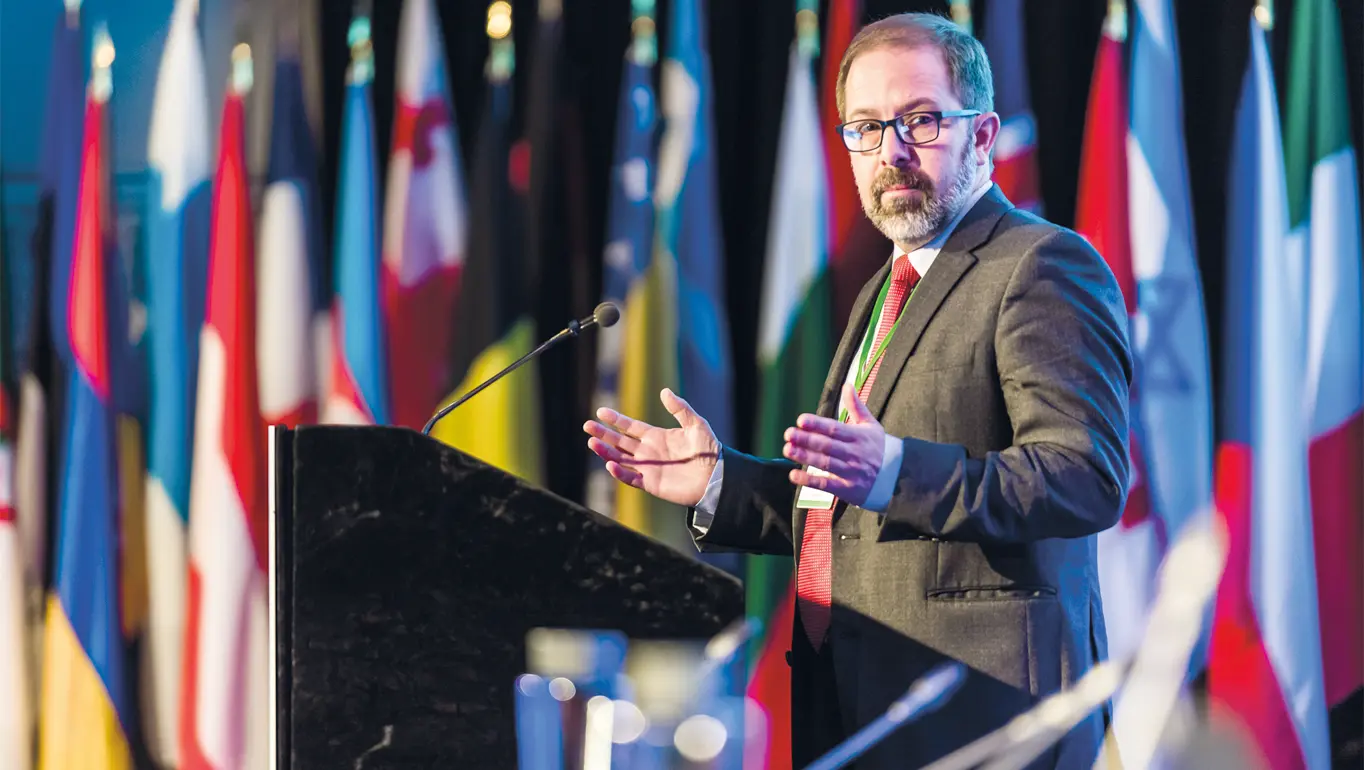
Keir Giles is former Senior Consulting Fellow with the Russia and Eurasia Programme at Chatham House and a Director of the Conflict Studies Research Centre. His career began in aviation before shifting to defence and security analysis through his work with the BBC Monitoring Service and later the UK Defence Academy. For more than two decades, he has specialized in Russian military, political and strategic affairs, contributing research for governments, think tanks and international institutions. He is the Author of several widely cited books and reports on Russia and Eurasian security, including Moscow Rules and Russia’s War on Everybody.
1. What first inspired you to start writing about Russia and its relationship with the West?
Completely by accident. I never set out to become an analyst, let alone one specialized in Russia. My original ambition was to fly planes for the Royal Air Force, and I was privileged to learn the basics of flying at our late Majesty Queen Elizabeth’s expense. But when peace broke out at the end of the 1980s, they no longer needed me to do that, so I had to rethink my plans.
I happened to be studying Russian, because someone had decided I was good at languages, and at that time the former USSR seemed full of possibilities. That led to an unexpected direction: instead of flying for the RAF, I ended up flying in Crimea and helping run a company that introduced British and European pilots to Soviet military aircraft. It was a remarkable experience, and when Russia later annexed Crimea, the locations on the news were all too familiar.
Because that work was seasonal, I needed a winter job and joined the BBC Monitoring Service, the part of the BBC tasked with open source information-gathering for the British government. What was meant to be six months turned into 13 years of analyzing Russia, the post Soviet space, and military and economic affairs.
From there, I was seconded to the Ministry of Defence’s Conflict Studies Research Centre, the UK’s former “red team” for understanding Soviet and later Russian strategy. When that centre was dissolved, partly because Russia was no longer considered a priority, I continued working independently with former colleagues and later with Chatham House as an external Russia specialist. And that is how a career I never planned became a 30-year vocation.
2. How do you measure whether your work has made an impact?
It’s extraordinarily difficult. Working outside government means feeding assessments into what often feels like a black hole. Only very rarely do we get confirmation that someone has read our work, let alone acted on it.
The UK also tends to have stronger divides between government and external expertise than some other countries. That separation makes it challenging for longstanding specialists to influence decision-making. Over the decades, my colleagues and I have been consistently accurate in identifying what would come next from Russia and Eurasian security challenges, but those assessments are not always acted upon.
There have been repeated attempts to bridge the gap between outside experts and those with access to classified material and strategic priorities. When those perspectives combine, the results can be extremely effective, but those moments are exceptions rather than the rule.
3. What are the biggest challenges you face when making complex geopolitical issues accessible for readers?
One challenge has eased somewhat. When I wrote Russia’s War on Everybody in 2021, I dedicated it to Vladimir Putin because he had made my job easier. For years we tried to explain the contradictions between Russia’s worldview and Europe’s, and that those contradictions were irreconcilable and would inevitably lead to conflict. Now that the conflict is unfolding, it has become far easier to illustrate the issues. Russia’s own actions, such as redrawing the borders of Georgia and Ukraine on its own maps, explain its ambitions more clearly than any analyst could. But convincing people before events occur rather than afterwards remains the real difficulty.
Another challenge is writing for very different audiences. Sometimes it’s long, detailed briefs for fellow specialists. Sometimes it’s single-page summaries for busy decision makers. And, sometimes, it’s op-eds for the general public, which require a completely different approach. The key is tailoring the depth, tone, and context to what the reader needs.
There is also the problem of repetition. Some issues never go away, and we must find new ways to explain the same dynamics without oversimplifying or fatiguing the audience. Editors rarely intervene heavily in my work, either because the writing lands correctly or because they’re too busy. The exceptions tend to be think tank publications, which have very specific messages and audiences.
Ultimately, making complex geopolitics accessible is about striking a balance. It means giving readers enough history and context to understand the stakes without overwhelming them or diluting the core message.