


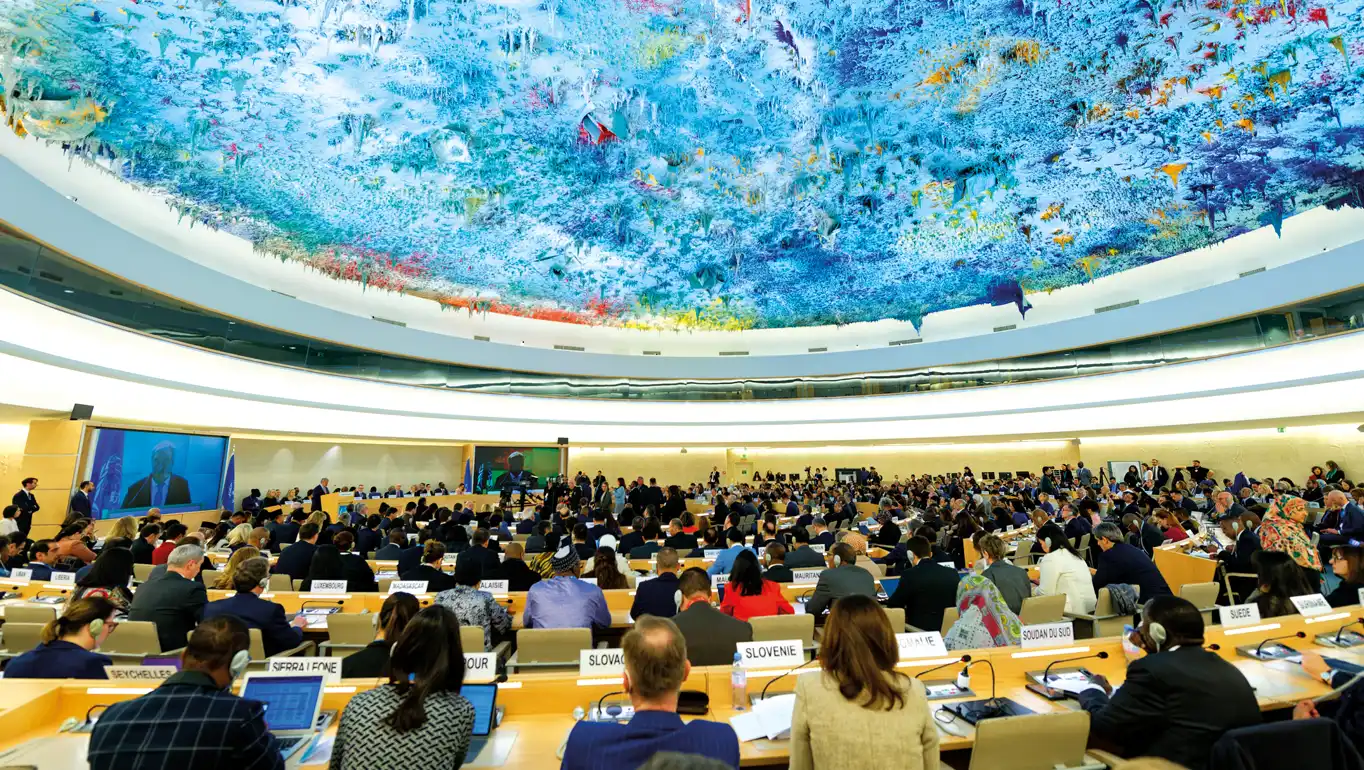
Twenty years after its creation, the Human Rights Council stands at a peculiar crossroads. Conceived in 2006 as the imperfect product of a complex reform, it was tasked with both inheriting the heavy legacy of the Commission on Human Rights and inventing a new method of addressing violations in a fractured world. Today, in 2026, the Council looks simultaneously resilient and fragile, celebrated and maligned, indispensable and marginalized, too heavy in its procedures and working methods and too light in its outreach and terms of reference. The paradox is not new, yet it appears sharper than ever.
Inheriting and recasting
The Council was born amidst disappointment. The Commission, despite, or because of its achievements, had been presented by many anti-UN players as the caricature of selectivity and political manipulation. By replacing it with a supposedly more authoritative body that meets year-round, the General Assembly sought to restore credibility. Although few believed a new nameplate on the Palais des Nations in Geneva would suffice, the Council did gradually reshape the terrain.
The Universal Periodic Review (UPR) became the emblem of this change. Its universality and equality distinguished it from any predecessor. For the first time, all States, powerful or small, wealthy or poor, underwent a similar examination. Power was no longer a symbol of avoiding monitoring by the international community and for the first time P5 or G20 members became subjected to a human rights scrutiny at the UN level. Coupled with the strengthening of Special Procedures and a growing resort to special sessions or urgent debates, the Council carved a role for itself as an early responder, investigator, and moral compass.
Yet the UPR’s consensual nature and the Council’s broadest mandate also revealed the limitations of a body that cannot compel compliance given its status within the United Nations. Peer review without enforcement resembles a mirror in which States may contemplate, or lament, but are not obliged to act.
The challenges of today
At 20, the Council also bears scars. Its very visibility makes it a target for illiberal groups or States, anti-rights movements, populists and extremists of all kinds which often use the very same human rights language that they abhor. The predominant global power, and few others, denounce its alleged bias, starves it of funds, and imposes sanctions on some of its mechanisms and experts. Others dismiss its conclusions as politicized, cherry-pick its resolutions, or despise double standards without being in a position to launch initiatives that would curb this so-called bias. The Council is simultaneously accused of doing too much and too little.
Polarization remains the deepest wound. The North–South divide, however it is being referred to, once about development priorities, has at times metastasized into open suspicion. Gaza and Ukraine are the most glaring examples today, but certainly not the only ones. The world is unfortunately full of such examples.
Implementation is the second fault line. Identifying violations is easier than remedying them. The Council rests with a paralyzed Security Council but has no enforcement power and is responsible for peace and security. Even follow-ups to UPR recommendations or special rapporteurs’ findings remains occasional. Without stronger links to domestic processes, the Council risks becoming a ritual of speeches and reports, detached from the lives of those it seeks to protect.
Enforcement is another fault line with the Council, given its non-UN Charter status, is not in a position to request application of its findings. In order to do so it needs to rely on UN peace and security or the good will of development bodies, which is certainly not forthcoming; the former being blocked by the current architecture and veto rights and the latter being deprived of adequate budget allocations and still operating in silos.
Financing is another silent crisis. By withholding dues, the predominant global power (as well as other contributors) reduce the Office of the High Commissioner and the Council’s mechanisms to chronic scarcity. The Council, its mechanisms and the High Commissioner’s Office scramble for minimal resources and work on shoestring budgets, while global military expenditures soar.
Finally, fear and caution corrode courage. Against bullies, bowing one’s head has never worked. Yet many leaders hesitate to use the words that matter: genocide, crimes against humanity, sanctions, accountability. The Council is weakened when its own members and leaders fail to articulate truths that victims suffer every day.
Seizing opportunities
Despite these challenges, the Council’s twentieth anniversary should not be a moment of despair but of possibility. History teaches us that international bodies survive not by perfection but by adaptation. The League of Nations collapsed because it could neither adapt nor include. The UN, flawed as it is, endures simply because it remains indispensable. The Council, as the main multilateral forum on human rights, not only shares but exemplifies this paradoxical strength.
First, the UPR can be revitalized. Its current cycle has already shown signs of fatigue. Shorter recommendations, clearer follow-up, and genuine involvement of special procedures, treaty bodies’ experts, (real) civil society and other stakeholders combined with a firm commitment to continuing universality, could help restore meaning.
Second, the Council should continue to expand its thematic reach. Climate change, artificial intelligence, business and human rights, right to development and the rights of older persons are in its agenda. Far from diluting focus, these themes demonstrate the universality of rights in a changing world.
Third, trans-regional coalitions must be nurtured. When States from different regions break ranks with blocs to support principled initiatives, credibility soars.
Fourth, civil society and victims must remain central. In an era of shrinking civic space, the Council is often their only platform. Protecting NGO participation, while limiting the impact of anti-UN, illiberal and anti-human rights groups is a sine qua non.
Fifth, courage must again be valued and actively protected. Leaders who dare to name crimes, who refuse to indulge in linguistic acrobatics to avoid offending the powerful, restore dignity to the Council. Their interventions remind us that the body exists not for diplomatic convenience but for human beings.
Sixth, the budgetary and financial crises should be seen as triggers for real but not cosmetic or bureaucratic reforms. Innovation and flexibility should be leitmotifs of the age. The Council should be granted the full usage of the funds allocated to it by the numerous program budget implications adopted in the past twenty years. A rejuvenated and dynamic secretariat should emerge from this period with rewards to dynamism and a flatter organization.
And in the same vein, the Council’s efficiency and effectiveness process must be revitalized and strengthened as well as fully supported by the United Nations Secretariat at large. To do so requires deeper thought and full use of sessional and intersessional periods.
Finally, clarity and intelligibility must become guiding principles. Reports should be written for citizens of the world as well as experts, for students as well as diplomats. If the United Nations cannot communicate beyond the Palais, it risks irrelevance.
Looking ahead
At 20, the Council resembles a young adult: full of potential, scarred by early mistakes, uncertain of its place in the world. It is not the revolutionary body some imagined in 2006, nor the impotent talking shop its critics caricature. It is far more complex: a stage where the global struggle over human dignity is played out daily, at times painfully, and often inspiringly.
We can lament endlessly the United Nations’ or Council’s flaws, or we can seize the opportunities it offers and fight against those who want to delegitimize human rights, despite multilateralism, and impose the law of force over the force of the law. We can complain about the existing crises, or we can recognize that a permanent crisis is the normal condition of multilateralism and the sheer reflection of our world.
What matters is persistence and courage. Twenty years on, the Human Rights Council and its mechanisms remain a fragile but remarkable compass. Its needle sometimes wavers, yet it still points toward universal protection, respect and dignity for humankind.