


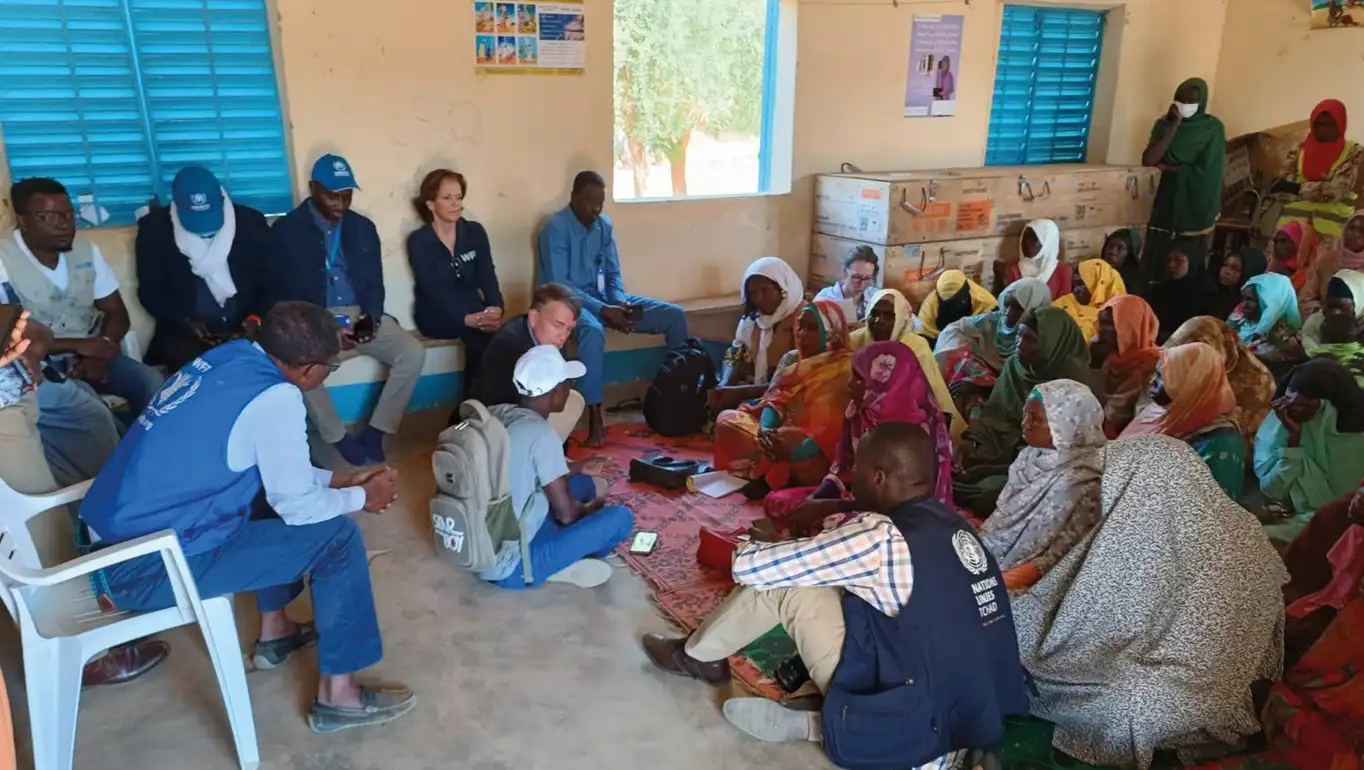
No matter who you are or where you serve, everyone has a role to play in preventing and responding to sexual exploitation and abuse. Find out how the UN’s core values are upheld in this interview with Dr. Masudi Mohamed Jerry, Inter-Agency Protection from Sexual Exploitation and Abuse (PSEA) Coordinator for the Office of the Resident Coordinator in Chad.
What does a typical day in your role as Inter-Agency Protection from Sexual Exploitation and Abuse Coordinator for the Office of the Resident Coordinator in Chad look like?
Chad has been identified as a high-risk country for sexual exploitation and abuse, and currently hosts over 2 million Sudanese refugees and internally displaced persons in urgent need of humanitarian assistance. In my role, I lead the implementation of the 2024-2028 Inter-Agency PSEA Strategy on behalf of the Resident and Humanitarian Coordinator, the senior most representative of the UN and NGOs in Chad.
My work involves fostering a humanitarian and development environment that upholds zero tolerance for sexual exploitation and abuse, both towards staff and vulnerable communities.
Through the National PSEA Network and five sub-national networks, I facilitate regular coordination meetings with over 200 PSEA experts and focal points. I also organize training, raise awareness among staff and communities, ensure confidential reporting, and coordinate access to safe services for survivors.
What are the major challenges you encounter in your work and how do you overcome them?
In a complex humanitarian context marked by massive displacement and heightened vulnerabilities, our response to sexual exploitation and abuse in Chad faces major challenges: high staff turnover, limited government involvement and capacity in PSEA implementation, underreporting of cases, underfunding of protection efforts, and limited capacities of local NGOs and civil society organizations—who are on the frontlines of responding to sexual exploitation and abuse.
To address these issues, we are implementing concrete solutions.
We’re strengthening training; providing targeted support to local organizations, especially those led by women; implementing community-based mitigation efforts, by using culturally sensitive approaches and engaging local leaders; and reinforcing our advocacy with donors and national authorities.
One recent policy was a historic step. The Resident Coordinator now requires all humanitarian actors in Chad—with donor support—to budget for at least four activities to protect against sexual exploitation and abuse in every project. The goal of this policy is to better integrate our protection efforts, strengthen accountability, and place survivors at the center of the humanitarian response.
What achievement are you most proud of?
Thanks to the support of the Resident Coordinator and the UN Country Team and Humanitarian Country Team, Chad now has a robust inter-agency PSEA Network. It brings together 120 organizations and more than 250 focal points committed to preventing and responding to sexual exploitation and abuse.
One of our major accomplishments was the rapid, coordinated response to SEA allegations among Sudanese refugees, which were reported by the Associated Press in November 2024. We facilitated direct assistance to survivors and strengthened risk mitigation in refugee communities across 21 sites, in partnership with the refugee-led NGO, the Sudan Volunteer Organization.
Our response was supported by Christian Saunders, the UN’s Special Coordinator on PSEA, who reassured affected communities and engaged with the Chadian government. Ultimately, our response led to a national review and the creation of a joint UN-Government PSEA plan as part of Chad’s UN Sustainable Development Cooperation Framework (UNSDCF).
What motivates you to work on protection from sexual exploitation and abuse?
As a doctor and PSEA adviser, my commitment to protection from sexual exploitation and abuse is grounded in the principles of human dignity, justice, and moral conscience. It is unacceptable that those entrusted with delivering aid become sources of harm. Protecting survivors and preventing abuse means restoring meaning and humanity to humanitarian and development action. To be part of this fight is to respond to a profound calling: the call of humanity at its most essential. Most of all, I am proud to contribute to a fairer system, one where every survivor is heard, protected, and treated with respect.
If you were granted one wish, or there was one thing that could allow us to be more successful in addressing SEA, what might that be?
If I could propose one measure, it would be this: require every humanitarian project to budget for at least four PSEA activities from the design phase. These would cover four key actions: training staff, informing communities about expected behavior, helping survivors access support and reporting channels, and regularly checking for risks throughout humanitarian and development projects.
This policy—which was endorsed by the Resident Coordinator in Chad—should become a global standard, supported by donors, UN leaders, and NGOs. If staff and contractors were properly trained and resources were dedicated to this issue, the risk of sexual exploitation and abuse would be significantly reduced.
What message would you like to share with your colleagues, partners, and leaders?
I would amplify the message of the Resident Coordinator in Chad: we need to intensify—not ease up—both our individual and collective efforts to protect against sexual exploitation and abuse.
In the face of a historic decline in funding and widespread reforms to the humanitarian system, the risk of sexual exploitation and abuse in Chad is higher than ever. In this context, we need to safeguard hard-fought progress, strengthen the capacity of national actors and communities, and double down on our prevention and response efforts.
Everyone—agencies, NGOs, donors, and authorities—must ensure that every case is reported, that every survivor receives assistance and protection, and that every perpetrator is held accountable, regardless of rank or location. We have both a shared responsibility and a moral imperative to uphold the dignity of the populations we serve.